Brightwheel Pricing in 2026: What It Actually Costs
Brightwheel is the most widely used childcare management platform in the U.S. But its per-child pricing model means your monthly bill grows with every enrollment. Here is a factual breakdown of what Brightwheel costs and how it compares to flat per-center pricing.
How Brightwheel Pricing Works
Brightwheel uses a per-child pricing model. This means you pay a base subscription fee plus an additional charge for each child enrolled at your center. The more children you serve, the more you pay each month.
Brightwheel does not publicly list its exact per-child rates on its website. Pricing is typically disclosed during a sales call or demo, and it can vary based on your center size, the plan tier you select, and any negotiated discounts. Based on publicly available information from childcare operator forums and reviews, per-child fees generally range from $3 to $10 per child per month, depending on the plan tier and features included.
In addition to the per-child fee, Brightwheel charges payment processing fees when parents pay tuition through the platform. Credit card processing fees are typically around 2.9% + $0.30 per transaction, which is standard across the industry. ACH transfers carry a lower fee.
A note on accuracy
Because Brightwheel does not publish its pricing publicly, the figures in this article are based on publicly available reports from childcare operators. Your actual quote may differ. We recommend requesting a specific quote from Brightwheel for your center size.
What Each Tier Typically Includes
Brightwheel offers multiple plan tiers. Based on publicly available information, here is what you can generally expect at each level:
Basic / Starter tier
Attendance tracking, daily reports, parent communication, and basic reporting. This tier covers the essentials but may not include billing and payment processing.
Premium tier
Everything in the basic tier plus integrated billing, online payments, automated invoicing, and more advanced reporting features. This is the tier most centers need for a complete solution.
The key point is that regardless of which tier you choose, the per-child pricing model means your costs increase with enrollment. This is the fundamental difference between per-child and flat per-center pricing models.
Cost Comparison by Enrollment Size
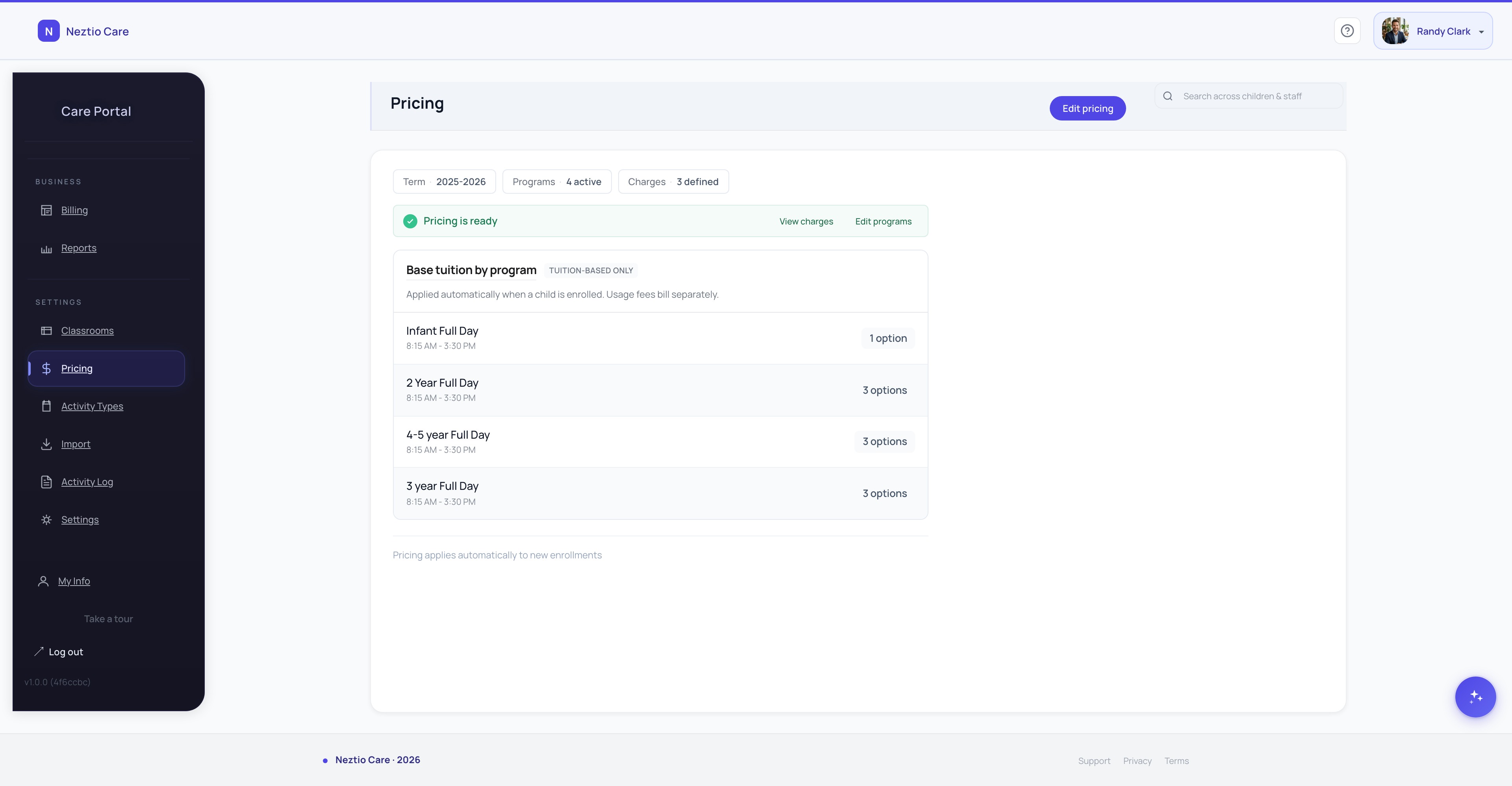
To illustrate how per-child pricing scales compared to flat pricing, here is a side-by-side comparison at different enrollment sizes. We use an estimated $5/child/month for Brightwheel (a mid-range estimate based on publicly reported figures) and Neztio's published Growth plan at $149/month.
| Enrolled Children | Brightwheel (est. $5/child) | Neztio Growth ($149 flat) | Annual Difference |
|---|---|---|---|
| 20 children | ~$100/mo ($1,200/yr) | $149/mo ($1,788/yr) | Brightwheel saves ~$588/yr |
| 50 children | ~$250/mo ($3,000/yr) | $149/mo ($1,788/yr) | Neztio saves $1,212/yr |
| 80 children | ~$400/mo ($4,800/yr) | $149/mo ($1,788/yr) | Neztio saves $3,012/yr |
| 100 children | ~$500/mo ($6,000/yr) | $149/mo ($1,788/yr) | Neztio saves $4,212/yr |
| 150 children | ~$750/mo ($9,000/yr) | $149/mo ($1,788/yr) | Neztio saves $7,212/yr |
The crossover point
At approximately 30 children, flat per-center pricing starts to become more economical than per-child pricing. Above 50 children, the savings become significant. For larger centers, the annual savings can easily exceed $3,000-$7,000, money that can go toward staff wages, classroom supplies, or facility improvements.
Hidden Costs to Consider
Beyond the per-child subscription fee, there are other costs that affect the total cost of ownership for any childcare software platform. These apply to Brightwheel and most of its competitors:
Payment processing fees
If you collect tuition through the platform, expect to pay 2.9% + $0.30 per credit card transaction. On a $1,200 monthly tuition payment, that is about $35 in processing fees. ACH fees are lower but still add up across your entire enrollment. These fees exist on all platforms, including Neztio.
Seasonal enrollment fluctuations
With per-child pricing, your bill fluctuates with enrollment. Summer programs that bring in extra children temporarily increase your software cost. With flat pricing, seasonal changes do not affect your bill.
Price increases over time
Per-child rates can increase over time as vendors raise prices. With Neztio, your rate is locked in as long as you remain a customer. The price you sign up at is the price you keep.
Switching costs
Once you are on a platform, switching requires migrating data, retraining staff, and getting families set up on a new parent app. This makes the initial pricing decision even more important. For guidance on switching, see our guide to switching childcare software.
Per-Child vs. Flat Per-Center Pricing: The Core Trade-Off
The per-child model has one advantage: for very small programs (under 25-30 children), it can be cheaper than a flat monthly fee. If you run a small home daycare with 10-15 children, a per-child plan may cost less than a $149/month flat plan. This is exactly why Neztio offers a free Starter plan for up to 15 children, so small providers do not need to pay anything.
The disadvantage of per-child pricing becomes clear as your center grows. Every new enrollment increases your software cost. This creates a perverse incentive: the more successful your center becomes, the more you pay for the same software. Flat pricing removes this friction entirely. Your software cost is predictable and fixed, regardless of whether you have 30 children or 130.
There is also a psychological cost to per-child pricing that is easy to overlook. When you know that each child adds to your software bill, it subtly affects how you think about growth. Flat pricing aligns your software vendor's incentives with yours: they want your center to thrive, not just to enroll more children.
Beyond Pricing: What Else to Consider
Pricing is important, but it should not be the only factor in your decision. Here is what else to weigh when comparing Brightwheel with alternatives:
Feature depth vs. breadth
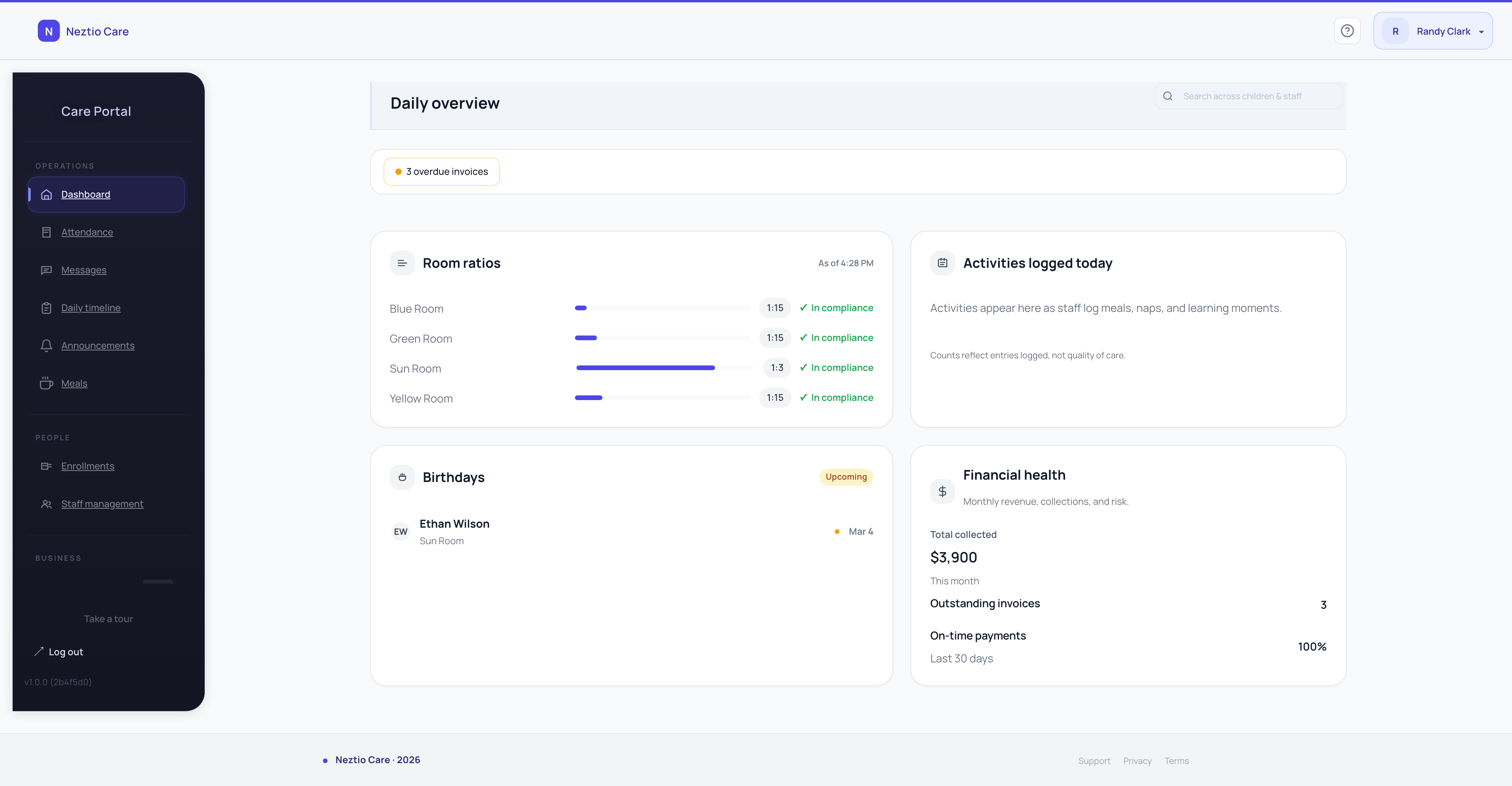
Brightwheel covers most core workflows well. But it lacks AI features for automating daily reports, message drafting, and director insights. It also does not offer real-time staff-to-child ratio monitoring. If these capabilities matter to your operation, consider platforms that include them. See our guide to AI in childcare for more.
Bilingual support
If your center serves Spanish-speaking families, check whether the platform supports bilingual communication in both the admin portal and the parent app. Neztio supports English and Spanish across the entire platform.
Rate lock guarantees
Ask whether the platform guarantees your subscription rate or if it can increase over time. Neztio locks in your rate for as long as you are a customer. Not all platforms offer this.
The Bottom Line
Brightwheel is a solid platform with a strong reputation. Its per-child pricing model works well for smaller programs but becomes expensive as enrollment grows. If your center has 50 or more children, flat per-center pricing will almost certainly save you money, and the savings grow with every additional enrollment.
Compare your options carefully. See our full Neztio vs. Brightwheel comparison or view Neztio pricing to calculate your exact savings.
Related
Best Daycare Management Software in 2026
Related
How to Choose Childcare Software for Your Center
Glossary terms in this article
Billing Automation
Software features that automatically generate invoices, process payments, and track tuition for childcare programs.
Childcare Management Software
An integrated platform that handles enrollment, billing, attendance, communication, and reporting for childcare programs.
Tuition
The fees families pay for childcare services, typically charged weekly, biweekly, or monthly based on the child's schedule.