What to Include in Your Childcare Parent Handbook
A parent handbook is one of the most important documents your childcare center will produce. It sets expectations, protects your program legally, and gives families a single reference for every policy that affects their child's care. Here is what to include and why each section matters.
Why Every Center Needs a Parent Handbook
Most states require licensed childcare programs to maintain written policies and share them with families. A parent handbook fulfills that requirement while also serving as a practical tool for reducing misunderstandings between your center and the families you serve.
Without a handbook, common questions become recurring conversations: What happens if I am late for pickup? Do I still pay tuition on holidays? Can my neighbor pick up my child? A well-written handbook answers these questions once, clearly, so staff and families are always on the same page.
Required by licensing in most states
State licensing regulations typically require childcare providers to have written policies covering health, safety, discipline, and operational procedures. The parent handbook is where these policies live.
Sets clear expectations from day one
When families know your policies before their child starts, there are fewer surprises. This is especially important for tuition, late pickup fees, and illness exclusion criteria.
Reduces misunderstandings and disputes
If a disagreement arises about a policy, you can point to the handbook. This keeps conversations objective rather than personal.
Protects your center legally
A signed acknowledgment form confirms the family received and reviewed your policies. This is important documentation if a dispute escalates or during a licensing audit.
Signed acknowledgment at enrollment
Include a signature page at the end of your handbook. Families should sign and date it during enrollment, and you should keep the signed copy in the child's file.
Program Overview
Open your handbook with a brief introduction to your program. This gives families context about who you are and what you believe before they read your policies.
Mission statement and philosophy
A few sentences about your program's approach to early childhood education. Whether you follow a play-based, Montessori, Reggio Emilia, or other philosophy, state it clearly so families understand your values.
Ages served
Specify the age range your program accepts (for example, 6 weeks through 5 years, or 2 through 12 for programs with school-age care).
Hours of operation
List your opening and closing times, including any early drop-off or late pickup options. Be specific: "6:30 AM to 6:00 PM, Monday through Friday."
Holidays and closures
List every day your center will be closed during the year. Include federal holidays, staff professional development days, and any seasonal closures. Families need this information for their own planning.
Staff introduction
Briefly introduce your leadership team and lead teachers. Include their qualifications and experience. Parents feel more comfortable leaving their children with people they know something about.
Enrollment and Withdrawal Policies
Your handbook should explain how families enroll, what documents are required, and what happens if they need to leave your program.
Enrollment process
Outline the steps: tour, application, document submission, and start date confirmation. If you charge a registration fee, state the amount and whether it is refundable.
Required documents
List everything families must provide before their child can start: immunization records, emergency contacts, authorized pickup list, medical and allergy information, and signed handbook acknowledgment.
Waitlist policy
If your center maintains a waitlist, explain how it works, whether there is a waitlist fee, and how families will be notified when a spot opens.
Withdrawal notice requirements
Most centers require two weeks' written notice before withdrawal. State the notice period clearly and explain what happens if notice is not given (for example, the family is responsible for tuition during the notice period).
Re-enrollment
If a family withdraws and later wants to return, explain whether they need to go through the full enrollment process again and whether a new registration fee applies.
Related reading
For a detailed breakdown of the enrollment workflow, see our guide on how to streamline your childcare enrollment process.
Tuition and Billing
Tuition is the most common source of parent-center disagreements. The more specific your handbook is about billing policies, the fewer conversations you will have to navigate later.
Rates by age group and schedule
List your tuition rates broken down by age group (infant, toddler, preschool) and schedule type (full-time, part-time, drop-in if offered). If rates change annually, note when increases take effect.
Payment due dates
Specify when tuition is due (for example, the first of each month, every Friday, or biweekly). Be clear about whether payment is due in advance or arrears.
Accepted payment methods
List the payment methods you accept: check, cash, ACH transfer, credit card, or online payment through your childcare management software.
Late payment and returned check fees
State the exact dollar amount of any late fees and when they are applied. If you charge a fee for returned checks or failed payments, include that amount as well.
Holiday and closure billing
Most childcare centers charge full tuition during holidays and closures because they are reserving the child's spot and staff are often still being paid. State this explicitly so there is no confusion.
Vacation and absence policy
Explain whether you offer any tuition credit for extended absences or family vacations. Many centers do not offer credits because the spot is still being held, but some allow a limited number of vacation days per year at a reduced rate.
Drop-Off and Pickup
Drop-off and pickup policies are directly tied to child safety. This section of your handbook should leave no ambiguity about who can pick up a child and what happens when things do not go as planned.
Drop-off and pickup hours
Specify the window for drop-off (for example, between 6:30 AM and 9:00 AM) and the latest pickup time. If there is a cut-off after which children will not be accepted for the day, state it.
Late pickup fees and policy
State the per-minute or flat fee for late pickup (for example, $1 per minute after 6:00 PM). Explain the process: who stays with the child, how you attempt to reach the family, and at what point you contact emergency contacts or authorities.
Authorized pickup list
Explain that children will only be released to individuals on the authorized pickup list. Families must update this list in writing, and anyone picking up must present a valid photo ID.
Photo ID verification
Staff should check photo ID for any person they do not recognize, even if that person is on the authorized list. This is standard practice at licensed childcare centers and a basic safety measure.
Custody documentation
If there are legal custody restrictions, the center needs a copy of the court order on file. Without documentation, the center cannot legally refuse to release a child to a biological parent.
Check-in and check-out procedures
Describe your daily sign-in/sign-out process. Whether you use a paper sign-in sheet or a digital check-in system, explain what families need to do at drop-off and pickup every day.
Health Policies
Health policies protect every child in your program. Be thorough here, because this is the section families will reference most often when deciding whether to send their child on a given day.
Illness exclusion criteria
List the specific symptoms that require a child to stay home: fever of 100.4 F or higher, vomiting, diarrhea, undiagnosed rash, eye discharge (possible conjunctivitis), and active head lice. Include your return policy, such as being symptom-free for 24 hours without medication.
Medication administration
Explain your policy on giving medication. Most licensed programs require written parent authorization, the medication to be in its original container with the child's name, and specific dosage instructions. Some states require a physician's note for prescription medication.
Immunization requirements
State that all children must be up to date on immunizations per your state's schedule. If your state allows medical or religious exemptions, note the process for filing one. Immunization records must be on file before the child's first day.
Allergy management
Describe how your center handles food and environmental allergies. Include your policy on allergy action plans, EpiPen storage and administration, and whether your center is nut-free or nut-aware.
More on health and safety
For a deeper look at health and safety best practices, see our guide on health and safety in childcare.
Behavior Guidance
Parents want to know how their child will be treated when challenging behaviors arise. This section reassures families and protects your staff.
Positive discipline approach
Describe your center's approach to behavior guidance: redirection, positive reinforcement, natural consequences, and age-appropriate expectations. Corporal punishment is prohibited in licensed childcare programs in all states.
Biting policy
Biting is common in toddler classrooms and understandably upsetting for families on both sides. Explain how your center responds: immediate comfort for the affected child, redirection for the child who bit, incident reports for both families, and observation for patterns. Be clear that you do not disclose the identity of either child to the other family.
Communication with families
Explain how and when you will communicate with families about behavior concerns. Regular check-ins and written incident reports keep parents informed and involved in solutions.
When additional support may be needed
If a child's behavior consistently puts themselves or others at risk despite intervention, describe the steps you take: parent conferences, behavior plans, referrals to early intervention services, and the circumstances under which you may need to discuss alternative care arrangements.
Communication
Strong communication between your center and families is the foundation of trust. Your handbook should explain every channel families can expect to use.
Daily reports
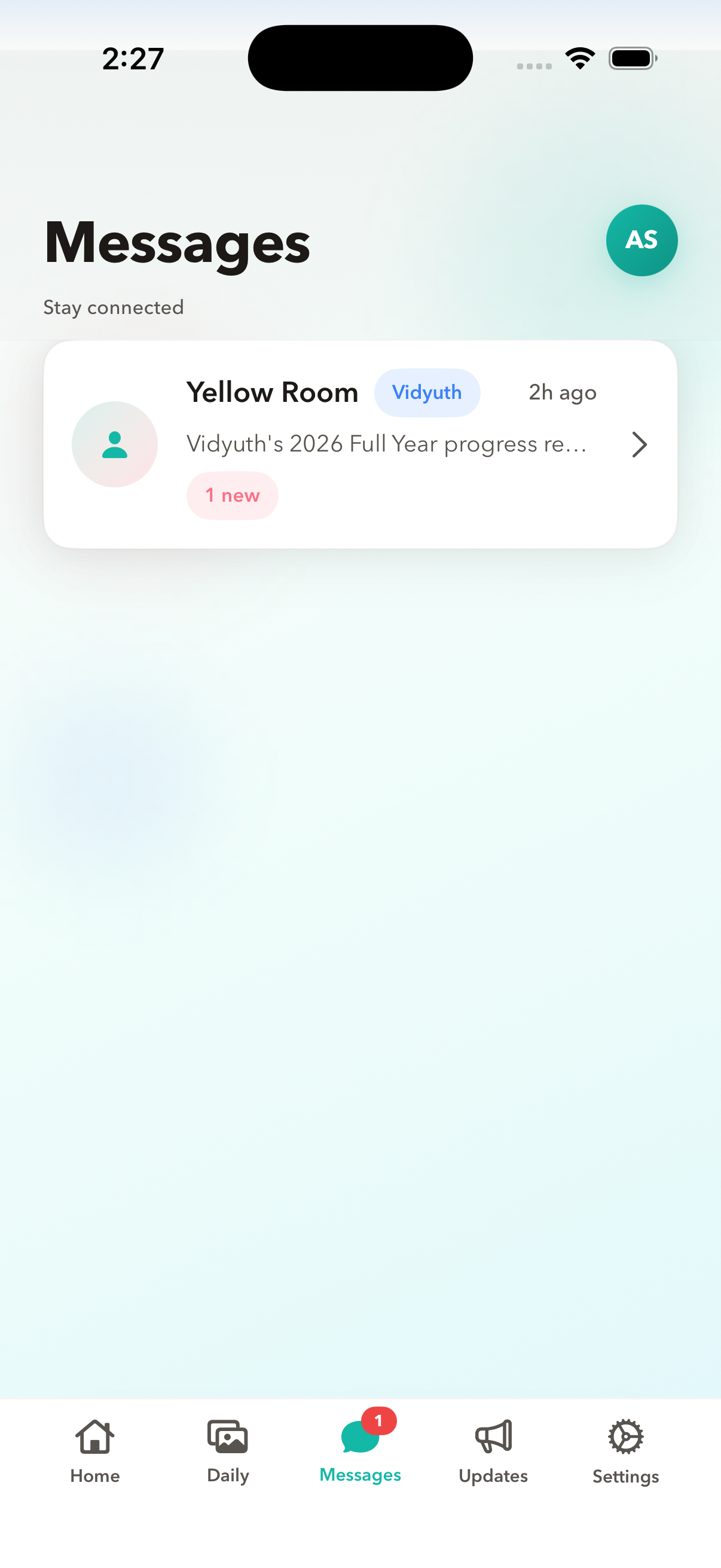
Describe what families will receive each day: activity summaries, meal information, nap times, diaper changes, and any notes from teachers. Whether you send these digitally or on paper, explain the format and timing.
Messaging
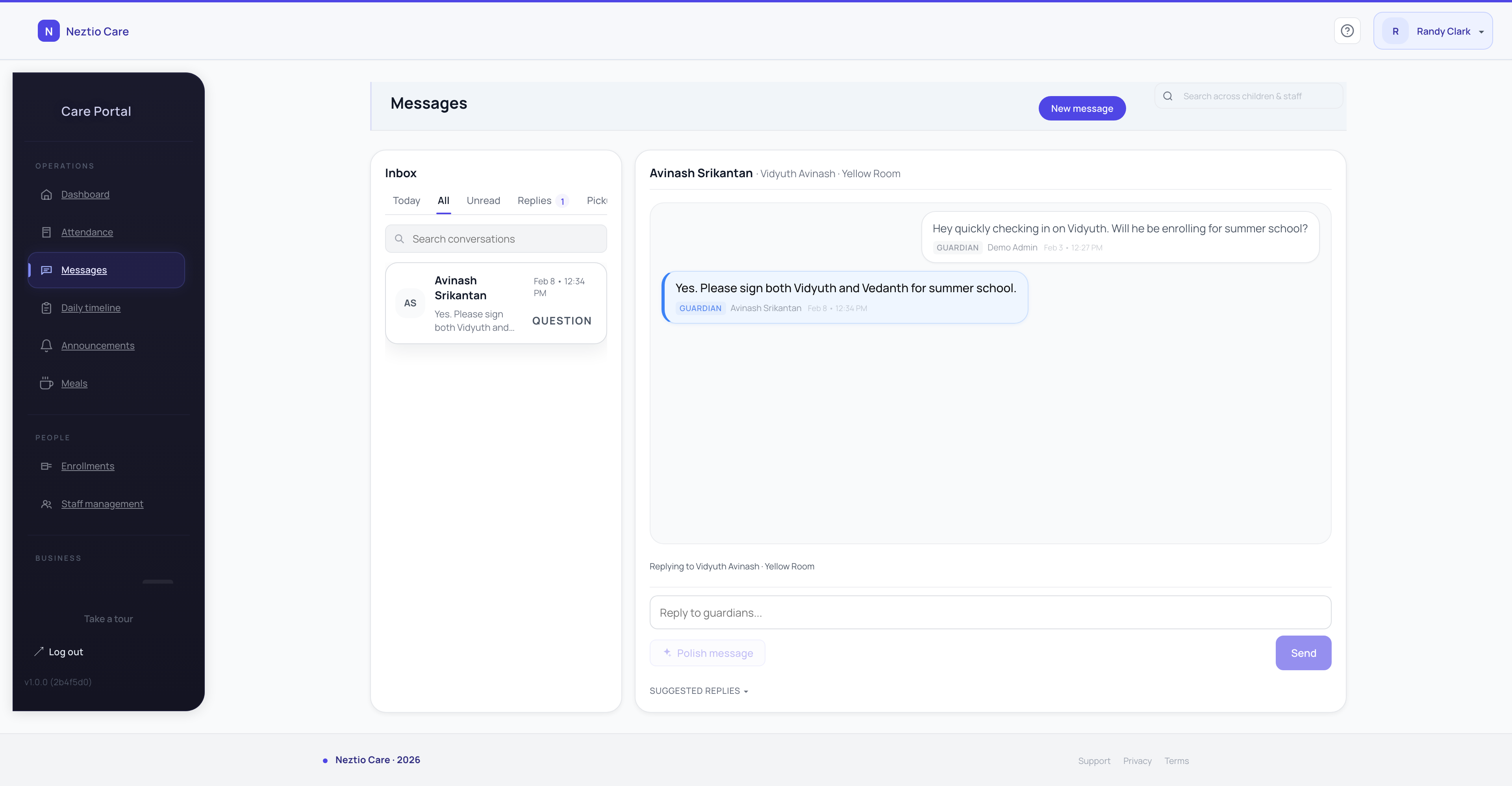
Explain how families can reach their child's teacher or the director for questions or concerns. If you use a childcare app for messaging, let families know they can send and receive messages directly through it.
Announcements
Describe how center-wide updates are shared: closures, schedule changes, events, and policy updates. Announcements through your childcare app or email ensure families do not miss important information.
Parent-teacher conferences
If you hold scheduled conferences, note how often (for example, twice a year) and how families can request additional meetings. Conferences are an opportunity to discuss the child's development and set goals together.
How to raise concerns
Give families a clear path for raising issues: start with the classroom teacher, then the director, and provide contact information for both. Families should know their concerns are welcome and will be addressed promptly.
Simplify family communication
Neztio's parent app (available on iOS and Android) gives families a single place to receive daily reports, message teachers, and read center announcements, keeping all communication organized and accessible.
Emergency Procedures
Your full emergency plan will be a separate document, but your parent handbook should include a summary so families know what to expect.
Types of emergencies covered
List the scenarios your center has plans for: fire, severe weather, lockdown, medical emergencies, and facility emergencies (such as power outage or water main break).
Parent notification procedures
Explain how and when you will contact families during an emergency. Include the methods you will use (phone call, text, app notification) and give families realistic expectations about timing.
Evacuation and reunification
If your center needs to evacuate, where will children be taken? How will families pick up their children from the secondary location? Include the address of your designated evacuation site.
Reference to full emergency plan
Note that the complete emergency preparedness plan is available for review at the center and that drills are conducted regularly as required by licensing.
Meals and Nutrition
Families want to know what their children are eating each day. This section should cover your meal program, allergy handling, and any policies about food from home.
Menu information
Explain whether your center provides meals and snacks or if families pack their own. If you provide meals, describe how menus are planned and how families can view them (posted in classrooms, sent home weekly, or available in your childcare app).
CACFP participation
If your center participates in the Child and Adult Care Food Program (CACFP), explain what this means for families: meals and snacks meet USDA nutritional guidelines, and the program helps offset food costs for the center. CACFP is a federal program administered by the USDA that reimburses childcare providers for serving nutritious meals.
Allergy accommodations
Describe how you handle food allergies: substitutions, separate preparation areas, and communication with families about menu changes. Families with children who have allergies need to know their child will be safe at mealtimes.
Food from home policies
If families send food, specify requirements: no nuts (if applicable), all items labeled with the child's name, no candy or soda, and whether food must be in ready-to-serve portions. If your center does not allow outside food, state that clearly.
What to Bring and What Not to Bring
A clear list of what children should and should not bring to the center prevents lost items, safety issues, and daily confusion.
Extra clothes
Ask families to keep at least one full change of weather-appropriate clothes at the center, labeled with the child's name. For toddlers in potty training, two or three changes is typical.
Diapers and wipes
If your center does not provide diapers, specify that families need to supply them and how many to keep on hand. Let families know you will notify them when supplies are running low.
Comfort items
Many centers allow one small comfort item (a stuffed animal or blanket) for nap time, especially for younger children. Specify any limits and note that the center is not responsible for lost or damaged personal items.
No toy weapons
Most centers prohibit toy guns, swords, and other weapon-like toys. State this clearly to avoid daily conversations with families.
No jewelry policy
Small jewelry items like necklaces, bracelets, and hoop earrings are choking and strangulation hazards for young children. Many centers ask that children not wear jewelry, or limit it to small stud earrings.
Putting Your Handbook Together
A thorough parent handbook takes time to write, but it pays off every day your center is open. It answers questions before they are asked, protects your program during disputes and audits, and shows families that you run a professional, well-organized operation.
Review and update your handbook at least once a year, ideally before the start of a new enrollment cycle. When you make changes, distribute an updated copy to all currently enrolled families and collect new signed acknowledgments.
Neztio helps childcare centers manage the policies and processes that go into a parent handbook, from enrollment and billing to daily reports, messaging, and meal tracking. Get started and bring your center's operations into one platform.
Related
How to Streamline Your Childcare Enrollment Process
Related
Parent Communication Strategies for Childcare Centers
Glossary terms in this article
Enrollment
The process of registering a child in a childcare program, including collecting required documents and family information.
Parent Communication
The methods and tools childcare centers use to share information with families, including daily reports, messaging, and conferences.
Licensing
State-issued permission to operate a childcare facility, requiring compliance with health, safety, and staffing standards.
Tuition
The recurring fee families pay for childcare services, typically charged weekly, biweekly, or monthly.
Authorized Pickup
Individuals designated by parents or guardians who are permitted to pick up a child from the childcare center.