Childcare Staff Management: Hiring, Scheduling, and Retention
Your staff are the heart of your childcare program. Here is a practical guide to finding qualified teachers, building schedules that maintain compliance, and creating a workplace where great educators want to stay.
The Staffing Crisis in Childcare
Childcare centers across the country are facing a staffing crisis. The work is demanding, the responsibility is enormous, and the pay has not kept pace. According to the U.S. Bureau of Labor Statistics, the median hourly wage for childcare workers is around $14 per hour, making it one of the lowest-paid professions despite the critical role these workers play in child development.
The result is chronic turnover. Many centers report annual staff turnover rates of 30% or higher. When a teacher leaves, children lose a trusted caregiver, remaining staff absorb extra workload, and directors spend weeks recruiting and training a replacement. The cost of replacing a single employee, including recruiting, onboarding, and lost productivity, can easily reach several thousand dollars.
Understanding the scope of this challenge is the first step toward building a more stable team. The sections below cover practical strategies you can implement at your center, from smarter hiring to reducing the administrative burden that contributes to burnout. For a deeper look at the compliance side, see our staff-to-child ratios glossary entry.
Hiring Qualified Staff
Finding the right candidates starts with knowing what to look for and where to search. Requirements vary by state, but there are common qualifications every childcare director should prioritize.
Child Development Associate (CDA) credential
The CDA is the most widely recognized credential in early childhood education. It demonstrates that a candidate has foundational knowledge in child development and classroom management.
State-specific licensing requirements
Every state sets its own qualifications for childcare workers. Some require a minimum number of college credits in early childhood education, while others accept a combination of experience and training hours. Check your state licensing agency for exact requirements, or see our childcare licensing checklist for a comprehensive overview.
Background checks
All 50 states require background checks for childcare workers. This typically includes a criminal history check, sex offender registry check, and in many states, an FBI fingerprint check. Never skip this step, even for volunteers or substitutes.
CPR and First Aid certification
Most states require at least one staff member with current pediatric CPR and First Aid certification in each classroom at all times. Many centers require it for all staff as a condition of employment.
Where to recruit
Partner with local community colleges and universities that have early childhood education programs. Post on specialized job boards for educators. Attend early childhood conferences in your area. Employee referral programs can also be effective, as your best staff often know other qualified professionals in the field.
Understanding Ratio Requirements
Staff-to-child ratios are set by each state's licensing agency and dictate the minimum number of adults required per group of children. These ratios vary by age group because younger children need more individualized attention. Here are the common ranges you will see across states:
| Age Group | Common Ratio Range | What This Means |
|---|---|---|
| Infants (0-12 months) | 1:3 to 1:4 | One caregiver for every 3-4 infants |
| Toddlers (12-24 months) | 1:4 to 1:6 | One caregiver for every 4-6 toddlers |
| Two-year-olds | 1:5 to 1:8 | One caregiver for every 5-8 children |
| Preschool (3-5 years) | 1:8 to 1:10 | One caregiver for every 8-10 preschoolers |
| School-age (5+ years) | 1:10 to 1:15 | One caregiver for every 10-15 children |
Important
These are general ranges. Your state may be stricter. Always verify the exact ratios with your state licensing agency. Some states also set maximum group sizes in addition to ratios. For a deeper dive, read our full guide on staff-to-child ratios, or use our ratio calculator to check your numbers.
Scheduling Around Ratios
Knowing your required ratios is one thing. Maintaining compliance throughout every hour of the day is another. Ratios must be met at all times, not just when the day starts. Here are the key scheduling strategies:
- 1
Stagger shifts to cover the full day
If your center opens at 6:30 AM and closes at 6:00 PM, you need coverage for 11.5 hours. No single teacher should work all of that. Use staggered start times (e.g., 6:30 AM, 8:00 AM, 9:30 AM) so you have enough staff during peak hours while controlling labor costs during lighter periods.
- 2
Plan for breaks without breaking ratios
When a teacher steps away for lunch or a break, their classroom still needs to be in ratio. Build a float or floater position into your schedule whose job is to cover breaks, support transitions, and fill in for unexpected absences.
- 3
Account for transitions
Drop-off and pick-up times, outdoor play transitions, and nap time overlap are moments when ratios can easily slip. Map out your daily schedule and identify every transition point. Assign specific staff to cover each one.
- 4
Build a substitute list
Staff will call in sick. Have a reliable list of pre-approved substitutes who have already completed background checks and orientation. Some centers maintain relationships with local staffing agencies that specialize in childcare.
- 5
Track attendance patterns
If you know that Fridays typically have lower child attendance, you can adjust staffing accordingly. Tracking historical attendance data helps you forecast staffing needs more accurately and avoid overstaffing on light days.
Reducing Turnover
Retention is ultimately about making your center a place where talented educators want to build a career. While you may not be able to match corporate salaries, there are proven strategies that reduce turnover:
Pay as competitively as you can
Even small pay increases matter. A dollar-per-hour raise can be the difference between keeping a great teacher and losing them to a retail job. Review pay annually and benchmark against other centers in your area.
Invest in professional development
Pay for CDA renewals, conference attendance, or college coursework. Teachers who feel they are growing professionally are more likely to stay. Some states offer scholarships and wage supplements for staff pursuing credentials.
Create clear career paths
Define a progression from assistant teacher to lead teacher to curriculum coordinator to director. When staff can see a future at your center, they are less likely to leave for opportunities elsewhere.
Build a positive workplace culture
Regular team meetings, recognition for good work, and a supportive leadership style go a long way. Staff who feel valued and heard are more engaged. Solicit feedback and act on it.
Reduce administrative burden
Teachers did not enter childcare to do paperwork. When staff spend less time on manual attendance logs, paper forms, and disorganized communication, they have more energy for the children. This is where technology can make a real difference.
Training and Professional Development
Most states require childcare workers to complete a certain number of training hours each year to maintain their credentials and meet licensing standards. The exact requirements vary, but 15-24 hours per year is a common range. Staying on top of these requirements is essential for compliance and for keeping your staff sharp.
Build an annual training calendar
At the start of each year, map out required trainings for every staff member. Include CPR/First Aid recertification, state-mandated topics (abuse recognition, health and safety), and elective professional development.
Track credential expiration dates
CDAs must be renewed every three years. CPR and First Aid certifications typically expire every two years. Letting a credential lapse can put your center out of compliance. Keep a centralized record of every staff member's certifications and their expiration dates.
Leverage free and low-cost training resources
Many states offer free online training modules through their child care resource and referral (CCR&R) agencies. Organizations like the National Association for the Education of Young Children (NAEYC) also provide webinars and self-paced courses.
Make training time paid time
If you require training, pay staff for the time they spend completing it. Asking teachers to train on their own unpaid time breeds resentment and contributes to turnover.
Using Software to Reduce Administrative Burden
One of the most effective ways to support your staff is to eliminate unnecessary paperwork and manual processes. Modern childcare management software can handle many of the administrative tasks that eat into your team's time.
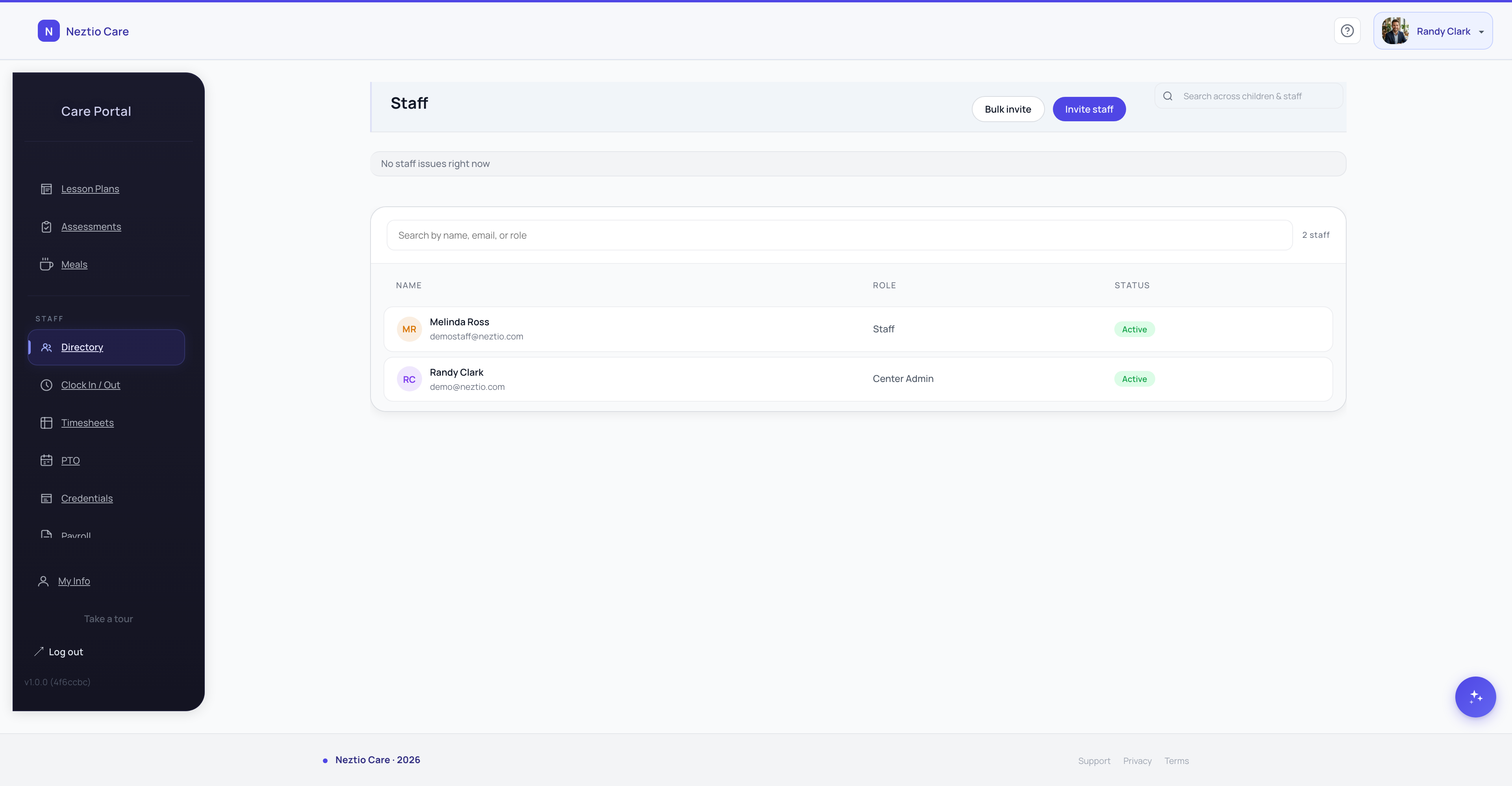
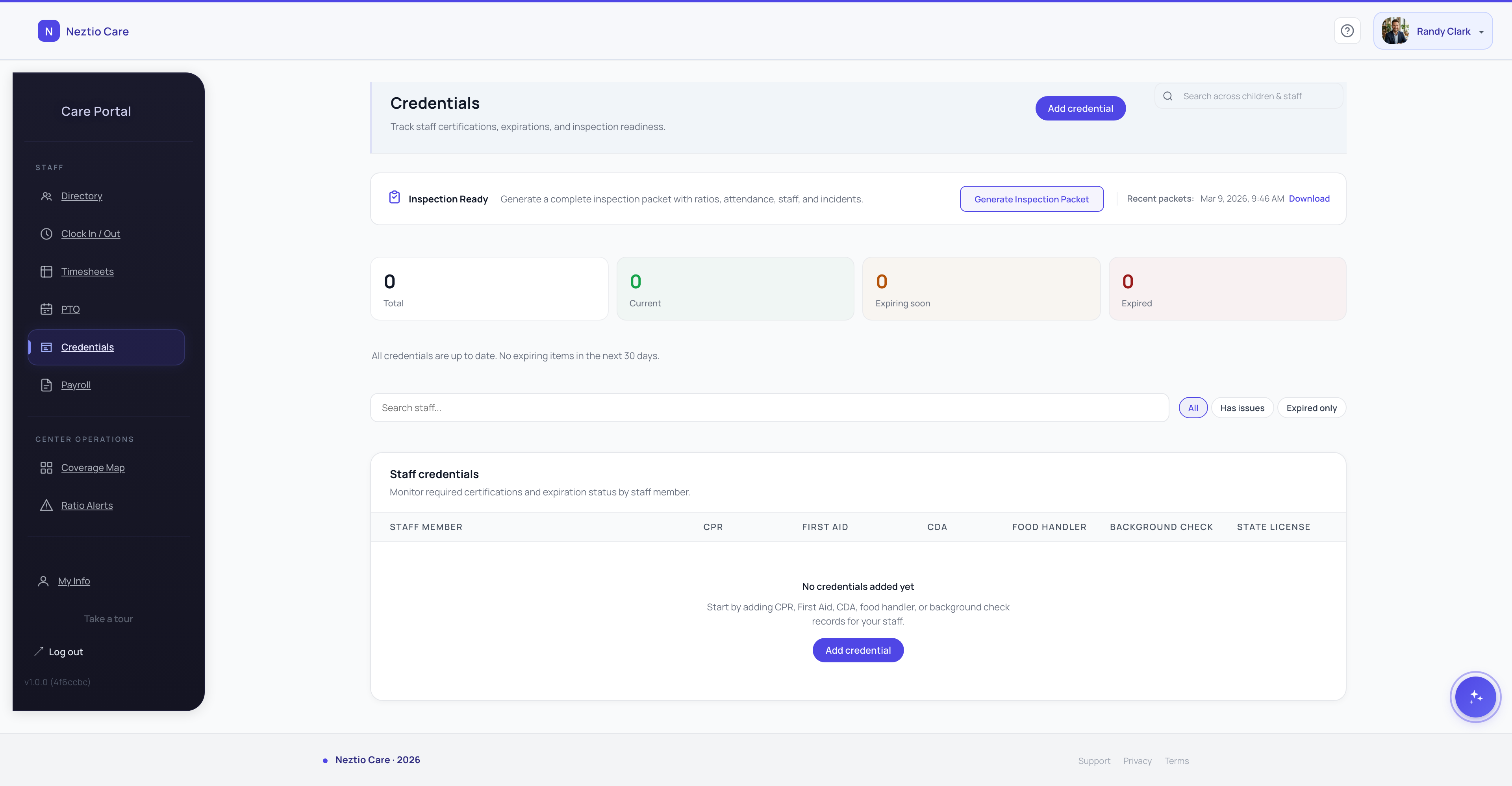
Tools like Neztio's staff management feature help directors track staff assignments to classrooms, monitor real-time classroom ratios, and maintain records of credentials and certifications. Instead of manually counting heads and shuffling paper sign-in sheets, your team can focus on the children.
Digital attendance and check-in, integrated messaging with parents, daily activity reports, meal tracking, and automated billing all reduce the repetitive tasks that contribute to staff burnout. When you free up even 30 minutes a day per teacher, that time goes back to meaningful interactions with children.
The Bottom Line
Investing in your staff is investing in the quality of care your center provides. Hire carefully, schedule thoughtfully, support professional growth, and remove administrative friction wherever possible. The centers that retain great teachers are the ones that treat staffing as their most important operational priority.
Ready to streamline your staff management? See how Neztio helps childcare centers manage staff, classrooms, and ratios so your team can focus on what matters most.
Related
Staff-to-Child Ratios: What Every Childcare Provider Needs to Know
Related
How to Choose Childcare Software for Your Center
Glossary terms in this article
Staff-to-Child Ratio
The number of caregivers required per group of children, set by state licensing regulations based on age.
Group Size
The maximum number of children allowed in a single classroom or care group, regulated by state licensing.
Licensing
State-issued permission to operate a childcare facility, requiring compliance with health, safety, and staffing standards.
Lead Teacher
The primary educator responsible for a classroom, typically holding a CDA or degree in early childhood education.