Childcare Licensing Checklist: What Every New Center Needs
Opening a childcare center is exciting, but navigating state licensing requirements can feel overwhelming. This checklist breaks down the essentials so you know exactly what to prepare before your first inspection.
Quick Answer
Para obtener la licencia, su centro de cuidado infantil necesita cumplir con los requisitos de instalaciones (más de 35 pies cuadrados por niño en interiores, área exterior cercada), pasar verificaciones de antecedentes para todo el personal, mantener las proporciones requeridas de personal por niño, tener políticas escritas (plan de emergencia, manual para padres, procedimientos de salud) y pasar una inspección presencial de su agencia estatal de licencias.
What is childcare licensing?
Every state requires childcare centers serving a certain number of children to be licensed. Licensing is administered by each state's Department of Health and Human Services (or an equivalent agency, such as a Department of Children and Family Services or Department of Early Education). The specific agency name varies by state, but the purpose is the same: to set and enforce minimum standards for health, safety, and care quality.
Licensing is not optional. Operating without a license when required is illegal in all 50 states and can result in fines, closure, and criminal penalties. Even if you plan to start small, check your state's threshold for how many unrelated children trigger the licensing requirement, as it can be as few as one child in some states.
Important
Licensing requirements vary significantly by state. This checklist covers common requirements across most states, but you should always consult your specific state's licensing agency for exact rules. Browse our state licensing guides for state-by-state breakdowns, or see our licensing glossary entry for a full definition.
Facility requirements
Your physical space must meet specific standards before you can receive a license. Inspectors will evaluate every area of your facility. Here are the most common requirements across states:
Indoor square footage: Most states require a minimum of 35 square feet of usable indoor space per child. This measurement typically excludes bathrooms, hallways, kitchens, and storage areas.
Outdoor play area: A common standard is 75 square feet of outdoor space per child using the area at any one time. Outdoor areas must be fenced (typically at least 4 feet high), free of hazards, and have age-appropriate equipment with proper fall zones.
Age-appropriate equipment and furniture: Cribs, highchairs, tables, and chairs must be sized for the age groups served. All furniture must meet current CPSC safety standards.
Fire safety: Fire extinguishers, smoke detectors, and carbon monoxide detectors must be installed and maintained. You must have a posted evacuation plan and conduct regular fire drills (monthly is a common requirement).
Health and sanitation: Handwashing stations must be accessible to both children and staff. Food preparation areas must be separate from diaper changing areas. Diaper changing procedures must follow specific sanitation protocols.
ADA compliance: Your facility must have accessible entrances and be compliant with the Americans with Disabilities Act, including accommodations for children and families with disabilities.
Staff requirements
Staff qualifications are among the most scrutinized areas during licensing inspections. Since the reauthorization of the Child Care and Development Block Grant (CCDBG) Act of 2014, all states must meet certain baseline staffing requirements. For a deeper look at hiring, scheduling, and retention, see our childcare staff management guide.
Background checks: The CCDBG Act requires comprehensive background checks for all childcare staff, including FBI fingerprint-based checks, state criminal registry checks, state sex offender registry checks, and child abuse and neglect registry checks. These must be completed before an employee can be left alone with children.
CPR and First Aid certification: At least one staff member with current pediatric CPR and First Aid certification must be present at all times. Many states require all lead teachers to hold these certifications.
Minimum age: Most states require lead teachers to be at least 18 years old. Assistants may be 16 or older in some states but cannot be left alone with children.
Education requirements: These vary widely by state. Some states require lead teachers to hold a Child Development Associate (CDA) credential or an associate degree in early childhood education. Others accept a high school diploma with a specified number of training hours.
Annual professional development: Most states require ongoing training hours each year, commonly between 15 and 24 hours. Topics typically include child development, health and safety, and recognizing child abuse and neglect.
Staff-to-child ratios and group sizes
Every state mandates maximum staff-to-child ratios and group sizes based on the ages of children in care. Ratios must be maintained at all times, including during outdoor play, field trips, and transitions. Common ratio ranges include:
| Age Group | Common Ratio Range | Typical Max Group Size |
|---|---|---|
| Infants (0-12 months) | 1:3 to 1:4 | 6-8 |
| Toddlers (12-24 months) | 1:4 to 1:6 | 8-12 |
| Twos (24-36 months) | 1:5 to 1:8 | 10-16 |
| Preschool (3-5 years) | 1:8 to 1:12 | 16-24 |
| School-age (5+ years) | 1:10 to 1:15 | 20-30 |
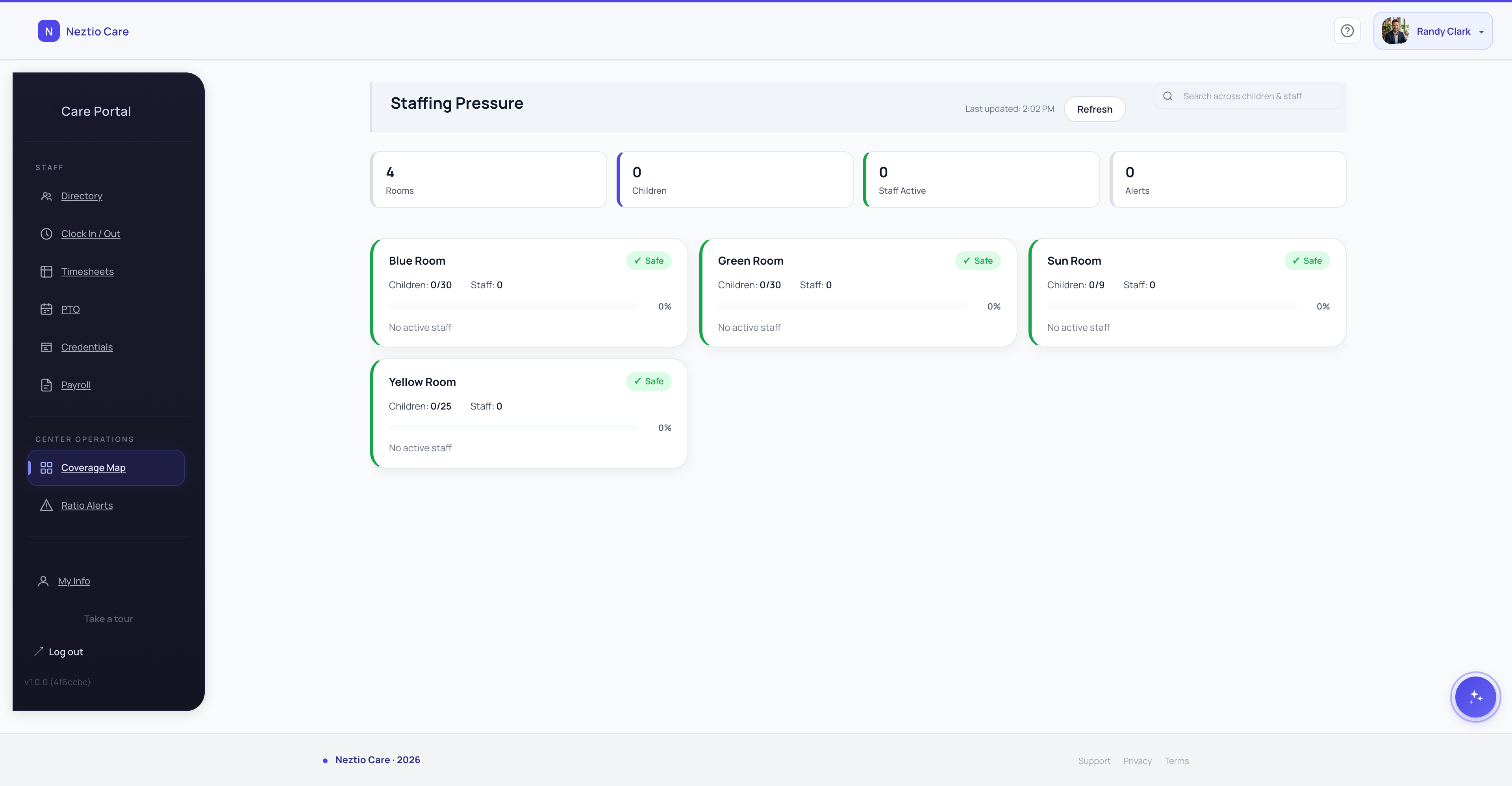
These ranges vary by state, and some states have stricter requirements than others. For a deeper look at ratio requirements and how to plan your staffing, see our complete guide to staff-to-child ratios and try our ratio calculator.
Required policies and documentation
Before your licensing inspection, you will need to have written policies covering key aspects of your operation. These policies must be shared with families and available for review by inspectors at any time.
Parent handbook: A comprehensive document covering your hours, fees, discipline policies, illness exclusion policies, drop-off/pickup procedures, and communication practices. For tips on creating one, see our guide to building a childcare parent handbook.
Emergency preparedness plan: Written procedures for fires, severe weather, lockdowns, medical emergencies, and missing children. Many states require you to practice these drills on a set schedule. Our guide to health and safety in childcare goes deeper on emergency protocols and compliance.
Health and medication administration policy: Guidelines for when to exclude sick children, how to administer medication (with parent authorization), and protocols for handling allergies.
Behavior guidance policy: A written approach to behavior management that prohibits corporal punishment, psychological abuse, and coercion. Most states require positive guidance techniques.
Inclusion policy: How your center will accommodate children with special needs or disabilities, consistent with ADA requirements.
Mandatory reporter training: Childcare workers are mandatory reporters of suspected child abuse and neglect in all 50 states. Your policies must address reporting obligations, and staff must receive training on recognizing signs of abuse.
Record-keeping requirements
Licensing agencies require you to maintain detailed records, and inspectors will review them during every visit. Keeping records organized, up to date, and easily accessible is one of the most important things you can do to stay in compliance.
Child records: Enrollment forms, up-to-date immunization records, emergency contact information, authorized pickup lists, and allergy/medical information for every child. Our guide to the childcare enrollment process covers exactly what documents to collect and when.
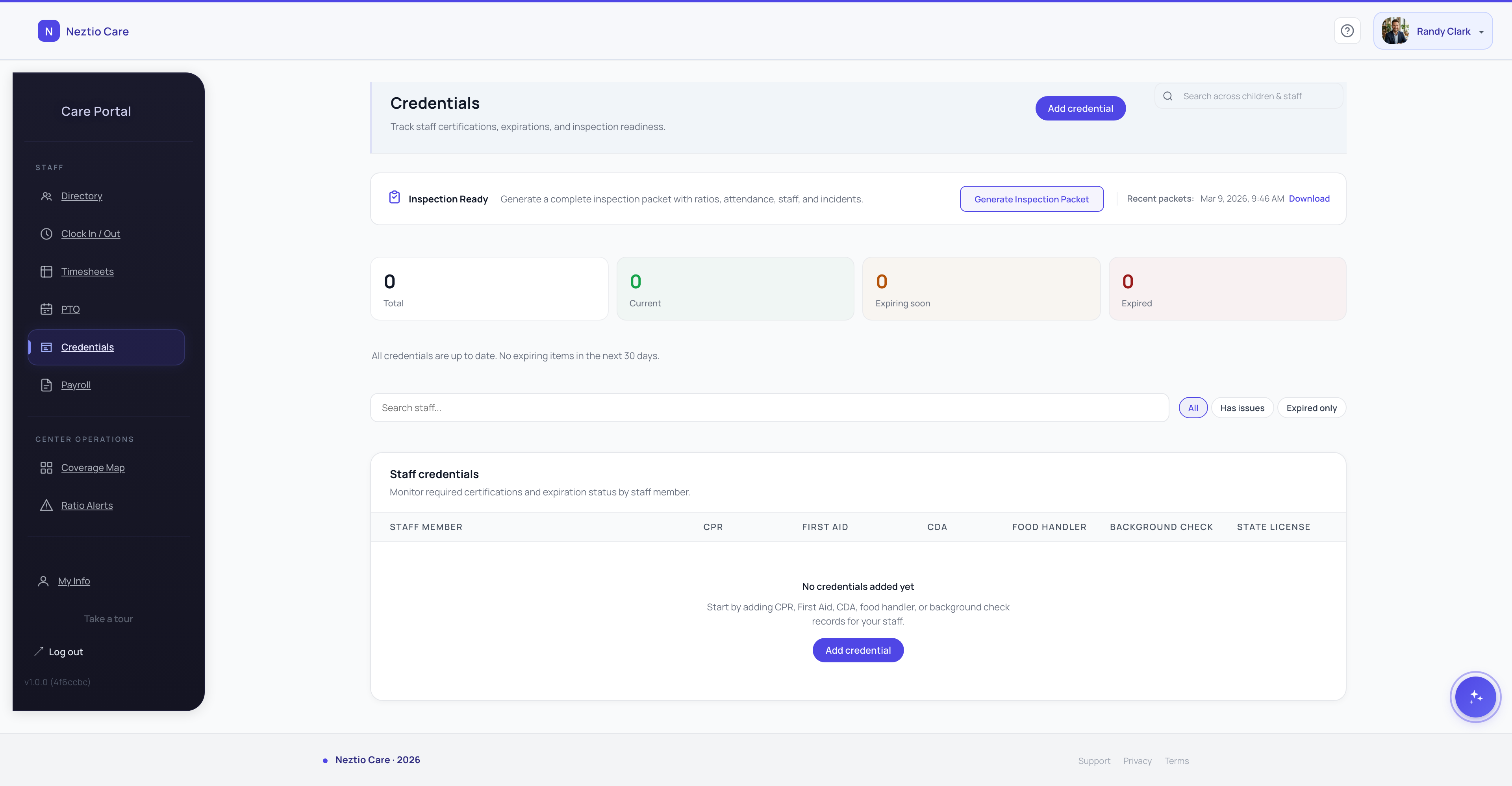
Staff records: Background check results, certifications (CPR, First Aid, CDA), training logs, and employment records for every staff member.
Daily attendance records: Sign-in and sign-out times for every child, every day. These records must be retained for a period specified by your state (commonly 3 to 5 years). See our attendance tracking guide for best practices on digital sign-in and record keeping.
Incident and accident reports: Written documentation of any injuries, incidents, or unusual events, including the date, time, what happened, and actions taken.
Fire drill and emergency drill logs: Documentation of every drill conducted, including the date, time, number of children and staff present, and evacuation time.
Tip: Childcare management software like Neztio can help you maintain digital records for attendance, enrollment, staff documentation, and authorized pickups, making it much easier to stay organized for inspections and audits.
The licensing inspection process
Understanding what to expect during inspections can help you prepare and reduce stress. The licensing process typically involves several stages:
- 1
Pre-application
Contact your state's licensing agency, attend any required orientation sessions, and review the full licensing standards. Many states offer pre-licensing consultations to help you understand the requirements before you invest in a facility.
- 2
Application and initial inspection
Submit your application with the required documentation and fees. A licensing representative will schedule an on-site inspection of your facility. They will check your physical space, review all documentation, and verify that your staffing meets the requirements.
- 3
Corrective action (if needed)
If the inspector identifies any deficiencies, you will receive a written report and a timeline to correct the issues. Common first-time deficiencies include incomplete staff files, missing fire drill logs, and documentation gaps.
- 4
License issued
Once all requirements are met, your license is issued. It must be posted in a visible location at your center. Licenses are typically renewed annually and require an annual inspection.
- 5
Ongoing compliance
After you are licensed, expect unannounced visits from your licensing agency. These can happen at any time during operating hours. The best preparation is to operate every day as if an inspector could walk in, because they can.
Beyond licensing: accreditation
Licensing sets the minimum floor for operating legally, but many centers pursue voluntary accreditation to demonstrate a higher level of quality. The two most recognized accreditation bodies for childcare centers in the United States are:
NAEYC (National Association for the Education of Young Children): The most widely recognized accreditation for early childhood programs. NAEYC accreditation requires meeting standards across 10 program areas, including curriculum, teaching practices, health, and family engagement.
NAC (National Accreditation Commission for Early Care and Education Programs): Another respected accreditation that evaluates programs on health and safety, curriculum, staff qualifications, and administration. NAC is often seen as a more accessible entry point for smaller programs.
Accreditation is not required to operate, but it can improve your reputation with families, qualify your center for higher subsidy reimbursement rates in some states, and help attract and retain quality staff.
The bottom line
Getting licensed is the first major milestone for any new childcare center. The process takes time and attention to detail, but every requirement exists for an important reason: keeping children safe. Start with your state's licensing agency, work through this checklist methodically, and do not rush the process. For a broader roadmap that covers everything beyond licensing, see our guide on how to start a daycare.
Once you are up and running, the right childcare management software can help you stay compliant day-to-day. See how Neztio helps centers manage attendance, enrollment, staff records, and more so you are always ready for your next inspection.
Related
Staff-to-Child Ratios: A Complete Guide for Childcare Centers
Related
CACFP Software Guide: Simplify Meal Tracking and Compliance
Glossary terms in this article
Licensing
State-issued permission to operate a childcare facility, requiring compliance with health, safety, and staffing standards.
Accreditation
Voluntary quality certification from organizations like NAEYC or NAC that recognizes programs exceeding minimum licensing standards.
Staff-to-Child Ratio
The required number of qualified staff per group of children, set by state licensing regulations based on age.
Group Size
The maximum number of children allowed in a single classroom or care group, determined by state licensing rules.
Background Check
Criminal history and registry screenings required for all childcare workers under the CCDBG Act of 2014.