How to Start a Daycare: A Step-by-Step Guide for 2026
Starting a daycare is one of the most rewarding small businesses you can build, but it takes careful planning to do it right. This guide walks you through every step, from choosing your childcare model to opening your doors and enrolling your first families.
Quick Answer
Para abrir una guardería necesita elegir un modelo de cuidado infantil (centro o hogar), obtener la licencia estatal, escribir un plan de negocios, preparar las instalaciones, contratar personal calificado y configurar las operaciones antes de inscribir a sus primeras familias. Planifique de 3 a 6 meses de preparación y presupueste al menos 3 meses de gastos operativos antes de abrir.
1. Decide on your childcare model
The first decision you need to make is what type of childcare program you want to run. Your choice affects everything from startup costs and licensing requirements to the number of staff you will need.
Center-based childcare: Operates in a commercial or dedicated facility with multiple classrooms, a larger staff, and higher capacity. Center-based programs can serve dozens or even hundreds of children. Startup costs are higher due to facility leases, renovations, and staffing, but revenue potential is also greater.
Family/home-based childcare: Operates out of the provider's home, typically serving a smaller group of children (often 6 to 12 depending on the state). Startup costs are significantly lower, and the setting offers a more intimate, home-like environment for families who prefer smaller groups.
You will also want to think about your curriculum philosophy. Common approaches include:
Play-based learning: Child-directed activities that develop social, emotional, and cognitive skills through play. This is the most common approach in the United States.
Montessori: Emphasizes independence, hands-on learning, and mixed-age classrooms with specially designed materials. Montessori programs often require staff with Montessori-specific training or certification.
Reggio Emilia-inspired: A project-based approach that treats children as active learners, with an emphasis on documentation, community, and the environment as a "third teacher."
2. Research your state's licensing requirements
Every state has its own set of licensing rules for childcare providers, and understanding them early will save you time and money. You can find your state's specific requirements in our state licensing guides. Your state's childcare licensing agency is usually part of the Department of Health and Human Services or the Department of Children and Family Services, though the exact agency name varies.
Contact your licensing agency as early as possible. Many states offer free pre-licensing orientations or consultations that walk you through their specific requirements. Key areas that licensing covers include:
Facility standards: Indoor and outdoor square footage per child, fire safety, sanitation, and ADA accessibility.
Staff qualifications: Education requirements, minimum age, CPR/First Aid certification, and ongoing professional development hours.
Staff-to-child ratios: The maximum number of children each staff member can supervise, which varies by age group.
Background checks: Federal law (the CCDBG Act of 2014) requires comprehensive background checks for all childcare workers, including FBI fingerprint checks, state criminal registry checks, and child abuse registry checks.
For a detailed breakdown of licensing requirements, see our Childcare Licensing Checklist.
3. Write a business plan
A solid business plan forces you to think through every aspect of your operation before you invest money. It is also essential if you plan to seek financing from a bank, the SBA, or investors. Your plan should cover:
Target market: What ages will you serve? Will you offer full-day, part-time, before/after school, or drop-in care? Research the demographics in your area and identify gaps in the local childcare supply.
Capacity: How many children will you serve at full enrollment? This determines your facility size, staffing needs, and revenue projections.
Tuition rates: Research local market rates by calling other providers in your area or checking state market rate surveys (published by most states for the CCDF subsidy program). Your rates need to be competitive while covering your costs. For help structuring your pricing, see our guide to childcare tuition pricing.
Startup costs: Common expenses include facility lease or purchase, renovation and buildout, furniture and equipment, licensing fees, insurance, initial supplies, marketing, and technology. Startup costs for a center-based program can range widely depending on location and capacity.
Operating budget: Staff wages are typically the largest expense for childcare businesses, commonly representing 60% to 70% of total operating costs. Other ongoing expenses include rent or mortgage, food, supplies, insurance, utilities, and professional development.
Important
Build at least 3 to 6 months of operating expenses into your startup budget. Most new childcare programs do not reach full enrollment immediately, so you need a financial cushion while you ramp up.
4. Find and prepare your facility
Your facility must meet both zoning and licensing requirements, so verify both before signing a lease or starting renovations.
Zoning: Contact your local zoning or planning department to confirm the property is zoned for childcare use. Some areas require a special use permit or conditional use permit to operate a childcare facility, which can take weeks or months to obtain.
Indoor space: Most states require a minimum of 35 square feet of usable indoor space per child. This typically excludes hallways, bathrooms, kitchens, and storage areas.
Outdoor space: A common requirement is 75 square feet of outdoor play space per child using the area at any given time. Outdoor areas must be fenced, free of hazards, and equipped with age-appropriate play equipment.
ADA accessibility: Your facility must be accessible to children and families with disabilities, including accessible entrances, restrooms, and play areas.
Fire safety and health inspections: You will need to pass a fire inspection and, in most states, a health department inspection before receiving your license. Install smoke detectors, carbon monoxide detectors, fire extinguishers, and post evacuation plans.
Child-specific renovations: Plan for child-height sinks and toilets (or step stools), secure fencing, age-appropriate bathroom facilities, and safe food preparation areas separated from diaper changing areas.
5. Get licensed and insured
Once your facility is ready, you can apply for your state childcare license. The application process typically involves submitting documentation, paying a licensing fee, and passing an on-site inspection. Many states also require you to complete a pre-licensing orientation or training course before you can apply.
State childcare license: Submit your application with all required documentation (policies, staff records, facility floor plan). Expect the licensing process to take several weeks to a few months.
General liability insurance: Covers accidents and injuries that occur on your premises. This is required by most states and landlords.
Professional liability insurance: Covers claims related to the care and supervision of children, sometimes called "abuse and molestation" coverage.
Workers' compensation insurance: Required in most states for any business with employees. Covers medical expenses and lost wages for employees injured on the job.
Business registration: Register your business entity (LLC, corporation, etc.) with your state and obtain an EIN from the IRS. You may also need a local business license.
6. Hire and train staff
Your staff are the heart of your program. Hiring well and investing in training from the start will set the tone for your center's culture and quality.
Background checks: Required by federal law (the CCDBG Act of 2014) for all childcare workers. This includes FBI fingerprint-based checks, state criminal registry checks, sex offender registry checks, and child abuse and neglect registry checks. Background checks must be completed before an employee can be left unsupervised with children.
CPR and First Aid: At least one staff member with current pediatric CPR and First Aid certification must be present at all times during operating hours. Many states require all lead teachers to hold these certifications.
State-specific training: Most states require new childcare workers to complete a minimum number of pre-service training hours before working with children, with additional annual training requirements (commonly 15 to 24 hours per year).
Staffing plan: Calculate the number of staff you need based on your state's required staff-to-child ratios for each age group. Build in substitutes and floaters to maintain ratios during breaks, absences, and transitions.
For more on managing your team, see our guide to childcare staff management.
7. Set up operations
Before you enroll your first child, you need the operational backbone in place: the forms, policies, schedules, and systems that keep your program running smoothly every day.
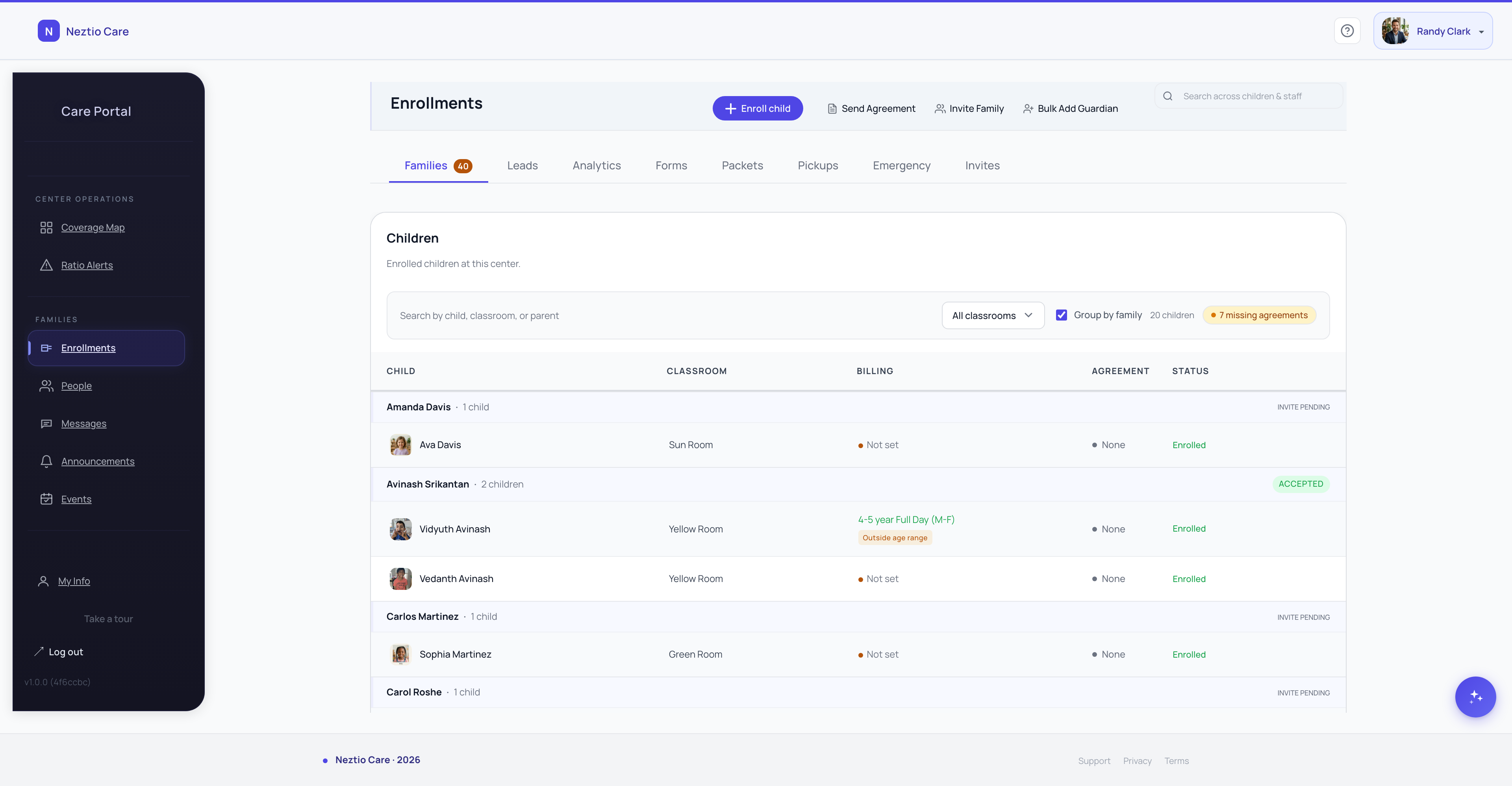
Enrollment forms: Collect contact information, emergency contacts, authorized pickups, medical information, allergies, immunization records, and signed consent forms.
Parent handbook: Document your hours, tuition rates, payment policies, late pickup fees, illness exclusion policies, discipline approach, communication practices, and drop-off/pickup procedures.
Daily schedules: Create age-appropriate daily routines that include structured activities, free play, meals and snacks, rest time, and outdoor time.
Meal planning: Plan nutritious meals and snacks that meet state health department requirements. If you plan to participate in the USDA CACFP program (covered in step 9), your meals must meet CACFP meal pattern requirements.
Billing and tuition collection: Set up a system for invoicing families and collecting payments. Decide on payment schedules (weekly, biweekly, monthly), accepted payment methods, and late payment policies.
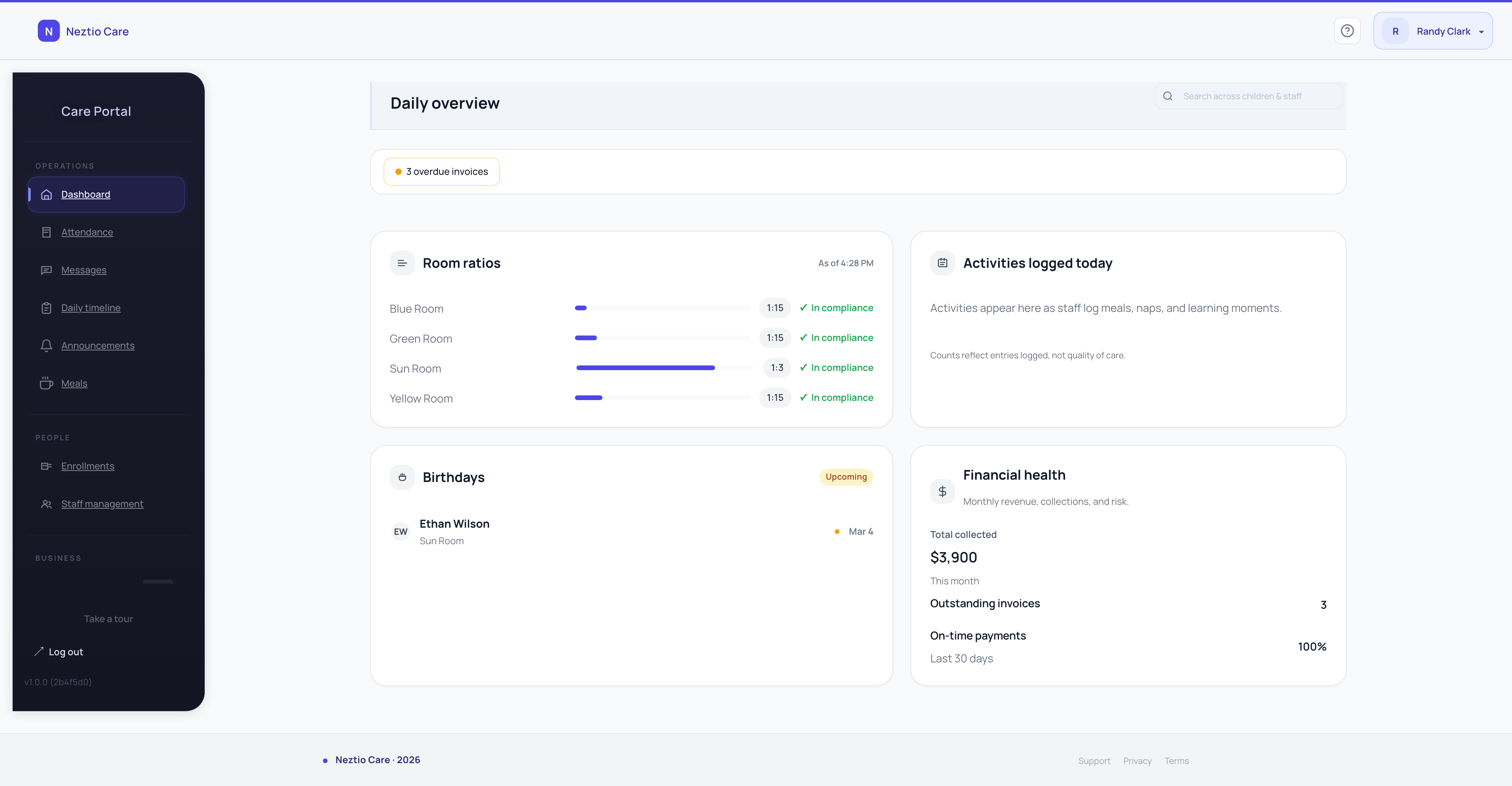
Tip: Childcare management software like Neztio can handle enrollment, billing and payments, attendance tracking, meal tracking, daily activity reports, messaging with parents, and staff management from day one, so you do not have to piece together multiple tools or rely on paper records. See our guide on how to choose childcare software to evaluate your options.
8. Enroll families and open
With your license in hand and your operations set up, it is time to start enrolling families. Building your initial enrollment takes effort, but there are several proven strategies:
Google Business Profile: Create and verify your Google Business listing. This is how most local families will find you when searching for childcare. Include your hours, photos of your facility, and a link to your website.
Social media: Create pages on Facebook and Instagram to showcase your program, share photos (with parent permission), and engage with your local community. Our childcare marketing guide covers more strategies for building your online presence.
Community outreach: Post on local community boards, partner with pediatricians and family-focused businesses, and attend community events. Word of mouth is the most powerful marketing channel for childcare.
Tours and open houses: Offer facility tours to prospective families. This is your best opportunity to make a strong impression. Have enrollment packets ready to hand out and be prepared to answer questions about your program, ratios, staff qualifications, and tuition.
State referral lists: Most state licensing agencies maintain a searchable directory of licensed providers. Make sure your center is listed once your license is issued, as many families use these directories to find care.
Consider a soft opening with a small group of children before you ramp up to full capacity. This gives your staff time to settle into routines and work out any operational issues before you are at full enrollment.
9. Apply for CACFP
The USDA Child and Adult Care Food Program (CACFP) reimburses eligible childcare providers for meals and snacks served to children in their care. Most licensed childcare centers and family childcare homes are eligible to participate.
Eligibility: Licensed or license-exempt childcare centers, Head Start programs, and family childcare homes can participate. You must serve meals that meet CACFP meal pattern requirements.
Reimbursement: CACFP reimburses up to two meals and one snack (or two snacks and one meal) per child per day. Reimbursement rates are set by the USDA and adjusted annually.
How to apply: Contact your state's CACFP administering agency (usually the state Department of Education or Department of Agriculture) to begin the application process. You will need to submit menus, meal counts, and attendance records.
CACFP reimbursement can be a meaningful revenue supplement, especially for programs serving families in lower-income areas. For more details, see our CACFP software guide.
10. Plan for sustainability
Opening your doors is a major milestone, but long-term success requires ongoing attention to financial sustainability, quality improvement, and community relationships.
Accept childcare subsidies: Consider becoming an approved provider for your state's Child Care and Development Fund (CCDF) subsidy program. Accepting subsidies (sometimes called vouchers) expands your potential enrollment by serving families who receive financial assistance for childcare.
Pursue quality ratings: Most states operate a Quality Rating and Improvement System (QRIS) that rates childcare programs on a tiered scale. Higher ratings can qualify you for higher subsidy reimbursement rates, grants, and increased parent confidence.
Invest in professional development: Ongoing training keeps your staff engaged and improves program quality. Many states offer free or subsidized training through their early childhood professional development systems.
Build parent feedback loops: Regularly survey families and hold parent-teacher conferences. Strong family engagement improves retention and generates word-of-mouth referrals, which is the most cost-effective marketing for childcare programs.
Monitor your finances: Track enrollment trends, revenue per child, and expense ratios monthly. Childcare is a thin-margin business, so staying on top of your numbers is essential for long-term viability.
Ready to get started?
Starting a daycare takes planning, persistence, and a genuine commitment to caring for children. The steps above give you a clear roadmap, but the most important thing is to start: contact your state licensing agency, begin your business plan, and take it one step at a time.
When you are ready to set up your operations, see how Neztio helps new childcare programs manage attendance, enrollment, billing, parent communication, and more so you can focus on what matters most: the children in your care.
Related
Childcare Licensing Checklist: What Every New Center Needs
Related
How to Choose Childcare Software: A Buyer's Guide
Glossary terms in this article
Licensing
State-issued permission to operate a childcare facility, requiring compliance with health, safety, and staffing standards.
Enrollment
The process of registering children into a childcare program, including collecting required forms and documentation.
Tuition
The fee charged to families for childcare services, typically billed weekly, biweekly, or monthly.
CCDF
The Child Care and Development Fund, the federal subsidy program that helps low-income families pay for childcare.
Staff-to-Child Ratio
The required number of qualified staff per group of children, set by state licensing regulations based on age.