How to Set Childcare Tuition Rates: A Pricing Guide for Directors
Setting the right tuition rates is one of the most important financial decisions a childcare director makes. Charge too little and you cannot cover costs or pay staff competitively. Charge too much and families look elsewhere. This guide walks through how to calculate your true costs, research your local market, structure your pricing, and communicate changes to families.
Understanding Your Costs
Before you can set tuition rates, you need to know what it actually costs to care for each child. Many directors set rates based on what competitors charge or what feels right, but sustainable pricing starts with understanding your own cost structure. Your goal is to calculate a per-child cost that accounts for every dollar your program spends.
The major cost categories for most childcare centers are:
Staff wages and benefits
This is by far the largest expense for childcare programs, typically accounting for 60% to 70% of total revenue. It includes lead teachers, assistant teachers, substitutes, administrative staff, and any benefits you offer (health insurance, paid time off, retirement contributions). Because childcare is labor-intensive and regulated staff-to-child ratios dictate how many teachers you need, this cost is largely fixed relative to enrollment.
Facility costs
Rent or mortgage payments, utilities (electricity, water, gas, internet), building maintenance, and repairs. These costs are relatively fixed regardless of how many children you enroll, which means your per-child facility cost drops as enrollment increases.
Food and meals
If your center provides meals and snacks, food costs can be significant. Centers participating in the Child and Adult Care Food Program (CACFP) receive federal reimbursement that offsets some of this cost, but the reimbursement rarely covers the full expense of food preparation and service.
Supplies and curriculum materials
Art supplies, classroom materials, toys, books, diapers (if provided), cleaning supplies, and curriculum or assessment tools. These costs vary but tend to be a smaller share of the budget.
Insurance
General liability insurance, professional liability, workers' compensation, and property insurance. Insurance costs have been rising for childcare providers in recent years and can be a meaningful line item, especially for larger centers.
Administrative and overhead costs
Software subscriptions, accounting, licensing fees, professional development and training, marketing, and miscellaneous operational expenses. These are easy to overlook but add up over the course of a year.
Margins are thin
Most childcare centers operate on net margins under 10%. Some barely break even. This means small changes in enrollment, unexpected repairs, or staff turnover can quickly turn a profitable month into a loss. Understanding your per-child cost helps you set rates that keep the business sustainable while remaining fair to families.
Researching Local Market Rates
Once you know your costs, the next step is understanding what other providers in your area charge. Your tuition rates need to be competitive enough to attract families while covering your expenses. Here are the best sources for market rate data:
Call or visit competitors
The most direct approach. Call other centers in your area and ask about their rates for each age group, full-time vs. part-time pricing, and any additional fees. Most centers will share this information freely since parents ask the same questions. Visit their websites as well, since many post rate sheets online.
State market rate surveys
Most states publish market rate surveys as part of their childcare subsidy program (CCDF requires states to conduct these surveys to set subsidy reimbursement rates). These surveys compile actual tuition data from providers across the state, broken down by region, age group, and care type. Search for your state's name plus "childcare market rate survey" to find the most recent report.
Local CCR&R agencies
Child Care Resource and Referral agencies maintain databases of local providers and often have rate information. They can help you understand where your pricing falls relative to other centers in your community. Contact your local CCR&R for rate comparisons and market insights.
When comparing rates, make sure you are comparing similar programs. A center offering a structured curriculum with degreed teachers, meals included, and extended hours is not in the same category as a home-based provider with fewer resources. Differentiate by age group, program type (full-time, part-time, before/after school), and the quality indicators that justify your pricing.
Pricing by Age Group
Not all children cost the same to care for. State licensing regulations mandate different staff-to-child ratios for different age groups, and these ratios directly drive your labor costs. This is why infant care is almost always the most expensive, and school-age care is the least.
Infants (highest cost)
Most states require a ratio of one caregiver for every three to four infants (1:3 or 1:4). This means you need significantly more staff per child, making infant classrooms the most expensive to operate. Infant tuition is typically the highest rate you charge.
Toddlers
Ratios typically range from 1:4 to 1:6 depending on the state and the exact age range. Toddler tuition is usually somewhat lower than infant rates but still among the higher tiers. Toddlers also require more hands-on care than older children, including diapering, feeding assistance, and closer supervision.
Preschool
Ratios widen to 1:8 or 1:10 in most states. With more children per teacher, the per-child labor cost drops. Preschool rates are typically lower than infant and toddler rates, though they still represent a significant expense for families.
School-age (lowest cost)
Before-school and after-school programs have the most favorable ratios, often 1:10 to 1:15, and children are present for fewer hours each day. This makes school-age programming the least expensive to operate on a per-child basis, and tuition rates reflect that.
Ratios drive the math
If a lead teacher earns $35,000 per year and your state requires a 1:4 ratio for infants, that teacher's salary alone costs $8,750 per infant annually before you add any other expenses. At a 1:10 ratio for preschoolers, the same salary costs $3,500 per child. This is why infant tuition is often 40% to 60% higher than preschool tuition at the same center.
Common Pricing Structures
How you structure your rates matters almost as much as the rates themselves. Clear, predictable pricing helps families budget and reduces billing confusion. Here are the most common approaches:
Weekly vs. monthly tuition
Weekly billing is common in childcare because it aligns with how families think about their schedules. Monthly billing simplifies your invoicing process (fewer invoices to generate and track) but requires families to pay a larger lump sum. Some centers offer both options or charge monthly with a weekly breakdown for reference. Choose the cadence that works best for your families and your cash flow.
Full-time vs. part-time rates
Full-time rates are typically for five days per week. Part-time rates (two, three, or four days) are usually not a simple pro-ration of the full-time rate. Most centers charge a higher per-day rate for part-time because the spot cannot easily be filled on the remaining days. A common approach is to set part-time at 60% to 75% of full-time for three days per week.
Drop-in rates
Drop-in or daily rates serve families who need occasional care. These rates are typically the highest per-day rate you charge, since the spot is not guaranteed and your planning is disrupted. Not every center offers drop-in care, but it can fill empty spots and generate incremental revenue.
Before/after care add-ons
If your center offers extended hours beyond the standard program day, these are typically priced as add-on fees. For example, a preschool program that runs from 9 AM to 3 PM might charge an additional daily or monthly fee for before-care (7 AM to 9 AM) and after-care (3 PM to 6 PM).
Sibling discounts
Offering a discount for families with more than one child enrolled is common practice. A typical range is 5% to 10% off the second child's tuition. This encourages families to enroll all their children at your center rather than splitting between providers. Apply the discount to the younger child's rate (the more expensive one) so the discount amount is meaningful to the family.
Registration and supply fees
Many centers charge a one-time registration or enrollment fee (covering administrative costs of onboarding a new family) and an annual supply fee (covering classroom materials, art supplies, and curriculum resources). These fees are typically non-refundable and help cover costs that are not easily built into weekly tuition.
Communicating Rate Increases
Raising tuition is necessary but never easy. Your costs go up every year (staff wages, insurance, food, supplies), and your rates need to keep pace. How you communicate increases makes a significant difference in how families respond.
Give 30 to 60 days written notice
Families need time to adjust their budgets. Most states require a minimum notice period for tuition changes (check your state's licensing rules), but even where not legally required, 30 to 60 days is a professional standard. Send a written letter or email so families have documentation.
Explain the reason for the increase
Be direct and honest about why rates are going up. Common reasons include staff wage increases (to recruit and retain quality teachers), rising insurance premiums, increased supply costs, and facility improvements. Families are more understanding when they see where the money goes, especially when it relates to the quality of care their children receive.
Time increases strategically
The beginning of the school year (August or September) or the start of the calendar year (January) are the most natural times to adjust rates. Families expect annual adjustments at these transition points. Avoid mid-year increases unless absolutely necessary, as they feel more disruptive.
Be transparent about where the money goes
Consider sharing a high-level breakdown of your expenses, such as the percentage that goes to staff, facility, food, and supplies. When families see that the majority of tuition goes directly to paying the teachers who care for their children, the increase feels less like a business decision and more like an investment in quality.
Small, regular increases are easier than large, infrequent ones
A 3% to 5% annual increase is much easier for families to absorb than a 10% to 15% increase every three years. If you have not raised rates in a while, you may need a larger initial adjustment, but commit to annual reviews going forward so increases stay manageable.
Late Fees and Payment Policies
Clear payment policies protect your revenue and set expectations with families from day one. These policies should be documented in your parent handbook and reviewed with every family at enrollment.
Late pickup fees
Charge a per-minute fee after your posted closing time (for example, $1 per minute per child after 6:00 PM). This compensates the staff who must stay late and discourages habitual late pickups. Make sure families acknowledge this policy in writing at enrollment.
Late payment fees
A flat late fee (such as $25) or a percentage of the outstanding balance applied when tuition is not received by the due date. Some centers offer a short grace period (one to three days) before the fee kicks in. The key is consistency: if you waive the fee for some families but not others, you undermine the policy and create resentment.
Payment due dates
Set a clear due date and stick to it. Tuition due on Monday for the current week (if billing weekly) or the first of the month (if billing monthly) are common approaches. Tuition is generally due in advance, not arrears, since you are reserving the child's spot regardless of attendance.
Vague or unwritten policies
If your payment policies are not clearly documented and communicated, enforcing them becomes difficult and uncomfortable. Write clear policies, include them in your parent handbook, and have families sign an acknowledgment at enrollment. This removes ambiguity and makes enforcement a matter of following agreed-upon terms, not a personal confrontation.
Accepting Subsidies
Many childcare centers serve a mix of private-pay and subsidy-funded families. Deciding whether to accept government childcare subsidies (typically funded through the Child Care and Development Fund, or CCDF) is both a business decision and a community service decision.
Advantages:
Fills enrollment spots that might otherwise go empty, improving your occupancy rate and revenue
Serves families in your community who need affordable care, fulfilling a social mission
Government payments are steady and reliable once processed, unlike chasing individual family payments
Challenges:
State reimbursement rates are often below your private-pay tuition, meaning you receive less per child
Additional paperwork and attendance documentation requirements add administrative burden
Payment processing timelines vary by state and can create cash flow gaps of two to four weeks
Many successful centers find a balance, accepting a certain number of subsidy-funded children while maintaining enough private-pay enrollment to keep overall revenue healthy. The right mix depends on your market, your costs, and the subsidy rates in your state. For a deeper look at how subsidies work, see our childcare subsidy guide.
Using Software for Billing
Managing tuition manually, with spreadsheets, paper invoices, or cash and check collection, works when you have a handful of families. But as your center grows, manual billing becomes a source of errors, missed payments, and wasted time. Childcare billing software automates the repetitive parts so you can focus on running your program.
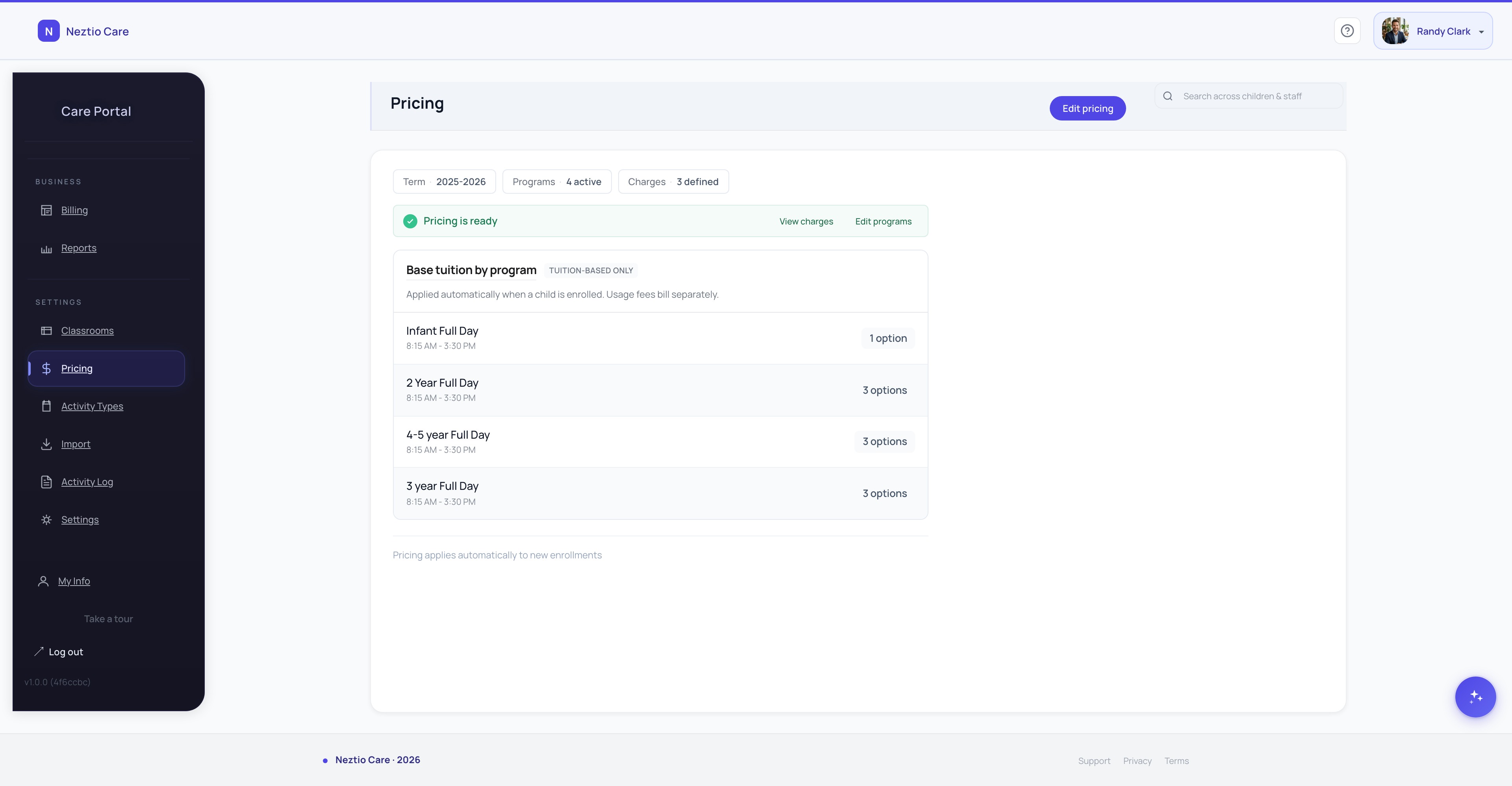
Set up tuition plans per child
Configure different rates for each child based on their age group, schedule (full-time, part-time), and any discounts. Once set, invoices generate automatically based on the plan, eliminating manual calculation each billing cycle.
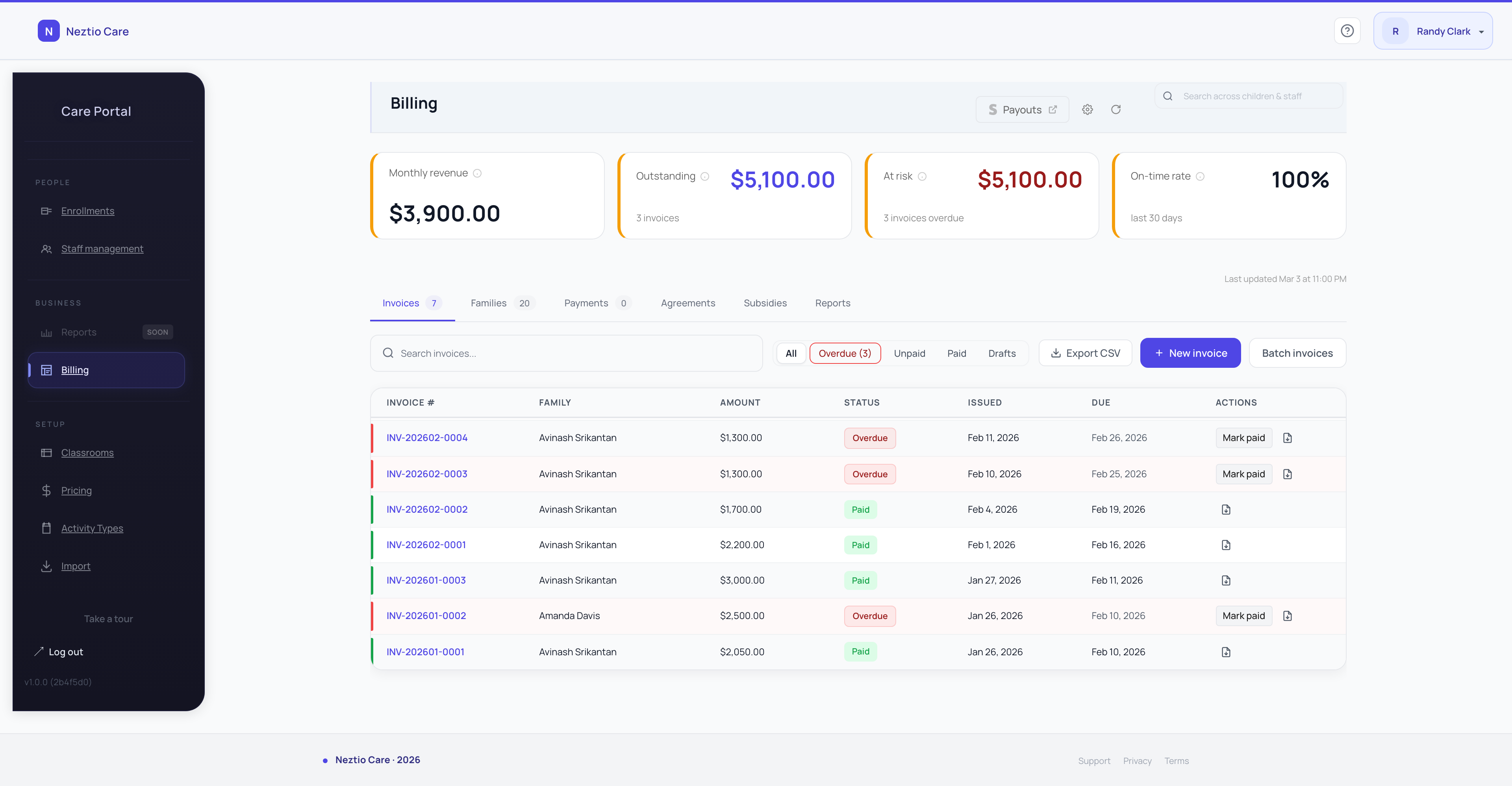
Automatic invoicing
Instead of creating invoices one by one, billing software generates them on your schedule, whether weekly, biweekly, or monthly. Invoices are sent to families automatically, and you can see at a glance which invoices are paid, pending, or overdue.
Online payments
Let families pay tuition online rather than bringing checks or cash. Online payments are faster to process, easier to track, and reduce the awkwardness of chasing down late payments in person. Families appreciate the convenience of paying from their phone.
Manage multiple rate structures
When you have different rates by age group, full-time vs. part-time, sibling discounts, and subsidy copays, keeping it all straight manually is error-prone. Billing software handles multiple rate configurations and applies them correctly every time.
Neztio's billing features include tuition plans, automatic invoicing, and online payments, all designed specifically for childcare centers managing different rate structures across age groups and schedules. For more on how billing automation works, see our guide on automating childcare billing.
The Bottom Line
Setting childcare tuition rates is not guesswork. It starts with understanding your true costs, researching what your local market supports, and building a pricing structure that accounts for different age groups, schedules, and family situations. Once your rates are set, clear policies around payment timing, late fees, and rate increases keep your revenue predictable and your family relationships healthy.
The right billing tools make all of this easier to manage as your center grows. Learn more about Neztio's billing features and see how automated tuition management can save your team hours every week.
Related
How to Automate Childcare Billing
Related
Understanding Childcare Subsidies: A Provider's Guide
Glossary terms in this article
Tuition
The recurring fee families pay for childcare services, typically charged weekly, biweekly, or monthly.
Billing Automation
Software features that automatically generate invoices, process payments, and track tuition for childcare programs.
Subsidy
Government financial assistance that helps eligible families pay for childcare, funded through programs like CCDF.
Enrollment
The process of registering a child in a childcare program, including collecting required documents and family information.
Waitlist
A list of families waiting for an available spot in a childcare program when enrollment is at capacity.