Understanding Childcare Subsidies: A Provider's Guide to CCDF and State Programs
Childcare subsidies help families afford care and help providers fill classrooms. But navigating the subsidy system, from CCDF block grants to state reimbursement processes, can be confusing. Here is what providers need to know about accepting subsidies, getting paid, and managing subsidy billing alongside private pay.
What Are Childcare Subsidies?
Childcare subsidies are government financial assistance programs that help eligible families pay for childcare. The primary federal funding source is the Child Care and Development Fund (CCDF), a block grant program administered by the U.S. Department of Health and Human Services, Office of Child Care. Congress authorizes CCDF funding, and states receive allocations based on formulas that account for factors like the number of children under age 13 and the share of children receiving free or reduced-price school lunch.
Each state (along with territories and tribes) operates its own subsidy program under CCDF guidelines. States set their own eligibility rules, reimbursement rates, and administrative processes. This means the subsidy experience varies significantly depending on where your center is located. Some states call the program "Child Care Assistance," others use "Child Care Vouchers" or "Working Connections Child Care." Regardless of the name, the underlying funding and structure come from CCDF.
For providers, subsidies represent a significant revenue stream. Accepting subsidy-funded children allows you to serve a broader range of families while receiving government payments for a portion of tuition costs. However, the subsidy system comes with its own billing requirements, documentation standards, and payment timelines that differ from collecting tuition directly from families.
How CCDF Works
The flow of subsidy funding follows a defined path from the federal government to your center:
- 1
Federal allocation
Congress appropriates CCDF funds. The Office of Child Care distributes block grants to states, territories, and tribal organizations. States must also contribute matching funds and maintenance-of-effort spending from their own budgets.
- 2
State program design
Each state sets its own eligibility criteria within federal guidelines. Common requirements include income limits (typically 85% of State Median Income or lower), work or education activity requirements for parents, and age limits for children (usually under 13, or under 19 for children with special needs).
- 3
Family application
Eligible families apply through their state's subsidy agency (often a Department of Social Services or Department of Human Services office). If approved, they receive a voucher or certificate authorizing a specific number of hours or days of care at an approved provider.
- 4
Provider reimbursement
The family selects an approved provider. The provider submits attendance records to the state agency for the subsidy-authorized hours. The state reimburses the provider at the state-set rate. The family pays any required copay directly to the provider.
CCDF does not cover all eligible families
CCDF is not an entitlement program, meaning not every eligible family is guaranteed assistance. When state funding runs out, eligible families may be placed on a waiting list. This is different from programs like SNAP or Medicaid, which serve all eligible applicants. As a provider, this means some families who qualify on paper may not currently have active subsidy authorization.
Becoming a Subsidy-Accepting Provider
The process for becoming an approved subsidy provider varies by state, but most states require the following:
Active childcare license
Most states require a current, valid childcare license issued by the state licensing agency. Some states also allow legally license-exempt providers (such as certain family, friend, and neighbor care arrangements) to accept subsidies, but with additional requirements.
Agreement to accept state reimbursement rates
You must agree to accept the state's payment rate for subsidy-funded children. This rate is set by the state and may be lower than your private-pay tuition. Signing a provider agreement typically includes accepting these terms.
Health and safety compliance
CCDF requires states to ensure subsidy providers meet basic health and safety standards, including safe sleep practices, prevention of shaken baby syndrome/abusive head trauma, first aid and CPR training, and building and physical premises safety. These requirements apply on top of your existing state licensing standards.
Background checks
Federal CCDF law requires comprehensive background checks for all childcare staff, including fingerprint-based checks of state and FBI criminal history, sex offender registry checks, and child abuse and neglect registry checks. Most licensed centers already complete these, but subsidy participation may trigger additional verification.
Provider agreement or registration
Some states have a specific application process to become a subsidy-approved provider. Others automatically allow all licensed providers to accept subsidy-funded children. Contact your state's childcare subsidy agency or your local Child Care Resource and Referral (CCR&R) agency to find out the process in your state.
How Providers Get Paid
Understanding the subsidy reimbursement process is critical to maintaining healthy cash flow. Here is how it typically works:
Attendance submission
You submit attendance records for subsidy-authorized children to the state agency, documenting the days and hours each child attended. Most states require this on a regular cycle, often monthly or biweekly. Some states have moved to electronic attendance systems; others still accept paper forms.
Rate calculation
The state pays based on the child's authorized schedule (full-time or part-time) and the provider's approved rate category (which may vary by child age, care type, and quality rating). Payment is calculated against the actual days or hours attended, though some states pay on an enrollment basis rather than strict attendance.
Payment timing
Payment timelines vary widely by state. Some states pay weekly, others biweekly or monthly. There is often a processing lag between when you submit attendance and when payment arrives. It is not uncommon for reimbursement to take two to four weeks after submission, and longer if there are discrepancies or missing information.
Family copay
Most subsidy-funded families are assigned a copay, which is the family's share of the cost. The copay amount is set by the state based on the family's income and family size. You collect the copay directly from the family, just like you would collect tuition from a private-pay family. The state pays the remaining authorized amount.
Common payment challenges:
Payment delays due to state processing backlogs or budget constraints
Denied payments for attendance records submitted late or with errors
Retroactive adjustments when a family's eligibility changes mid-month
Difficulty collecting copays from families who may already be financially strained
The Subsidy Rate Gap
One of the most significant financial challenges for subsidy-accepting providers is the gap between the state's reimbursement rate and the actual cost of care. The federal government recommends that states set subsidy reimbursement rates at or above the 75th percentile of current market rates, meaning the rate should be high enough to give subsidy families access to at least 75% of the providers in their area.
In practice, many states set rates below this benchmark. Market rate surveys, which states use to determine reimbursement rates, may be conducted infrequently (every two to three years), causing rates to lag behind actual tuition increases. The result is that many providers are reimbursed at a rate that does not fully cover their cost of providing care.
Providers face a choice when the subsidy rate is lower than their private-pay tuition:
Accept the difference
Absorb the gap as a cost of serving subsidy families. Many mission-driven providers choose this path to maintain access for lower-income families, but it can strain budgets over time.
Charge families the difference
Some states allow providers to charge subsidy families an additional amount above the copay to cover the gap between the subsidy rate and the private-pay rate. However, this is not allowed in all states, and where it is allowed, the rules vary. Check your state's policy before charging any amount beyond the assigned copay.
Pursue higher-tier quality ratings
Many states offer tiered reimbursement, meaning providers who achieve higher ratings in the state's Quality Rating and Improvement System (QRIS) receive higher subsidy rates. If your state offers tiered reimbursement, investing in quality improvements can directly increase your per-child revenue for subsidy children.
Know your numbers
Calculate your actual per-child cost of care (including staff wages, rent, meals, supplies, and overhead) and compare it to both your private-pay rate and the subsidy reimbursement rate. Understanding the exact size of the gap helps you make informed decisions about how many subsidy slots you can sustainably offer.
Managing Subsidy Billing Alongside Private Pay
Running a center that serves both subsidy-funded and private-pay families means managing two different billing workflows simultaneously. This is where administrative complexity increases and where good systems make a real difference.
Track funding source per child
Each enrolled child should be clearly categorized as private-pay, subsidy-funded, or a combination (subsidy plus copay plus any additional parent-pay amount). This information drives how you bill and who you bill.
Handle different billing cycles
Private-pay families might be invoiced weekly or monthly by your center. Subsidy billing follows the state's submission schedule, which may not align with your private-pay cycle. You need to track both timelines and ensure nothing falls through the cracks.
Collect copays consistently
The family copay is your responsibility to collect, just like private-pay tuition. Letting copays slide results in lost revenue that the state will not cover. Treat copay collection with the same consistency as any other tuition payment.
Monitor eligibility changes
Subsidy authorization has start and end dates. Families must recertify periodically (typically every 12 months under current CCDF rules). If a family's subsidy lapses and they have not recertified, you need to know immediately so you can either pause care or transition them to private pay.
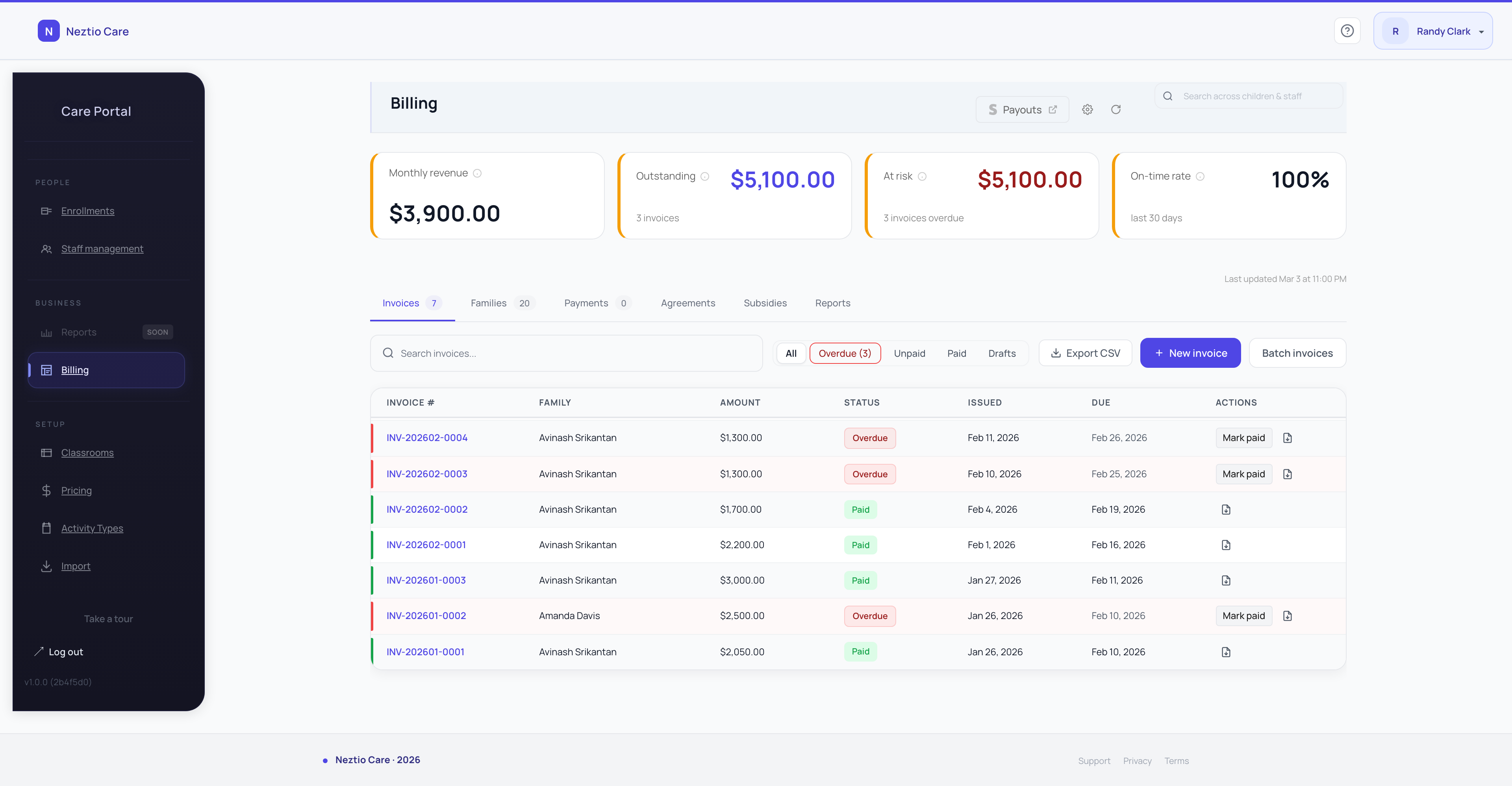
Billing software designed for childcare can help keep subsidy and private-pay billing organized in one system. Neztio's billing features let you set up tuition plans per child, generate invoices, and track payments, so you can manage all of your families' billing in one place regardless of their funding source.
Subsidy Attendance Documentation
Accurate attendance records are the foundation of subsidy reimbursement. States require documentation of each child's attendance to process payment, and errors or gaps in your records can directly result in denied or delayed reimbursement.
Missing sign-in/sign-out records
If a parent forgets to sign in or out and there is no record of attendance for that day, the state may deny payment for that day entirely. Some states require both a sign-in and sign-out time with a parent or guardian signature.
Late submission of attendance records
Most states have strict deadlines for attendance submission. Missing the deadline can mean waiting an entire additional billing cycle to receive payment, or in some cases, forfeiting reimbursement for that period.
Discrepancies between reported and authorized hours
If a child is authorized for part-time care but your records show full-time attendance, the state may flag this as an error and hold payment until the discrepancy is resolved.
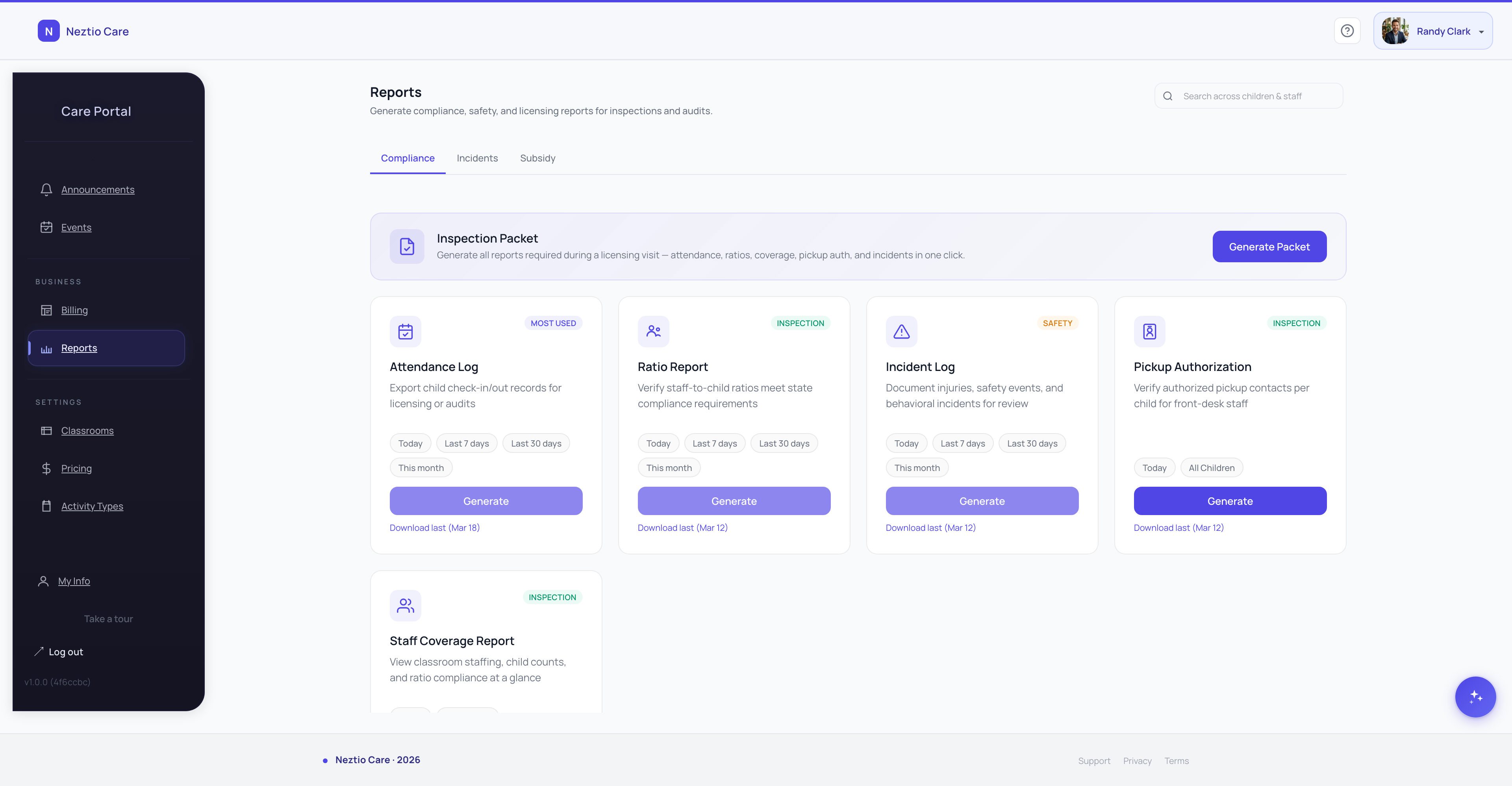
Digital attendance tracking provides a reliable documentation trail that reduces errors and makes subsidy reporting easier. When check-in and check-out times are recorded digitally with timestamps, you have the data you need for state reporting without relying on paper sign-in sheets that can be incomplete or illegible. Neztio's attendance and check-in features give you timestamped digital records for every child, every day.
For more on attendance tracking best practices, see our guide on daycare attendance tracking.
Other Funding Sources for Providers
CCDF subsidies are the largest source of government childcare assistance, but they are not the only funding available to providers. Diversifying your revenue streams can improve financial stability and help you invest in program quality.
CACFP meal reimbursement
The Child and Adult Care Food Program (CACFP) reimburses eligible childcare providers for serving nutritious meals and snacks. Reimbursement rates are set federally and vary based on the income eligibility of enrolled children. If you are not already participating in CACFP, it can provide meaningful additional revenue while improving the nutrition you offer. See our CACFP software guide for more details on managing meal program compliance.
QRIS quality improvement grants
Many states offer grants, bonuses, or higher subsidy reimbursement rates to providers who participate in the state's Quality Rating and Improvement System (QRIS). These programs incentivize quality improvements like staff training, curriculum adoption, and environmental enhancements. Check with your state's early childhood agency for available QRIS incentives.
Head Start partnerships
Some childcare centers partner with local Head Start or Early Head Start programs to serve eligible children. These partnerships can bring additional federal funding, staff training resources, and curriculum support. Head Start grantees sometimes contract with community childcare providers to expand their capacity.
Local and community grants
United Way chapters, community foundations, and local government agencies sometimes offer grants for childcare providers, particularly for facility improvements, equipment, or serving underserved populations. Your local CCR&R can often point you toward available opportunities in your area.
The Bottom Line
Accepting childcare subsidies allows you to serve more families and maintain fuller enrollment, but it comes with real administrative complexity. Understanding how CCDF works, staying on top of attendance documentation, and managing subsidy billing alongside private pay are all essential to making subsidy participation financially sustainable for your center.
Neztio helps childcare providers manage billing, attendance tracking, and enrollment in one platform, making it easier to stay organized whether your families pay privately or through subsidy programs. Learn more about Neztio's billing features and simplify how you manage payments across all funding sources.
Glossary terms in this article
Subsidy
Government financial assistance that helps eligible families pay for childcare, funded through programs like CCDF.
CCDF
The Child Care and Development Fund, a federal block grant that provides states with funding to subsidize childcare for eligible families.
CCR&R
Child Care Resource and Referral agencies that help families find childcare and support providers with training and resources.
Enrollment
The process of registering a child in a childcare program, including collecting required documents and family information.
Tuition
The recurring fee families pay for childcare services, typically charged weekly, biweekly, or monthly.