Daycare Parent Survey Template: Questions That Drive Improvement
Parent feedback is the fastest way to find out what is working at your center and what needs attention. A well-designed survey gives you actionable data, not just nice comments. Here is a complete template with 20 proven questions, plus guidance on when to send surveys, how to boost response rates, and how to turn feedback into action.
Why Parent Surveys Matter
Parents see your center from a perspective you cannot. They experience drop-off and pick-up, they read every message you send, they hear what their child says about their day, and they compare your program to alternatives. This perspective is invaluable for identifying blind spots, reinforcing what works, and preventing the kind of small frustrations that lead families to quietly disenroll.
Regular surveys also signal to parents that you care about their experience. Centers that actively seek and act on feedback tend to have higher parent satisfaction, stronger retention, and more word-of-mouth referrals. In an industry where the average center loses 20-30% of families each year, anything that strengthens the parent relationship has a direct impact on revenue.
The key is asking the right questions. Vague questions like "Are you satisfied?" produce vague answers. Specific, well-structured questions produce insights you can actually act on. For a broader look at building strong parent relationships, see our parent communication strategies guide.
When to Send Parent Surveys
Timing affects both response rates and the quality of feedback you receive. Here are the best moments to survey parents:
30 days after enrollment
New families have fresh impressions of your onboarding process, first-day experience, and initial communication. This is your chance to catch and fix early issues before they become lasting impressions.
Mid-year (January or February)
A mid-year check-in gives you time to make adjustments before families start making decisions about the following school year. This is especially important for centers that compete with public pre-K programs for 4- and 5-year-olds.
End of year (May or June)
A comprehensive annual survey captures the full year's experience. Use this to identify trends, compare against prior years, and plan improvements for the summer and fall.
After a major change
If you changed your curriculum, added a new classroom, updated your policies, or switched software, send a focused survey about that specific change. This tells you whether the change landed well with families.
Parent Survey Template: 20 Questions
Below is a complete survey template organized by category. Use a 5-point scale (Strongly Disagree to Strongly Agree) for the rated questions, and include space for open-ended responses where indicated. You do not need to use every question every time; pick 10-15 that are most relevant to your goals.
Overall Satisfaction (Questions 1-4)
- I would recommend this center to other families. (1-5 scale)
- Overall, I am satisfied with the quality of care my child receives. (1-5 scale)
- The center provides good value for the tuition we pay. (1-5 scale)
- What is the primary reason you chose this center? (Open-ended)
Communication (Questions 5-8)
- I receive enough information about my child's daily activities. (1-5 scale)
- The center communicates schedule changes and closures with enough notice. (1-5 scale)
- I feel comfortable raising concerns or questions with my child's teacher. (1-5 scale)
- What is your preferred method of communication with the center? (Multiple choice: app messages, email, phone, in-person at drop-off)
Curriculum and Development (Questions 9-12)
- My child is making progress in social skills since starting at this center. (1-5 scale)
- The activities and learning experiences are age-appropriate for my child. (1-5 scale)
- My child enjoys coming to the center. (1-5 scale)
- What skill or area would you most like to see your child develop this year? (Open-ended)
Safety and Environment (Questions 13-16)
- I feel confident that my child is safe at the center. (1-5 scale)
- The facility is clean and well-maintained. (1-5 scale)
- The check-in and check-out process is secure and efficient. (1-5 scale)
- The outdoor play areas are safe and provide enough variety for my child. (1-5 scale)
Staff (Questions 17-18)
- The teachers and staff are warm, attentive, and professional. (1-5 scale)
- My child has a strong relationship with their primary caregiver. (1-5 scale)
Open Feedback (Questions 19-20)
- What does this center do best? (Open-ended)
- If you could change one thing about the center, what would it be? (Open-ended)
How to Boost Response Rates
A survey is only useful if parents actually complete it. Here are proven strategies to get higher response rates:
- 1
Keep it short
A 10-15 question survey that takes 5 minutes will get far more responses than a 40-question survey that takes 20 minutes. Prioritize the questions that will give you the most actionable insights.
- 2
Make it digital
Paper surveys get lost in backpacks. Use a free tool like Google Forms, Typeform, or SurveyMonkey and send the link directly to parents. Mobile-friendly is essential since most parents will complete it on their phones.
- 3
Send reminders
Send the initial request, then one reminder 3-4 days later, and a final reminder a day before the deadline. Three touchpoints typically doubles your response rate compared to a single send.
- 4
Offer anonymity
Some parents will not share honest feedback if they think it can be traced back to them. Make the survey anonymous by default, with an optional field for those who are willing to be identified for follow-up.
- 5
Explain the purpose
Tell parents exactly why you are surveying them and how you plan to use the results. "We are collecting feedback to improve our program for next year" is far more compelling than "Please fill out this survey."
Distributing Surveys Through Your Communication Channels
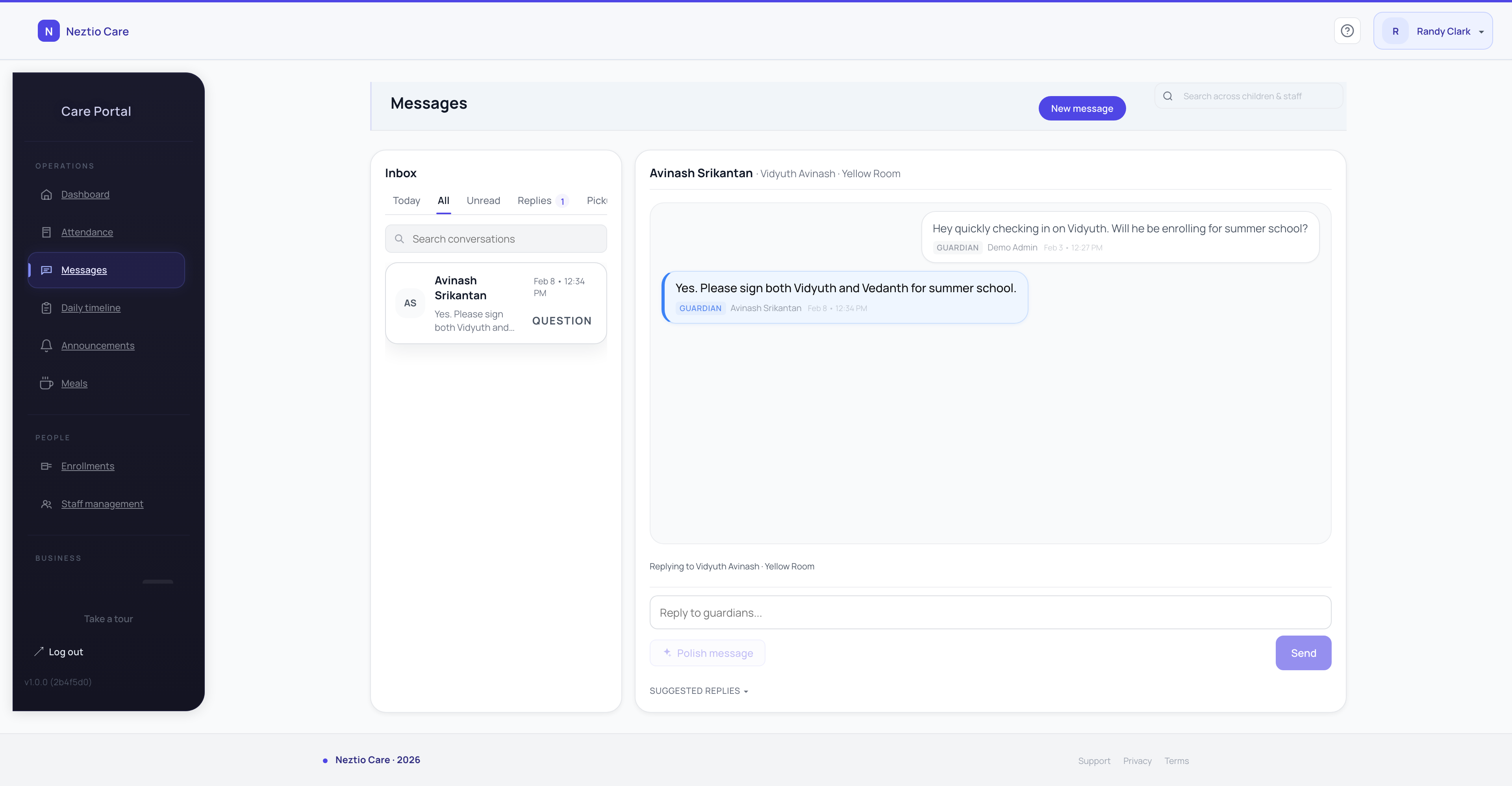
The best way to distribute a survey is through the channels parents already use. If your center uses in-app messaging, send the survey link there. Parents check messages about their child daily, so your survey link will be seen alongside updates they already engage with.
Neztio's in-app messaging lets you send a message to all parents at once or target specific classrooms. You can also post the survey link as an announcement, which appears prominently in the parent app. This approach has several advantages: parents are already in the app, the message comes from a trusted source (their child's center), and you can send follow-up reminders through the same channel.
Supplement in-app distribution with email for families that may not check the app frequently. Include the survey link in your newsletter or send a dedicated email. Avoid relying on paper flyers alone, as they have the lowest completion rates.
How to Act on Feedback
Collecting feedback without acting on it is worse than not surveying at all. It signals to parents that their input does not matter. Here is a framework for turning survey results into improvements:
Share the results
Publish a summary of the key findings with parents. You do not need to share every data point, but highlighting the top strengths and the areas you plan to improve shows transparency and accountability.
Identify the top 2-3 priorities
You cannot fix everything at once. Look for patterns in the data: if 60% of parents say communication about daily activities is lacking, that is a clear priority. Pick the 2-3 issues that affect the most families and focus there.
Create an action plan
For each priority, define the specific change you will make, who is responsible, and the timeline. "We will start sending daily activity summaries through the app by the end of this month" is concrete. "We will improve communication" is not.
Follow up with parents
After implementing changes, tell parents what you did and why. Close the feedback loop. This builds trust and makes parents more likely to participate in future surveys because they see that their input leads to real change.
Track improvement over time
If you survey annually, compare scores year over year. Are the areas you focused on improving? Are new issues emerging? Trending data is more valuable than any single survey.
Common Mistakes to Avoid
Even well-intentioned surveys can go wrong. Avoid these common pitfalls:
Leading questions
"How much do you love our amazing teachers?" is not going to give you honest data. Use neutral phrasing: "The teachers and staff are warm, attentive, and professional."
Too many open-ended questions
Open-ended questions yield rich qualitative data, but they take longer to answer. Limit them to 2-4 per survey. Use scaled questions for the bulk of the survey.
Surveying too often
Survey fatigue is real. Two to three surveys per year (a new-family check-in, a mid-year pulse, and an annual comprehensive survey) is the sweet spot. More than that and response rates will decline.
Ignoring negative feedback
It is tempting to dismiss criticism, but negative feedback is where the most valuable insights live. A parent who takes the time to write a detailed criticism is giving you a roadmap for improvement. Thank them for it.
The Bottom Line
Parent surveys are one of the most cost-effective tools for improving your childcare program. They cost nothing to create, they surface issues before families leave, and they demonstrate that you value parent input. Use the template above as a starting point, customize it to your center's priorities, and commit to acting on what you learn.
For more ways to build a strong parent-center relationship, explore our parent handbook guide and see how Neztio's communication tools make it easy to stay connected with families.
Related
Parent Communication Strategies for Childcare Centers
Related
Childcare Parent Handbook: What to Include and How to Write It
Glossary terms in this article
Parent Engagement
Active involvement of families in their child's care and education, fostered through communication, events, and feedback.
Net Promoter Score (NPS)
A metric measuring how likely customers are to recommend a service, based on a 0-10 scale response.
Retention Rate
The percentage of enrolled families who continue their enrollment over a given period, typically measured annually.
Family Satisfaction
A measure of how well a childcare program meets the expectations and needs of enrolled families.