Why No Other Childcare Software Has AI Features (Yet)
Large language models are reshaping every industry from healthcare to finance. But childcare management software? Zero AI features across the board. Brightwheel has raised over $600M and ships zero AI. Procare was acquired for $1.75B and ships zero AI. Here is why, and what it means for your center.
The State of the Industry
Name any major childcare software company. Brightwheel, Procare, HiMama (now Lillio), Kangarootime, Playground. Now open their feature pages and search for anything related to artificial intelligence. You will find nothing. No AI assistant, no smart report generation, no automated message drafting, no intelligent photo captions.
This is not because the technology does not exist. GPT-4, Claude, and other large language models have been commercially available since 2023. Every SaaS vertical from customer support to legal document review has adopted AI features. Yet the childcare industry, which serves over 10 million children in the United States alone, remains entirely untouched.
The question is not whether AI belongs in childcare software. It clearly does. The question is why no one has built it yet. The answer comes down to four structural problems that plague every incumbent in this market.
Problem 1: Legacy Architectures Cannot Integrate LLMs
Procare Solutions, the largest player in the market, started as a desktop application in the 1990s. Their architecture was designed around local installations, SQL databases, and on-premise servers. Even after their cloud migration, the fundamental data layer was not built for real-time, context-rich AI interactions.
To integrate an AI assistant that can look up a child's attendance history, draft a parent message, or generate a daily report card, your software needs a few things: a real-time cloud database that supports granular queries, a serverless function layer that can call LLM APIs with low latency, and a data model that makes it easy to assemble context about a specific child, classroom, or family.
Legacy systems were not built this way. Retrofitting AI onto a 30-year-old architecture is not a feature sprint. It is a multi-year re-platforming effort. Most incumbents are still working on basic cloud migration, let alone AI integration.
The technical gap
Modern AI features require your application to assemble rich context from multiple data sources in real time, then pass that context to an LLM with proper PII handling and return results inline in the user's workflow. This demands a cloud-native, event-driven architecture. Desktop-era platforms cannot do this without a ground-up rebuild.
Problem 2: Per-Child Pricing Leaves No Margin for AI Compute
Most childcare software companies charge per child per month. Typical pricing ranges from $1 to $5 per child. A 100-child center might pay $200 to $400 per month for their management software.
Now consider the cost of AI. Every time an LLM generates a daily report card, drafts a message, or answers a director's question, it costs real money in API compute. A single AI-generated daily report card for one child might cost a few cents. Multiply that across every child, every day, plus message drafting, photo captions, reply suggestions, and an interactive assistant, and the compute costs add up quickly.
When your revenue per customer is $200 to $400 per month and your gross margins are already squeezed by payment processing fees (for tuition collection) and customer support costs, there is no room left to absorb AI compute expenses. Adding AI features would either destroy margins or require a significant price increase that risks losing customers to cheaper competitors.
This is a structural problem, not a feature prioritization problem. The business model itself makes AI uneconomical for incumbents who have already locked in their pricing.
Problem 3: Regulatory Caution (Valid, But Solvable)
Childcare involves sensitive data about children, which makes any technology decision feel higher-stakes. Directors and administrators rightly ask: Is it safe to use AI with children's information? What about COPPA? What about state privacy regulations?
These concerns are valid, and they should be taken seriously. But they are solvable engineering problems, not fundamental barriers. The solution involves three practices:
PII scrubbing before LLM calls
Strip personally identifiable information (names, dates of birth, addresses) from the data sent to the AI model. The model receives anonymized context, generates its output, and then the application re-inserts the real names on the way back. The LLM never sees or stores PII.
Human-in-the-loop design
AI should draft, not send. Every AI-generated message, report card, or suggestion should be presented to a staff member for review and editing before it reaches a parent. The AI is a time-saving assistant, not an autonomous agent.
Consent-based activation
AI features should be opt-in at the center level. Directors decide whether to enable AI capabilities for their program, giving them full control over how technology is used in their center.
Incumbents have used regulatory concern as a reason to avoid AI entirely. But avoidance is not a strategy. The companies that solve these challenges first will set the standard for the industry.
Problem 4: Incumbents Optimize for Revenue, Not Innovation
Brightwheel has raised over $600 million in venture funding. Procare was acquired by Roper Technologies for $1.75 billion. With that kind of capital, you would expect at least one of them to ship an AI feature. Neither has.
The reason is incentive structure. When a company raises hundreds of millions of dollars or gets acquired at a multi-billion dollar valuation, the priority shifts to revenue optimization: expanding payment processing volume, increasing average revenue per customer, and minimizing churn. These are financial engineering objectives, not product innovation objectives.
AI features do not directly increase payment processing revenue. They do not immediately boost per-child pricing. They require significant R&D investment in a domain (machine learning operations) that is far from the company's core competency. For a company optimizing quarterly revenue metrics, AI is a distraction.
This creates an opening. While incumbents focus on squeezing more revenue from their existing product, the actual product experience stagnates. Directors are still manually writing daily reports, composing every parent message from scratch, and spending hours on tasks that AI could handle in seconds.
What Neztio Ships Today: 7 AI Features
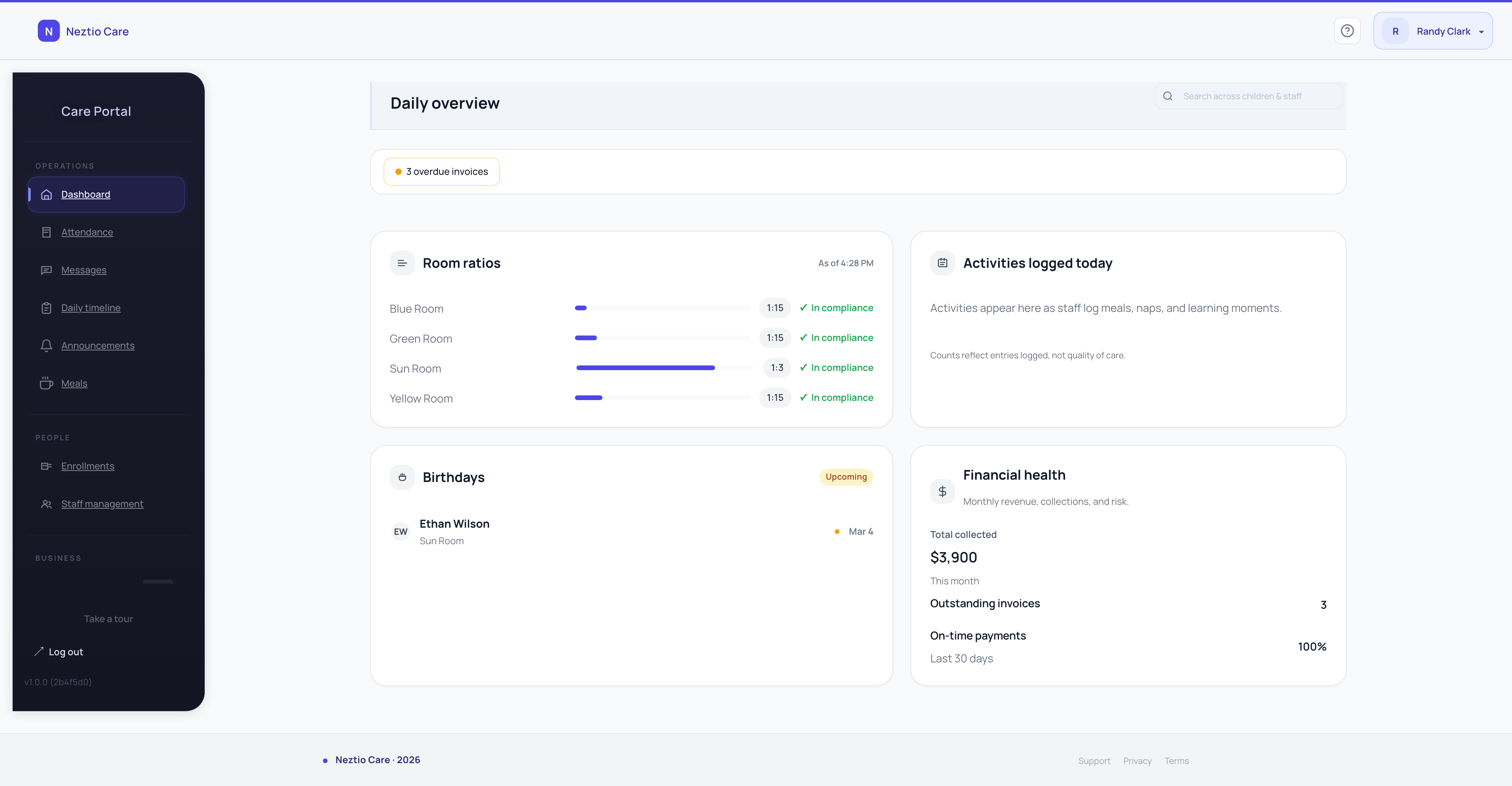
Neztio was built cloud-native and AI-first from day one. Our architecture uses Firebase as a real-time database, Cloud Functions for serverless compute, and Anthropic's Claude as our AI backbone. This is not a bolt-on. AI is woven into the core workflows that directors and staff use every day.
Here are the seven AI features Neztio ships today:
- 1
AI Daily Report Cards
Staff log activities throughout the day (meals, naps, diaper changes, learning moments). At the end of the day, one tap generates a personalized, narrative summary for each child that parents actually want to read. Staff review and edit before sending. What used to take 20 minutes per child now takes 20 seconds.
- 2
Smart Photo Captions
Upload a classroom photo and Neztio generates a descriptive, parent-friendly caption. Staff can edit or accept it. No more blank photo posts or rushed one-word descriptions.
- 3
Message Rewriting
Staff type a quick draft message to parents, and the AI polishes it into a professional, warm communication. The original meaning is preserved, but the tone and grammar are elevated. Every message from your center sounds consistent and thoughtful.
- 4
Reply Suggestions
When a parent sends a message, Neztio suggests contextual replies that staff can tap to use or customize. This speeds up response times and helps staff handle high message volumes without sacrificing quality.
- 5
Weekly AI Briefing
Every week, directors receive an AI-generated summary of their center's key metrics: attendance trends, billing status, enrollment pipeline activity, and anything that needs attention. It is like having an analyst on staff who reads every data point so you do not have to.
- 6
Director Insights
AI-powered observations surfaced on the dashboard that highlight patterns a busy director might miss: a child whose attendance has dropped, a classroom approaching ratio limits, or a billing anomaly worth investigating.
- 7
Agentic AI Assistant
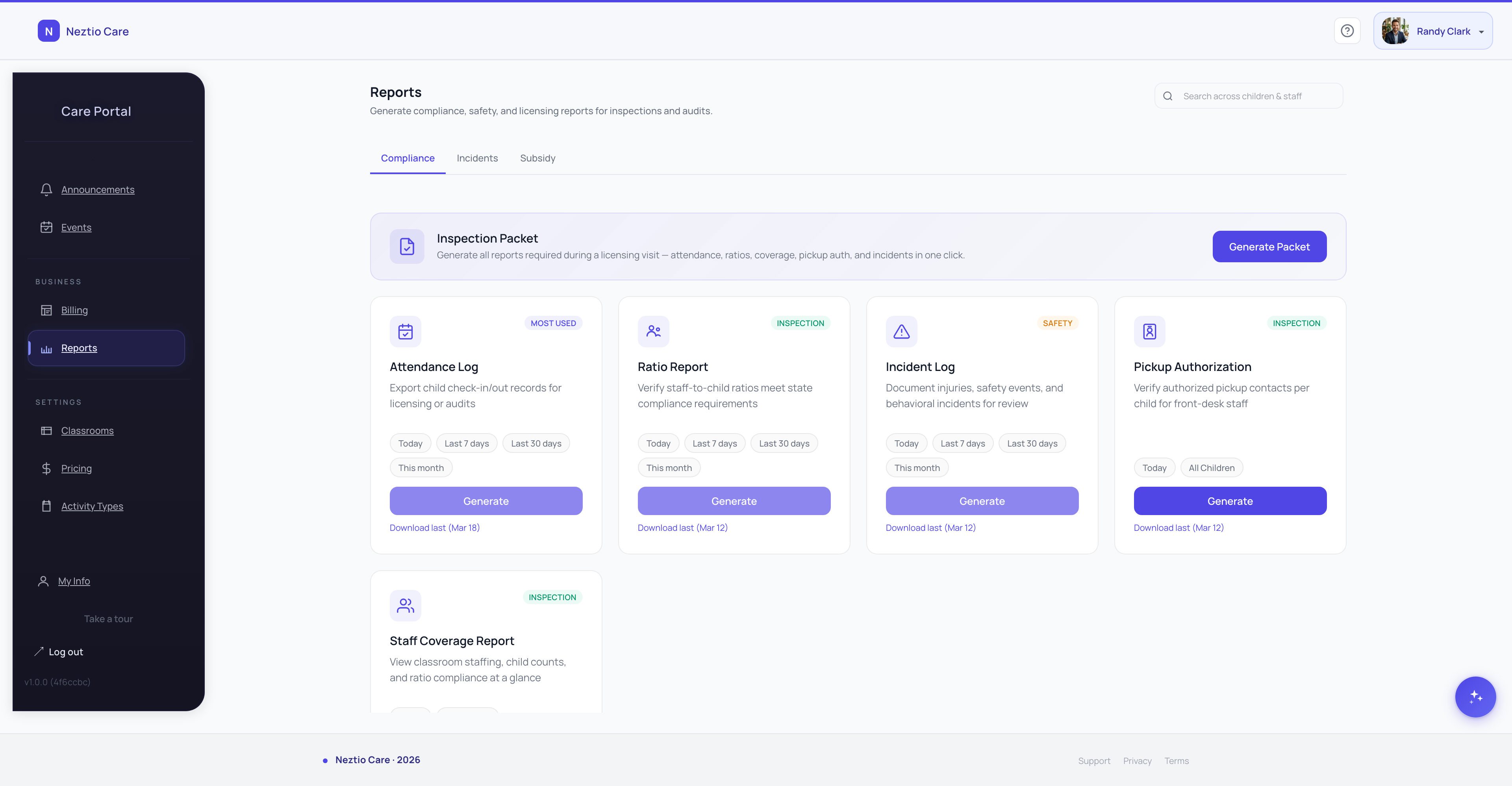
A conversational assistant built directly into the admin dashboard, powered by Claude with over 10 Firestore tools. Directors can ask natural-language questions like "Which families have unpaid invoices over 30 days?" or "What was Emma's attendance this month?" and get real answers pulled from live data. This is not a chatbot that points you to a help article. It reads your actual center data and responds with specifics.
Why Being Cloud-Native and AI-First Is a Structural Advantage
The difference between bolting AI onto a legacy platform and building AI into the foundation is not cosmetic. It is structural.
| Dimension | Legacy + Bolt-On AI | Cloud-Native AI-First |
|---|---|---|
| Data access | Batch exports, ETL pipelines | Real-time queries across all collections |
| Context assembly | Manual, slow, incomplete | Automated, per-child, per-classroom |
| Latency | Seconds to minutes | Sub-second for most features |
| PII handling | Retrofit required | Built into the data pipeline |
| New AI features | Months of integration work | Days to ship |
When AI is part of your architecture from day one, every new feature gets easier to build. When it is a retrofit, every new feature is a battle against your own technical debt.
The Competitive Picture
Here is a straightforward comparison of AI capabilities across the major childcare software platforms:
Brightwheel ($600M+ raised)
Zero AI features. Focused on payment processing and tuition collection. No public AI roadmap.
Procare ($1.75B acquisition by Roper Technologies)
Zero AI features. Still migrating from desktop to cloud. Legacy architecture makes AI integration a multi-year project.
HiMama / Lillio
Zero AI features. Focused on daily reports and parent engagement, but all content is manually created by staff.
Kangarootime, Playground, Sandbox, others
Zero AI features across the board. Same structural challenges: legacy tech, tight margins, no AI expertise.
Neztio
7 shipping AI features: daily report cards, smart photo captions, message rewriting, reply suggestions, weekly AI briefing, director insights, and an agentic AI assistant with 10+ live data tools. Built on Anthropic's Claude. Cloud-native from day one.
For a detailed feature-by-feature comparison, see our comparison page, or read our direct comparisons with Brightwheel and Procare.
What This Means for Directors
If you are running a childcare center today, the software you use is probably asking your staff to do everything manually. Every daily report written from scratch. Every parent message composed word by word. Every insight about your business extracted by staring at spreadsheets.
AI will not replace your teachers. It will give them back the hours they currently spend on administrative tasks so they can focus on the children. A teacher who spends 15 fewer minutes per child on daily reports gets that time back for actual teaching. A director who receives a weekly AI briefing instead of manually pulling reports can spend that time on curriculum, staff development, or family relationships.
The childcare industry will adopt AI. The only question is when, and which platform will lead the way. The incumbents have structural reasons to move slowly. If you are evaluating software for your center, it is worth asking: does your current platform have any AI capabilities? And if not, what is their plan?
The Bottom Line
The childcare software industry has zero AI features because incumbents face four compounding problems: legacy architectures that cannot integrate LLMs, per-child pricing that leaves no margin for AI compute, valid but solvable regulatory concerns that are used as an excuse for inaction, and incentive structures that prioritize revenue optimization over product innovation.
Neztio exists because we believe childcare directors and teachers deserve the same AI-powered tools that every other industry already has. Read our deep dive on how AI works in childcare, or see Neztio in action.
Related
AI in Childcare: How Artificial Intelligence Is Transforming Early Education
Related
AI Daily Report Cards: Save Hours on Parent Updates
Glossary terms in this article
Childcare Management Software
Digital platforms that help childcare centers manage enrollment, attendance, billing, communication, and compliance.
Daily Report
A summary of a child's day shared with parents, covering meals, naps, activities, and developmental observations.
Parent Communication
The methods and tools childcare centers use to share updates, announcements, and messages with families.
Staff-to-Child Ratio
The number of caregivers required per group of children, set by state licensing regulations based on age.