CACFP Reimbursement Rates 2026: What Childcare Providers Get Paid
The Child and Adult Care Food Program (CACFP) helps childcare providers offset the cost of serving nutritious meals. Understanding current reimbursement rates, eligibility tiers, and how to maximize your claims can add thousands of dollars to your annual revenue.
What Is CACFP?
The Child and Adult Care Food Program (CACFP) is a federal program administered by the USDA that provides reimbursement to childcare providers who serve meals and snacks that meet federal nutrition guidelines. The program covers childcare centers, family day care homes, Head Start programs, after-school programs, and adult day care centers.
For childcare providers, CACFP is one of the most valuable financial resources available. A participating center can claim reimbursement for up to two meals and one snack per child per day (or two snacks and one meal). For a center serving 50 children, this can amount to $30,000 to $70,000 or more per year, depending on the tier and the number of meals served.
To participate, providers must serve meals that meet USDA meal pattern requirements, keep accurate records of meals served and child attendance, and submit monthly claims to their state agency or sponsoring organization. For a comprehensive overview of the program and compliance tips, see our CACFP software guide.
Understanding Tier 1 vs. Tier 2 (Family Day Care Homes)
For family day care homes (as opposed to childcare centers), CACFP uses a two-tier reimbursement system. The tier determines how much you are reimbursed per meal, and the difference between tiers is significant.
Tier 1: Higher reimbursement
You qualify for Tier 1 if your day care home is located in a low-income area (where at least 50% of children in the school attendance area qualify for free or reduced-price meals), or if you personally qualify for certain income-based benefits (SNAP, TANF, FDPIR), or if your household income is at or below 185% of the federal poverty level.
Tier 2: Lower reimbursement
If you do not meet Tier 1 criteria, you receive Tier 2 rates. However, individual children in your care who qualify based on their family's income can still be claimed at the Tier 1 rate. This means a Tier 2 home may have some children reimbursed at Tier 1 and others at Tier 2.
Important for childcare centers
The Tier 1/Tier 2 system applies only to family day care homes, not to childcare centers. Centers use a different system based on the income eligibility of each individual child: free, reduced-price, or paid. Each child is categorized separately, and the center claims the corresponding rate for each meal served to that child.
Reimbursement Rates for Childcare Centers (July 2025 to June 2026)
Childcare centers are reimbursed at three levels based on each child's eligibility: free, reduced-price, or paid. The USDA adjusts these rates annually based on the Consumer Price Index. Below are the current rates per meal per child for the contiguous United States, effective July 1, 2025 through June 30, 2026 (Alaska and Hawaii have higher rates):
| Meal Type | Free Rate | Reduced-Price Rate | Paid Rate |
|---|---|---|---|
| Breakfast | $2.46 | $2.16 | $0.40 |
| Lunch/Supper | $4.60 | $4.20 | $0.44 |
| Snack | $1.26 | $0.63 | $0.11 |
Note on rates
These are the official USDA CACFP per-meal rates for the contiguous United States, effective July 1, 2025 through June 30, 2026, as published in the Federal Register. The USDA adjusts these rates for inflation and publishes updated figures each July for the coming year, so always verify the current rates with your state CACFP agency or your sponsoring organization.
Reimbursement Rates for Family Day Care Homes (July 2025 to June 2026)
Family day care homes use the Tier 1/Tier 2 system described above. Here are the current per-meal rates for the contiguous United States, effective July 1, 2025 through June 30, 2026:
| Meal Type | Tier 1 Rate | Tier 2 Rate |
|---|---|---|
| Breakfast | $1.70 | $0.61 |
| Lunch/Supper | $3.22 | $1.94 |
| Snack | $0.96 | $0.26 |
The difference between tiers is substantial. A Tier 1 family day care home serving breakfast, lunch, and a snack to 8 children for 22 days a month would receive approximately $1,035 per month. The same home at Tier 2 rates would receive about $495 per month, a difference of over $6,400 per year.
How to Calculate Your Potential Reimbursement
To estimate your annual CACFP reimbursement, use this formula:
(Rate per meal) x (Number of children) x (Meals per day) x (Operating days per month) x (12 months)
For example, a childcare center with 40 children, all qualifying for the free rate, serving breakfast, lunch, and an afternoon snack, operating 22 days per month:
Breakfast: $2.46 x 40 x 22 x 12 = $25,977.60
Lunch: $4.60 x 40 x 22 x 12 = $48,576.00
Snack: $1.26 x 40 x 22 x 12 = $13,305.60
Total annual reimbursement: $87,859.20
In practice, not all children will qualify for the free rate, and not every child will be present every day. But even a conservative estimate shows how significant CACFP revenue can be for childcare programs.
Maximizing Your CACFP Reimbursement
Many providers leave money on the table because of incomplete records, missed meals, or not enrolling all eligible children. Here are proven strategies to maximize your reimbursement:
- 1
Collect income eligibility forms from every family
For childcare centers, your reimbursement per child depends on their family's income category. If you do not have an income eligibility form on file, that child defaults to the "paid" rate (the lowest). Make collecting these forms part of your enrollment process. Many families qualify for free or reduced rates without realizing it.
- 2
Record every meal served accurately
You can only claim reimbursement for meals you have documented. If a meal is served but not recorded, you lose that reimbursement. Make meal counting part of your daily routine, not an afterthought. For common documentation mistakes to avoid, see our guide on CACFP meal count errors.
- 3
Serve all allowable meals
You can claim up to two meals and one snack per child per day (or two snacks and one meal). If you are only claiming breakfast and lunch but also serve an afternoon snack, you are missing a third reimbursable meal service every day.
- 4
Ensure meals meet USDA meal patterns
A meal only qualifies for reimbursement if it includes all required components. For lunch, that means a meat or meat alternate, grain, two different vegetables or fruits, and milk. Missing one component means the entire meal is non-reimbursable. Build menus around the requirements. See our meal planning guide for help.
- 5
Submit claims on time
Claims must be submitted within 60 days of the last day of the claim month. Late claims are denied. Set a recurring calendar reminder to submit your claim within the first week of the following month.
The Role of Technology in CACFP Compliance
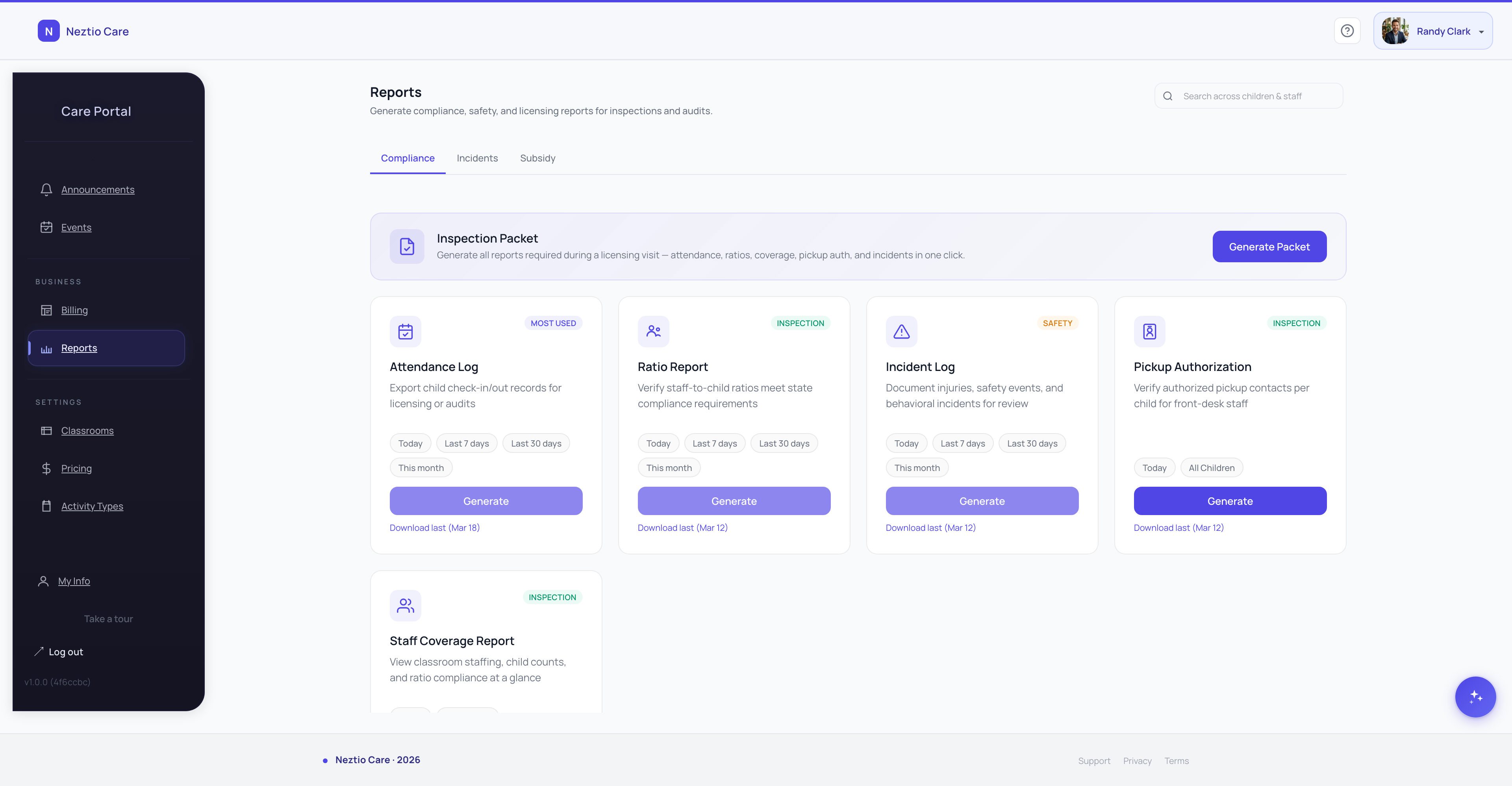
The biggest challenge with CACFP is not the rates themselves, but the record-keeping required to claim them. Providers must track daily attendance, record meals served per child, maintain menus that meet meal pattern requirements, and keep income eligibility documentation on file. Doing this on paper is time-consuming and error-prone.
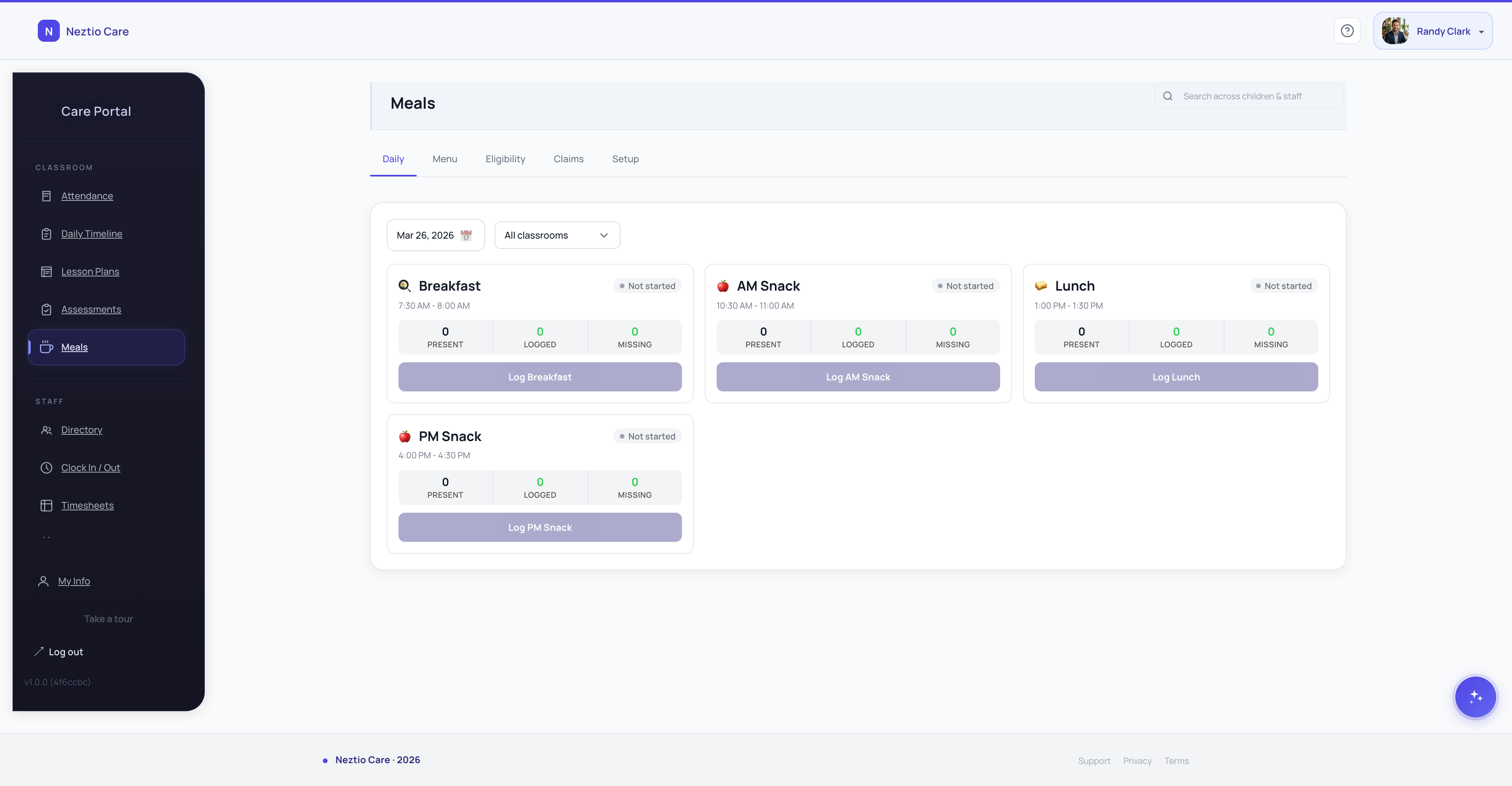
Neztio's CACFP meal tracking feature lets staff record meals digitally as they are served, with each child's attendance automatically linked. The system tracks each child's eligibility category (free, reduced, or paid) so you know exactly which rate applies. This eliminates manual cross-referencing and reduces errors that lead to disallowed claims.
Digital record-keeping also makes audits less stressful. When a CACFP reviewer asks for your records, you can pull them up instantly instead of digging through binders of paper forms. Accurate, organized records are your best defense in an audit.
Getting Started with CACFP
If you are not currently participating in CACFP, here is how to get started:
Contact your state CACFP agency
Each state has a designated agency (usually the state Department of Education or Department of Health) that administers CACFP. They can walk you through the application process and connect you with a sponsoring organization if needed.
Choose an independent application or a sponsor
Childcare centers can apply independently or through a sponsoring organization. Family day care homes must participate through a sponsor. Sponsors handle claim processing and provide training and monitoring in exchange for a portion of your reimbursement (typically 10-15%).
Complete required training
Before your first claim, you will need to complete CACFP training on meal patterns, record-keeping requirements, and civil rights compliance. Your state agency or sponsor provides this training.
Set up your record-keeping system
Before you start claiming, have your system in place: daily attendance records, meal count sheets, income eligibility forms, and a 4-week cycle menu that meets USDA meal patterns. Starting organized prevents problems down the road.
The Bottom Line
CACFP reimbursement is one of the largest sources of non-tuition revenue for childcare providers. Understanding the rate structure, collecting eligibility documentation for every child, accurately recording every meal, and submitting claims on time can add tens of thousands of dollars to your annual budget. The key is consistent, accurate record-keeping.
Want to simplify your CACFP record-keeping? See how Neztio's meal tracking and eligibility management features help childcare providers maximize their CACFP reimbursement while reducing paperwork.
Related
CACFP Software Guide: Simplify Meal Program Compliance
Related
Childcare Meal Planning: Nutrition, Menus, and Compliance
Glossary terms in this article
CACFP
The Child and Adult Care Food Program, a USDA program that reimburses childcare providers for serving nutritious meals.
Meal Pattern
USDA-defined requirements for food components and serving sizes that meals must meet to qualify for CACFP reimbursement.
Income Eligibility
The process of categorizing children as free, reduced-price, or paid based on family income for CACFP reimbursement purposes.
Claim
A monthly submission to the CACFP state agency documenting meals served and requesting reimbursement.