Including Children with Special Needs in Your Childcare Program
Every child deserves access to quality early care and education, regardless of ability. For childcare providers, building an inclusive program is both a legal responsibility and an opportunity to create a richer learning environment for all children. This guide walks through the practical steps your center can take to welcome and support children with special needs.
1. Understanding Your Legal Obligations Under the ADA
The Americans with Disabilities Act (ADA) applies to childcare centers, both public and private. Under the ADA, childcare programs cannot deny enrollment to a child solely because of a disability. This applies to children with physical disabilities, developmental delays, autism spectrum disorder, sensory impairments, chronic health conditions, and other qualifying conditions.
What the ADA requires:
- -Reasonable modifications to policies, practices, and procedures when necessary to serve a child with a disability. For example, if your center has a policy that all children must be potty-trained by age 3, you may need to make an exception for a child whose disability affects toileting.
- -Equal access to programs and activities. A child with a disability must be given the opportunity to participate in the same activities as other children, with appropriate supports.
- -Individualized assessment. You must evaluate each child's needs individually rather than making blanket assumptions based on a diagnosis.
What the ADA does not require:
- -A fundamental alteration of your program. If an accommodation would change the essential nature of your childcare service, it may not be required.
- -Accommodations that would create an undue financial or administrative burden on your center. However, this is a high bar, and most common accommodations are low-cost or free.
The U.S. Department of Justice provides guidance specifically for childcare providers on ADA compliance. If you are unsure about your obligations, consulting with your state's childcare licensing agency or a disability rights organization is a good starting point.
2. Understanding IEPs and IFSPs
If a child in your program has an identified disability or developmental delay, they may have a formal plan that guides their services and supports. Understanding these plans is essential for providing appropriate care.
IFSP (Individualized Family Service Plan):
- -For children from birth through age 2 (Part C of the Individuals with Disabilities Education Act, or IDEA).
- -Focuses on the family as well as the child. Goals address the child's development within the context of daily routines, including time spent in childcare.
- -Services under an IFSP (such as speech therapy or occupational therapy) are often delivered in the child's "natural environment," which can include your childcare setting.
IEP (Individualized Education Program):
- -For children ages 3 and older (Part B of IDEA).
- -Includes specific, measurable goals for the child and outlines the services and supports they will receive.
- -IEPs are managed through the local school district, but childcare providers may be invited to participate in IEP meetings as part of the team.
What this means for your center:
- -Ask families during enrollment whether their child has an IEP or IFSP, and request a copy (with parental consent) so your staff can understand the child's goals.
- -Review the child's goals and identify how your classroom routines can support them. For example, if a child has a speech goal around requesting items, teachers can create opportunities during play and mealtimes for the child to practice.
- -Welcome therapists who may come to your center to provide services. Having a quiet, dedicated space available for therapy sessions is helpful.
3. Common Accommodations in the Classroom
Accommodations do not need to be expensive or complicated. Many of the most effective supports are simple adjustments to your existing routines and materials. The right accommodations depend on each child's individual needs, but here are some of the most common ones childcare providers use:
- -Visual schedules. A picture-based daily schedule posted at child height helps all children understand what comes next, and is especially beneficial for children with autism, ADHD, or anxiety. Use simple images or photos showing each part of the day (circle time, snack, outdoor play, rest time).
- -Additional transition time. Some children need extra time and warning before switching activities. A five-minute verbal warning, followed by a two-minute warning, can prevent meltdowns that stem from unexpected changes.
- -Sensory supports. Noise-canceling headphones for children sensitive to loud sounds, fidget tools for children who need tactile input, weighted lap pads for calming, or a designated quiet corner with soft lighting for sensory breaks.
- -Adapted materials and equipment. Larger crayons or pencil grips for children with fine motor challenges, adapted scissors, slant boards for writing, or plates with raised edges to help children eat independently.
- -Communication supports. Picture exchange boards, simple sign language (common signs like "more," "help," "all done," and "bathroom"), or visual choice boards for children who are non-verbal or have limited speech.
- -Adapted seating. A child who has difficulty sitting on the floor during circle time might do better with a small chair, a floor seat with back support, or a wobble cushion.
- -One-on-one assistance during specific activities. Some children may need individual support during particular parts of the day (such as meals or outdoor play) even if they are independent during others.
Many of these accommodations benefit all children in the classroom, not just the child they were designed for. Visual schedules, transition warnings, and sensory tools are examples of universal design in early childhood education.
4. Staff Training and Ongoing Support
Your staff are the ones implementing inclusion every day in the classroom. Without proper training and support, even well-intentioned teachers can feel overwhelmed or unsure of how to help.
Training areas to prioritize:
- -Disability awareness. General training on common developmental disabilities and how they may present in young children. This helps staff respond with understanding rather than frustration when a child's behavior is related to their disability.
- -Child-specific training. When a child with an IEP or IFSP enrolls, take time to review their plan with the classroom team. Discuss the child's goals, strategies that work, and what to watch for.
- -Positive behavior support. Training on understanding the function of challenging behaviors and responding with strategies like redirection, visual supports, and environmental changes rather than punitive measures.
- -Knowing when to consult specialists. Teachers should understand when to request support from an occupational therapist, speech-language pathologist, or behavioral consultant. Building a relationship with the child's therapy team creates consistency between the therapy setting and the classroom.
Supporting your staff:
- -Check in regularly with teachers who have children with special needs in their classroom. Ask what is working and where they need help.
- -Provide planning time for teachers to collaborate with therapists and review children's goals.
- -Recognize that inclusion takes emotional energy. Teachers who feel supported by their administration are far more effective at supporting children with additional needs.
5. Working with Families as Partners
Families of children with special needs are the experts on their child. They have been navigating their child's diagnosis, therapy appointments, and school systems long before they walked through your door. The most effective childcare providers treat these families as genuine partners.
Building the partnership:
- -Start at enrollment. During the enrollment process, create space for families to share information about their child's needs, preferences, triggers, and what strategies work at home. Do not rely on paperwork alone. A conversation gives you context that forms cannot capture.
- -Ask families what works. Parents often know specific techniques that calm their child, help with transitions, or encourage communication. Use this knowledge in the classroom.
- -Share observations respectfully. When you notice something in the classroom, whether it is progress or a concern, share it with families in a way that is specific, objective, and compassionate. "We noticed Maya has been covering her ears during music time. We tried offering her headphones and she seemed much more comfortable. Have you seen anything similar at home?"
- -Regular check-ins beyond standard conferences. Families of children with special needs often benefit from more frequent communication. Brief weekly or biweekly check-ins, even just a few minutes at pickup, help both sides stay aligned on the child's progress and any emerging needs.
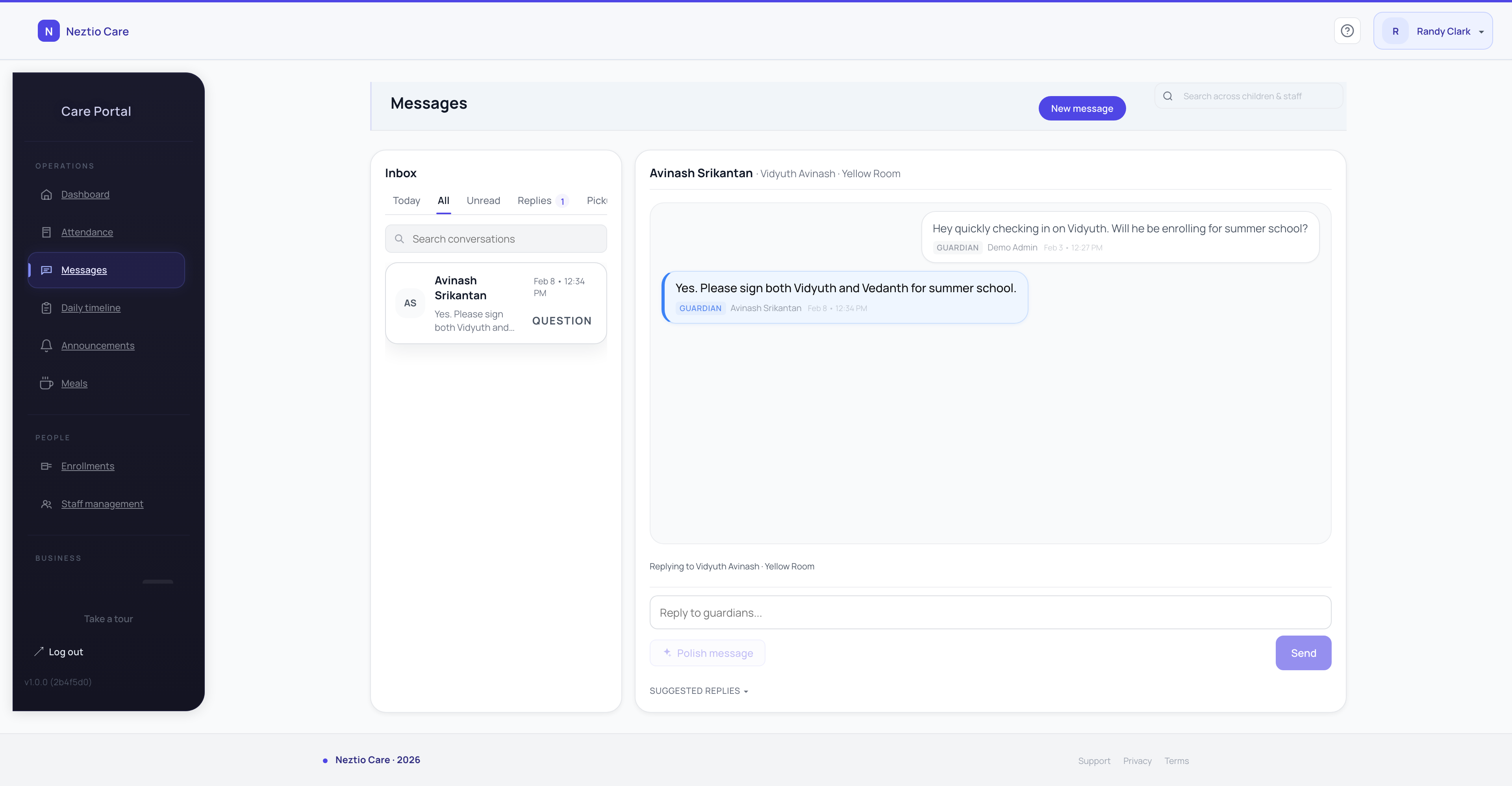
Ongoing communication tools make a real difference here. With a platform like Neztio, teachers and families can exchange messages throughout the day, share daily reports with observations and photos, and keep a running record of the child's experiences at the center. This kind of consistent, documented communication helps families feel connected to their child's day and gives both teachers and parents a shared reference point for discussions about progress and strategies.
6. Environmental Modifications
The physical environment of your center plays a significant role in how well children with special needs can participate. Many environmental modifications are straightforward and benefit all children.
- -Accessible entrances and bathrooms. Ramps, wide doorways, and accessible bathroom fixtures are essential for children who use wheelchairs or walkers. Check your facility against ADA accessibility standards.
- -Quiet spaces for sensory breaks. Designate a corner or small area where children can go when they feel overwhelmed. Stock it with calming items: soft pillows, books, noise-canceling headphones, and dim lighting. This is not a time-out area. It is a self-regulation space.
- -Visual labels and schedules. Label areas of the classroom with both words and pictures (block area, art area, reading corner). Post the daily schedule with images at child height. Use visual cues for classroom rules and expectations.
- -Adapted outdoor play areas. If possible, include ground-level play structures, poured rubber surfacing instead of mulch (which is difficult for wheelchairs), and sensory-rich elements like sand tables at accessible heights and musical instruments mounted at various levels.
- -Flexible classroom layout. Ensure there is enough space between furniture for children who use mobility devices. Arrange the room so that all learning centers are accessible and children can move between areas independently.
Walk through your center with fresh eyes, or better yet, invite a parent of a child with a disability to walk through with you and point out barriers you might not have noticed.
7. Fostering Peer Interactions and Social Inclusion
Physical presence in the classroom is not the same as true inclusion. A child who is in the room but always playing alone or being pulled away for one-on-one activities is not experiencing meaningful inclusion. The social dimension matters just as much as the physical accommodations.
Strategies for social inclusion:
- -Teach all children about differences and acceptance. Read books that feature characters with disabilities. Have age-appropriate conversations about how people have different abilities. Normalize adaptive equipment by explaining it simply: "Kai uses a wheelchair to get around, just like you use your legs."
- -Facilitate friendships intentionally. Pair children together during activities. Set up cooperative play opportunities where children work together toward a shared goal. Some children with social challenges benefit from structured play situations more than free play.
- -Model inclusive language. The way teachers talk about differences sets the tone for the entire classroom. Use person-first language ("a child with autism" rather than "an autistic child"), though some families prefer identity-first language. Ask the family what they prefer.
- -Buddy systems. Pairing a child who needs extra support with a peer buddy during transitions or group activities can be helpful, as long as the buddy relationship is rotated and does not burden any one child. Buddy systems work best when they are framed as "helping each other" rather than one child always being the helper.
- -Celebrate every child's strengths. Make sure children with special needs have opportunities to shine. A child who struggles with verbal communication might be an excellent builder, artist, or puzzle solver. Highlight these strengths publicly so all children see their classmate's abilities, not just their challenges.
8. Funding and Resources for Inclusive Programs
One of the most common concerns childcare providers have about inclusion is cost. While some accommodations do require investment, many are low-cost, and there are funding sources and support systems available to help.
Federal and state programs:
- -Part C early intervention (birth to 3). Under IDEA, states are required to provide early intervention services for eligible infants and toddlers. These services, including speech therapy, occupational therapy, and developmental support, can be delivered in your childcare setting at no cost to the family or provider.
- -Part B preschool services (ages 3-5). Local school districts are responsible for providing special education services to eligible children starting at age 3. Some districts provide itinerant services where therapists and special education teachers visit community childcare settings.
- -State inclusion grants. Some states offer grants specifically to help childcare providers purchase adaptive equipment, modify facilities, or hire additional staff to support inclusion. Check with your state's childcare licensing agency or early childhood office for available programs.
- -Additional childcare subsidy funds. Some states provide higher subsidy reimbursement rates for childcare providers serving children with disabilities, recognizing the additional support these children may need.
Organizations and resources:
- -Child Care Resource and Referral (CCR&R) agencies. Your local CCR&R can connect you with inclusion specialists, training opportunities, and technical assistance for serving children with special needs.
- -Division for Early Childhood (DEC). DEC, a division of the Council for Exceptional Children, publishes recommended practices for early childhood inclusion that are widely used in the field.
- -NAEYC inclusion position statement. The National Association for the Education of Young Children (NAEYC) and DEC jointly published a position statement on early childhood inclusion that provides a framework for what high-quality inclusive programs look like.
- -Your state's early intervention program. Contact your state's Part C coordinator (listed on the ECTA Center website) to learn how early intervention services can be delivered in your childcare setting.
Building an Inclusive Program Takes Intention, Not Perfection
No center gets inclusion right 100% of the time. What matters is a genuine commitment to welcoming every child, learning from families and specialists, training your staff, and continuously improving your environment and practices. The children in your care, all of them, benefit when your program reflects the diversity of the real world.
See how Neztio helps childcare centers manage enrollment, communicate with families, and keep staff organized. Explore all features or get started free.
Related
Childcare Licensing Checklist: What You Need to Know
Related
7 Parent Communication Strategies That Build Trust
Glossary terms in this article
IEP
An Individualized Education Program, a legally binding plan that outlines special education services and goals for a child ages 3 and older with a qualifying disability.
IFSP
An Individualized Family Service Plan, a document that guides early intervention services for infants and toddlers (birth to age 3) with developmental delays or disabilities.
Licensing
The process by which a state regulatory agency certifies that a childcare program meets minimum health, safety, and operational standards.
Enrollment
The process of registering a child at a childcare center, including collecting family information, health records, and authorized pickup contacts.
Parent Communication
The ongoing exchange of information between childcare providers and families about a child's daily experience, development, and center operations.