How to Market Your Childcare Center: A Practical Guide
Filling enrollment spots is one of the biggest challenges childcare operators face. The good news is that effective marketing for a childcare center does not require a big budget or a marketing degree. It takes consistency, a few smart strategies, and a genuine focus on the families you serve. This guide covers the most practical, proven approaches to get more families through your door.
Quick Answer
Start with three high-impact, low-cost strategies: claim and optimize your Google Business Profile so parents find you in local search, ask happy families to leave Google reviews (aim for 20+), and follow up with every tour inquiry within 24 hours. Word of mouth from satisfied families remains the strongest enrollment channel for childcare centers.
1. Set up and optimize your Google Business Profile
When parents search for childcare, the first thing most of them do is type something like "daycare near me" or "childcare in [city]" into Google. Your Google Business Profile (GBP) is how you show up in those local search results and on Google Maps. It is free, and it is the single most important piece of your online presence.
Claim and verify your listing: Go to business.google.com and claim your center. Verification usually involves receiving a postcard or phone call from Google. Until you verify, you cannot fully manage your listing.
Accurate information: Make sure your address, phone number, hours of operation, and website URL are correct and consistent with what appears on your website and social media. Inconsistencies can hurt your ranking in local search results.
Add photos: Upload high-quality photos of your facility, classrooms, outdoor play areas, and common spaces. Parents want to see where their child will spend the day. Update photos periodically so your listing stays fresh.
Post updates: Google lets you publish short posts to your profile, similar to social media. Use them to announce enrollment openings, holiday closures, events, or program highlights. This signals to Google that your listing is active.
Respond to reviews: Reply to every review, positive or negative. A thoughtful response to a negative review can actually build trust with prospective families who are reading them.
Tip: Choose the correct business category. "Child care agency" or "Day care center" are the most common primary categories. You can also add secondary categories like "Preschool" if applicable.
2. Build a simple, effective website
Your website does not need to be fancy, but it needs to answer the questions parents have when they are evaluating childcare options. Think of it as your digital brochure: clear, informative, and easy to navigate.
Essential information: Include your program description, ages served, hours of operation, tuition ranges (or a note to contact you for pricing), enrollment process, location with a map, and contact information.
Photos: Real photos of your facility matter far more than stock images. Show your classrooms, outdoor areas, meals being served, and children engaged in activities (with proper photo consent from families).
Mobile-friendly: Most parents will visit your site on their phone. Make sure it loads quickly and is easy to read on a small screen. If you are using a website builder like Squarespace, Wix, or WordPress, choose a responsive template.
Contact form or call button: Make it easy for parents to reach you. A simple contact form, a clickable phone number, or both. The fewer steps between "interested" and "contacted you," the better.
Basic SEO: Include your city or neighborhood name in your page titles and headings. For example, "ABC Learning Center - Childcare in Maple Heights, OH" helps Google connect your site to local searches. Write a clear meta description for your homepage that includes your location and program type.
3. Prioritize online reviews
For parents choosing childcare, reviews from other families are one of the strongest trust signals. A center with 30 genuine Google reviews and a 4.5-star rating will consistently attract more inquiries than one with two reviews or none at all. Reviews also directly influence your ranking in Google local search results.
Ask at the right time: The best time to ask for a review is when a family has something positive to share, such as after a successful first week, a great parent-teacher conference, or when they express appreciation for your staff. A simple "We would love it if you could share your experience on Google" goes a long way.
Make it easy: Send parents a direct link to your Google review page. You can find this link in your Google Business Profile dashboard. Include it in a follow-up email or a printed card.
Respond to all reviews: Thank families who leave positive reviews. For negative reviews, respond calmly and professionally, acknowledge the concern, and offer to discuss it offline. How you respond to criticism tells prospective families a lot about how you handle problems.
Important
Never offer incentives in exchange for reviews. Google's policies prohibit this, and it can result in your reviews being removed. Simply ask genuinely satisfied families if they would be willing to share their experience.
4. Use social media consistently (but do not overcommit)
Facebook and Instagram are the most effective social media platforms for childcare centers. They let you show the personality of your program, keep current families engaged, and reach prospective families in your area. The key is consistency, not volume.
What to post: Classroom activities and art projects (with photo consent), staff spotlights and introductions, holiday closures and schedule reminders, enrollment openings, community events you are participating in, and tips for parents.
Frequency: Two to three posts per week is plenty. It is better to post consistently twice a week than to post daily for a month and then go silent for three months.
Photo consent: Always have a signed photo release on file before sharing any images of children. Many centers include this in their enrollment paperwork. Some families will opt out, and you must respect that.
Local community groups: Join local parenting groups on Facebook where parents ask for childcare recommendations. Do not spam these groups with ads, but do respond helpfully when someone asks for recommendations in your area.
5. Build community partnerships
Some of the best enrollment leads come from trusted local referral sources. Building relationships with organizations that serve families with young children creates a steady stream of warm referrals that no online ad can match.
Pediatricians and family doctors: Introduce yourself to local pediatric offices and ask if you can leave brochures in their waiting room. Pediatricians are frequently asked by new parents for childcare recommendations.
Local businesses and employers: Connect with HR departments at nearby businesses. Some employers maintain lists of childcare options for their employees, and some offer childcare benefits or referral programs.
Churches, libraries, and community centers: These are gathering places for families. Ask if you can post flyers on community boards, sponsor a children's reading hour at the library, or participate in community events.
Host workshops or events: Offer to host a free parenting workshop, a child development talk, or a family open house. This positions your center as a community resource, not just a business, and gives prospective families a reason to visit your facility.
6. Make tours your strongest conversion tool
A facility tour is the most important step in converting an interested parent into an enrolled family. Everything else in your marketing is designed to get a family to this point. When a parent walks through your door for a tour, that is your best opportunity to earn their trust.
First impressions matter: Your facility should be clean, organized, and welcoming. Make sure the entrance is tidy, classrooms are set up for learning, and common areas are well-maintained. Parents are evaluating the environment their child will spend all day in.
Have staff present: Introduce the touring family to teachers and staff. Parents want to see the people who will be caring for their child. Friendly, engaged staff make a stronger impression than any brochure.
Provide written materials: Have an enrollment packet or information sheet ready to hand out. Include your program overview, tuition rates, hours, age groups served, and enrollment steps. Give families something to take home and review.
Follow up within 24 hours: Send a brief, personal follow-up email or call within a day of the tour. Thank them for visiting, ask if they have any questions, and let them know the next steps for enrollment. Prompt follow-up shows professionalism and keeps your center top of mind.
Open houses: In addition to individual tours, consider hosting periodic open house events where multiple families can visit at once. These work well when you are launching a new program or have a large number of openings to fill.
7. Formalize a referral program
Word of mouth is consistently the strongest enrollment channel for childcare centers. When a trusted friend or family member recommends your program, it carries more weight than any advertisement. A formal referral program turns this natural behavior into a reliable system.
Keep it simple: Offer a clear, easy-to-understand reward for referrals that result in a new enrollment. Common incentives include a tuition credit (for example, one week of credit toward tuition) or a gift card.
Communicate it: Make sure current families know about the program. Mention it during enrollment, include it in your parent handbook, and remind families periodically through your regular communications.
Reward both sides: Consider offering a small welcome incentive to the new family as well, such as a waived registration fee. This makes the referral feel like a win for everyone.
Track it: Ask new families how they heard about you during the enrollment process. This helps you understand which referral sources are most effective and lets you thank the referring family promptly.
8. Treat retention as your best marketing strategy
The most cost-effective marketing you can do is keep your current families happy. Satisfied families stay enrolled longer, refer their friends and neighbors, and leave positive reviews. Every family you retain is one fewer spot you need to fill through external marketing.
Communication is everything: Parents want to know what their child did during the day. Daily activity reports, photos, and regular updates build trust and make families feel connected to your program even when they are at work.
Be responsive: When a parent sends a message or raises a concern, respond promptly. Quick, thoughtful communication shows families that you take their input seriously.
Transparency builds trust: Share attendance records, meal information, and daily activities with parents. The more visibility families have into their child's day, the more confident they feel in your program.
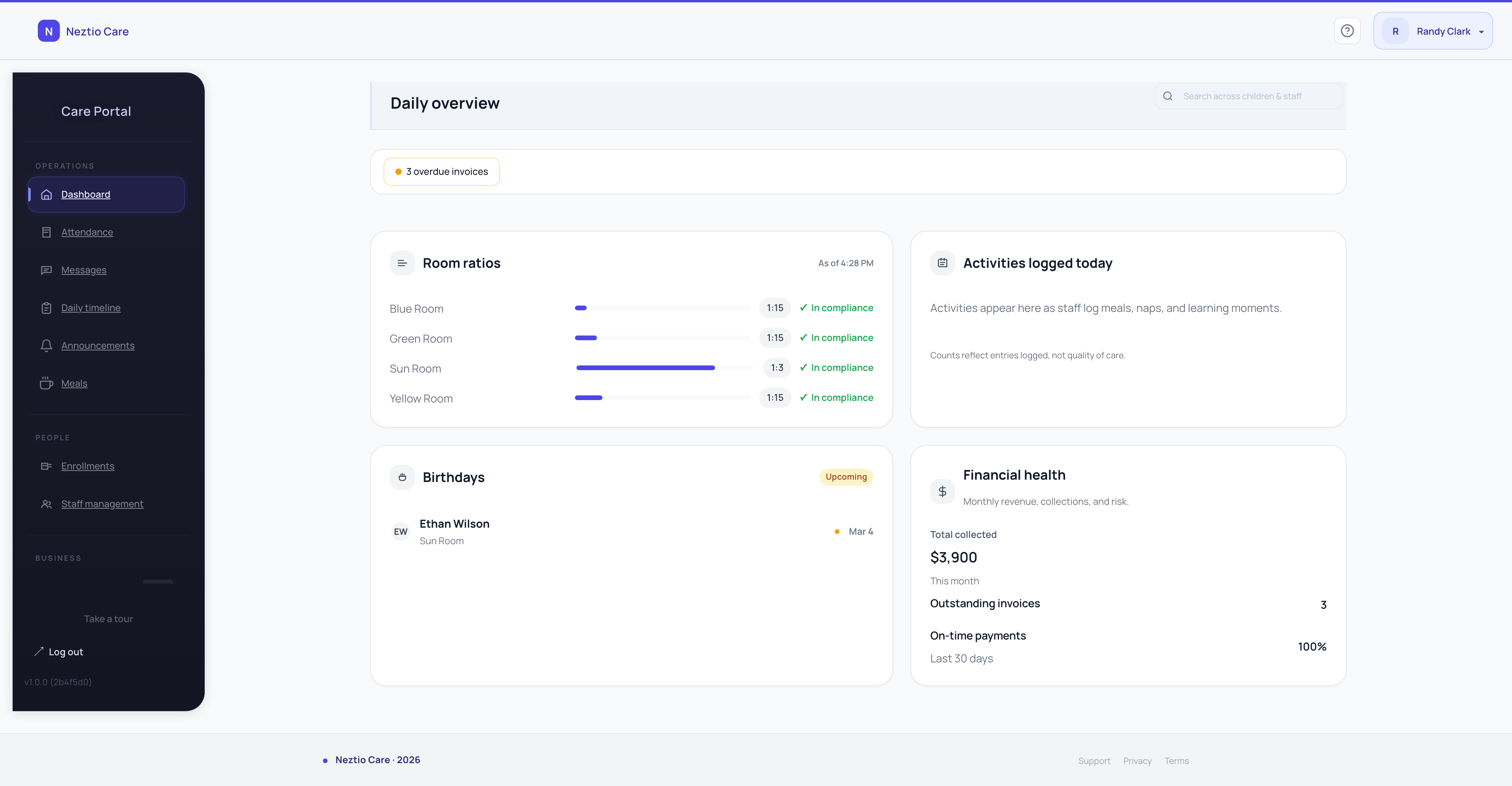
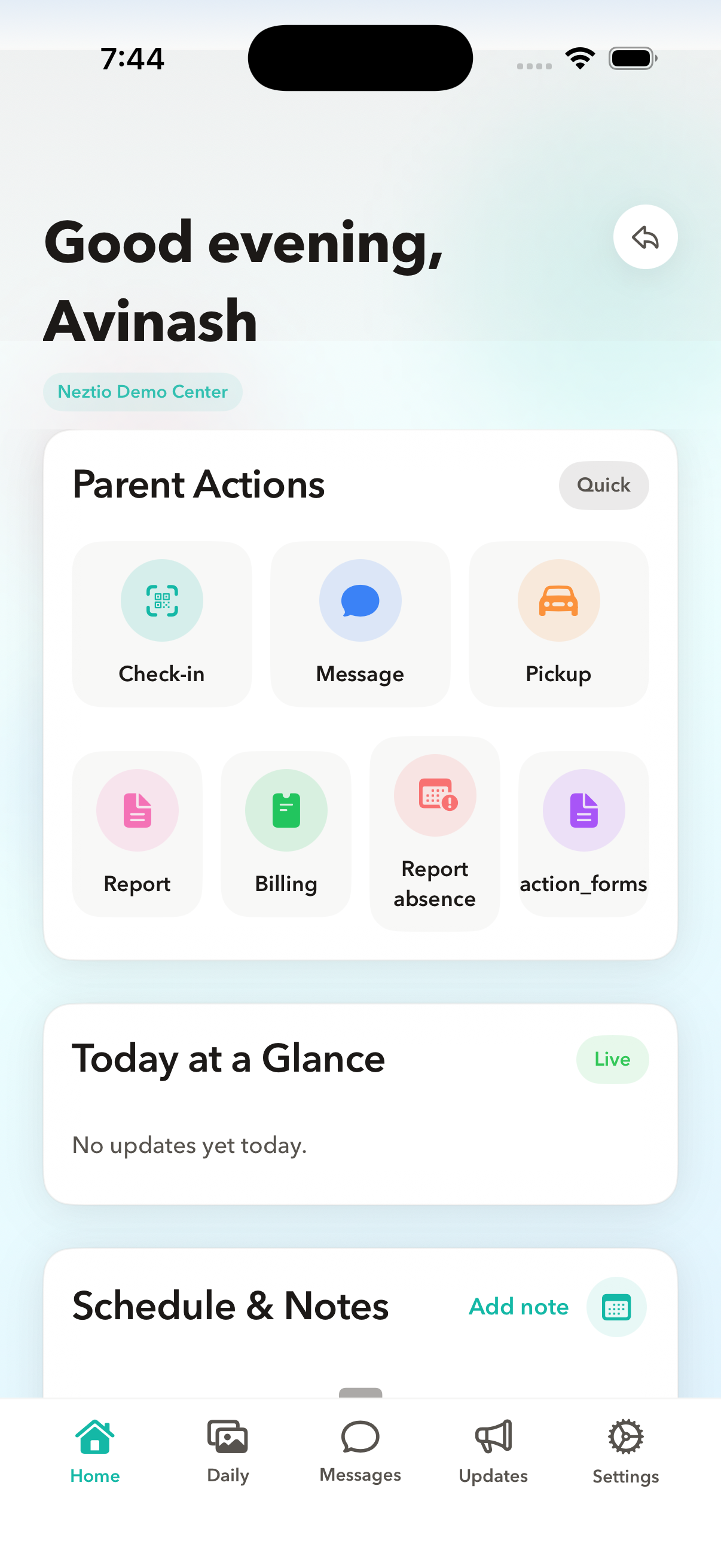
Use the right tools: Childcare management software like Neztio gives parents a dedicated mobile app (available on iOS and Android) where they can view daily activity reports, receive messages from teachers, see attendance check-ins, track meals, and read center announcements, all in real time. These tools replace scattered texts and paper notes with a single, professional communication channel that keeps families engaged and informed.
The bottom line: Marketing brings families in the door. The quality of your care, communication, and daily operations is what keeps them. Invest in both, and your enrollment will take care of itself over time.
Ready to grow your enrollment?
Marketing your childcare center does not require a big budget. Start with the basics: claim your Google Business Profile, make sure your website answers parents' questions, ask happy families for reviews, and follow up promptly with every tour. Consistency matters more than perfection.
When you are ready to streamline your operations, see how Neztio helps childcare centers manage enrollment, billing, attendance, parent communication, meal tracking, and more so you can spend less time on paperwork and more time building the program families love.
Related
How to Start a Daycare: A Step-by-Step Guide for 2026
Related
The Childcare Enrollment Process: From Inquiry to First Day
Glossary terms in this article
Enrollment
The process of registering children into a childcare program, including collecting required forms and documentation.
Waitlist
A list of families waiting for an available spot in a childcare program when it is at full capacity.
Tuition
The fee charged to families for childcare services, typically billed weekly, biweekly, or monthly.
Parent Communication
The methods and tools childcare providers use to share updates, daily reports, and messages with families.