Tax Considerations for Childcare Business Owners
Running a childcare business comes with unique tax considerations, from deductible expenses and payroll obligations to home-based provider deductions and record-keeping requirements. This article covers the key areas childcare business owners should be aware of when thinking about taxes.
Quick Answer
Los negocios de cuidado infantil pueden deducir costos de instalaciones, suministros, alimentos, seguros, salarios del personal, capacitación, tarifas de licencia y suscripciones de software. Los proveedores en el hogar pueden deducir una porción de los gastos del hogar usando el método de porcentaje tiempo-espacio del IRS. Mantenga cuentas bancarias comerciales separadas, guarde todos los recibos y trabaje con un contador que entienda el cuidado infantil.
Disclaimer: This is not tax advice
This article provides general information about common tax considerations for childcare businesses. It is not tax advice. Tax laws vary by state and change frequently. Consult a qualified CPA or tax professional for guidance specific to your situation before making any tax-related decisions.
Business Structure Matters
The legal structure of your childcare business affects how you file taxes, what tax rates apply, and your personal liability. Most small childcare operations start as one of four structures, each with different tax implications.
Sole proprietorship
The simplest structure. Business income and expenses are reported on Schedule C of your personal tax return. You pay self-employment tax (Social Security and Medicare) on net profit. There is no separation between you and the business for liability purposes. Many home-based family childcare providers operate as sole proprietors.
Limited Liability Company (LLC)
Provides personal liability protection while offering flexibility in how you are taxed. A single-member LLC is taxed like a sole proprietorship by default, while a multi-member LLC is taxed like a partnership. LLCs can also elect to be taxed as an S-corp. Many center-based childcare businesses choose the LLC structure for the liability protection it offers.
S-corporation
An S-corp election allows the business owner to pay themselves a reasonable salary (subject to payroll taxes) and take remaining profits as distributions (which are not subject to self-employment tax). This can reduce total tax liability for profitable businesses, but it adds complexity and requires proper payroll setup. Not every childcare business benefits from this structure.
C-corporation
Less common for small childcare businesses. C-corps are taxed at the corporate level, and distributions to owners are taxed again as dividends (sometimes called double taxation). This structure is typically more relevant for larger childcare organizations with multiple locations or outside investors.
Choose your structure carefully
The right business structure depends on your revenue, number of owners, growth plans, and personal financial situation. This is one of the most impactful decisions you will make for your business. Consult an accountant before choosing or changing your business structure, as each option has different implications for taxes, liability, and administrative burden.
Common Deductible Business Expenses
Childcare businesses can generally deduct ordinary and necessary expenses incurred in operating the business. These deductions reduce your taxable income, which lowers your tax bill. Common deductible expenses for childcare providers include:
Rent or mortgage interest for your facility
If you rent space for your childcare center, rent payments are fully deductible. If you own the building, you can deduct mortgage interest and property taxes. For home-based providers, a portion of these costs may be deductible (see the home-based deductions section below).
Utilities
Electricity, water, gas, internet, and phone expenses related to running the business. For center-based operations, these are typically fully deductible. For home-based providers, only the business-use portion is deductible.
Supplies and materials
Art supplies, classroom materials, books, toys, educational materials, cleaning products, diapers, and other consumables used in daily operations.
Food costs
If you provide meals and snacks to children in your care, food is a deductible business expense. Note that if you participate in the Child and Adult Care Food Program (CACFP), the reimbursements you receive offset your food costs and must be reported as income. The net food expense (cost minus reimbursement) is what you deduct.
Insurance premiums
General liability insurance, professional liability insurance, property insurance, and any other business-related coverage. These premiums are deductible as business expenses.
Staff wages and benefits
Salaries and wages paid to employees, along with the employer portion of payroll taxes and any benefits you provide (health insurance contributions, retirement plan matching, paid time off). Labor is typically the largest expense for childcare businesses.
Professional development and training
Costs for staff training, CPR/first aid certification, continuing education courses, and conference attendance. Many states require ongoing training hours for childcare staff, making these expenses both necessary and deductible.
Licensing fees
State licensing fees, background check costs for staff, and any other regulatory fees required to operate your childcare business.
Advertising and marketing
Website costs, online advertising, printed materials, signage, and any other marketing expenses used to attract families to your program.
Software subscriptions
Childcare management software, accounting software, payroll services, and other technology tools used in your business operations are deductible as business expenses.
Keep documentation for every deduction
The IRS requires that deductions be supported by records. Save receipts, invoices, and bank statements for all business expenses. If you are ever audited, having organized documentation is essential for substantiating your deductions.
Payroll Taxes
If you have employees (and most childcare centers do), you have payroll tax obligations as an employer. Understanding these from day one is important, since payroll tax mistakes can result in penalties and interest.
FICA (Social Security and Medicare)
Both the employer and the employee each pay 7.65% of gross wages (6.2% for Social Security up to the annual wage base, plus 1.45% for Medicare). As the employer, you are responsible for withholding the employee's share from their paycheck and remitting both shares to the IRS. This is a significant cost, so factor it into your labor budget.
Federal Unemployment Tax (FUTA)
Employers pay FUTA tax at a rate of 6.0% on the first $7,000 of each employee's annual wages. Most employers receive a credit of up to 5.4% for paying state unemployment taxes, reducing the effective FUTA rate to 0.6%. This tax is paid entirely by the employer.
State Unemployment Tax (SUTA)
Each state sets its own unemployment tax rates and wage bases. New employers are typically assigned a standard rate until they build a claims history. Your rate may go up or down over time depending on whether former employees file unemployment claims.
Workers' compensation
Most states require employers to carry workers' compensation insurance, which covers medical costs and lost wages for employees injured on the job. This is not technically a tax, but it is a mandatory payroll-related cost that childcare employers must budget for.
Set up payroll properly from the start
Many childcare businesses use a payroll service or software to handle tax withholding, filing, and deposits. Getting payroll wrong, whether by misclassifying workers as independent contractors, failing to withhold properly, or missing deposit deadlines, can result in IRS penalties. If you are unsure about your payroll setup, consult a tax professional or payroll provider before you hire your first employee.
Home-Based Childcare Deductions
Family childcare providers who operate out of their homes have access to specific deductions that center-based providers do not. Because your home serves dual purposes (personal residence and business), the IRS allows you to deduct the business-use portion of your home expenses.
The time-space percentage method
This is the most common method for calculating home-based childcare deductions. You calculate two percentages: the time percentage (hours your home is used for childcare divided by total hours in the year) and the space percentage (square footage used for childcare divided by total home square footage). These are multiplied together to determine the deductible portion of your home expenses. For example, if your time percentage is 40% and your space percentage is 80%, your time-space percentage is 32%, meaning you can deduct 32% of shared home expenses as business costs.
Expenses you can deduct a portion of
Using the time-space percentage, you can deduct a portion of mortgage interest or rent, property taxes, homeowner's insurance, utilities, home repairs and maintenance, depreciation of the home, and other shared costs. Rooms used exclusively for childcare (if any) may be deducted at a higher percentage.
Keep detailed records
To use the time-space percentage, you need to track the hours your home is used for childcare, including time spent on business activities when children are not present (meal prep, cleaning, record-keeping, planning). Accurate attendance records and a log of business hours are essential for supporting your deductions.
IRS Publication 587
IRS Publication 587, "Business Use of Your Home," provides detailed guidance on calculating and claiming home-based business deductions. Tom Copeland's resources on family childcare tax preparation are also widely recommended by home-based providers. Both are worth reviewing with your tax professional.
Record-Keeping Best Practices
Good record-keeping is the foundation of sound tax preparation. It ensures you claim all the deductions you are entitled to, makes filing faster and less stressful, and protects you in the event of an audit. Here are the practices every childcare business owner should follow:
Keep receipts for all business expenses
Save receipts for every purchase related to your business, whether it is supplies from the store, a repair to your facility, or a training course registration. Digital copies (photos or scans) are accepted by the IRS and are easier to organize than paper.
Separate business and personal bank accounts
Mixing business and personal finances makes it difficult to track expenses, increases the chance of missed deductions, and looks unprofessional in an audit. Open a dedicated business bank account and run all business income and expenses through it.
Track income by source
Record where your income comes from: tuition payments from families, government subsidy payments, CACFP reimbursements, grants, and any other sources. This helps at tax time and gives you a clearer picture of your revenue mix throughout the year.
Maintain payroll records
Keep records of all wages paid, tax withholdings, payroll tax deposits, and W-2 forms issued. Federal law requires employers to keep payroll records for at least three years, but many accountants recommend keeping them longer.
Use digital tools to stay organized
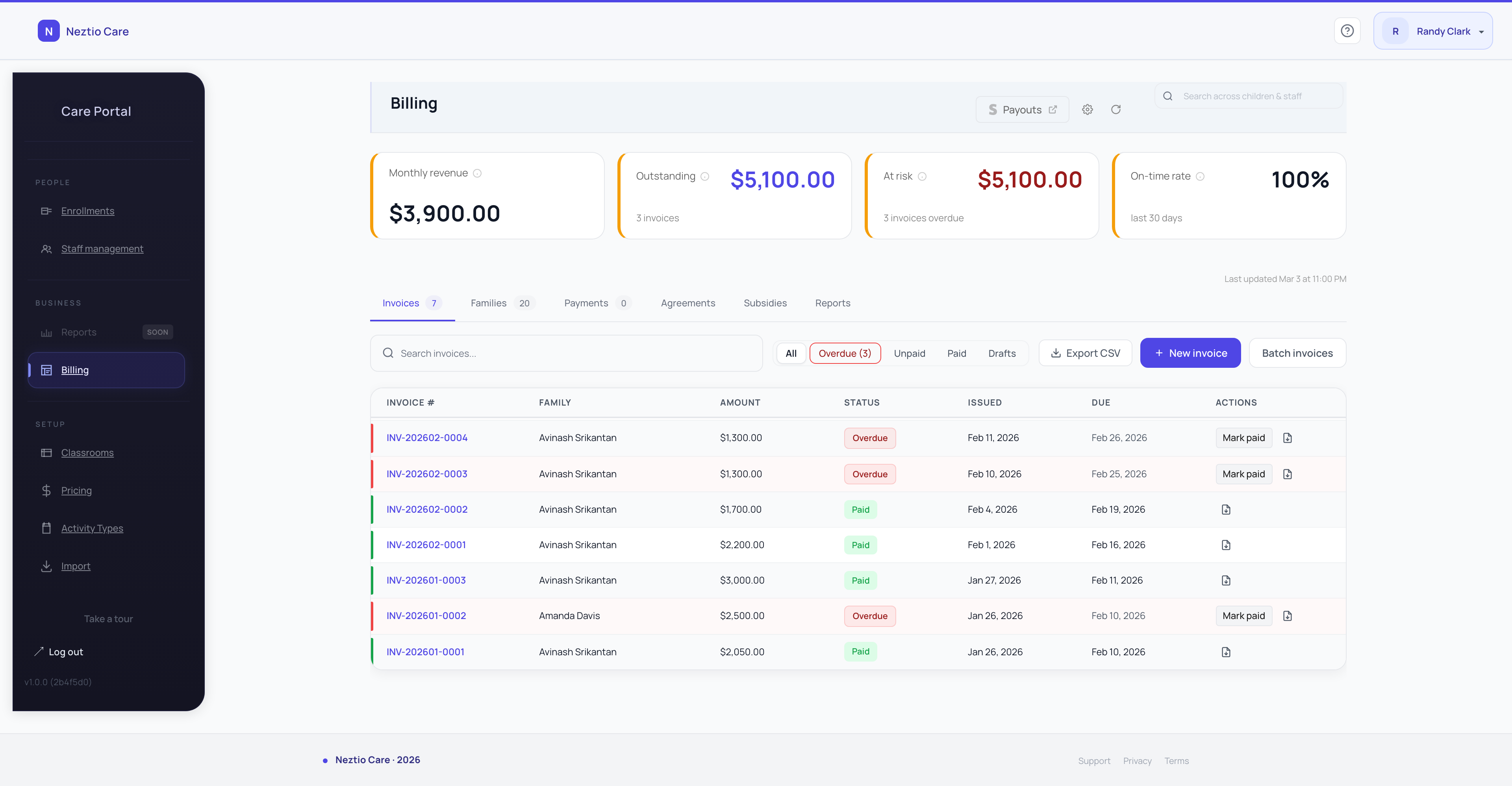
Digital record-keeping is easier to organize, search, and back up than paper files. Accounting software can categorize expenses automatically, and childcare management software can help track tuition income. Neztio's billing features, for example, help you track tuition payments, generate invoices, and maintain a clear record of all payment activity, making year-end tax preparation more straightforward.
Tax Credits and Grants
Beyond deductions, there are tax credits and funding programs that may benefit your childcare business. Unlike deductions (which reduce taxable income), tax credits directly reduce the amount of tax you owe, dollar for dollar.
State tax credits for childcare providers
Some states offer tax credits specifically for childcare businesses. These vary widely by state and may be based on factors like the number of children served, quality rating participation, or serving low-income families. Check with your state's department of revenue or your tax professional to see what is available in your state.
CACFP reimbursements
The Child and Adult Care Food Program provides federal reimbursement for meals and snacks served to children in eligible childcare programs. CACFP reimbursements are generally not taxable income for family childcare providers (they are considered reimbursement for expenses, not income), though the rules are nuanced. Consult your tax professional on how CACFP reimbursements apply to your specific situation.
Grants and stabilization funding
Federal, state, and local governments periodically offer grants to childcare providers. Contact your local Child Care Resource and Referral (CCR&R) agency to learn about available grants in your area. Note that grant income may be taxable depending on the specific program and how the funds are used, so keep records and discuss with your accountant.
Employer-provided childcare credit (Section 45F)
While this credit is primarily for employers who provide childcare for their employees (not childcare businesses themselves), it is worth knowing about if your business partners with employers to provide contracted childcare. Your tax professional can advise whether this applies to any of your arrangements.
Working with a Tax Professional
While some childcare business owners handle their own taxes, working with a qualified tax professional, particularly a CPA or enrolled agent who understands childcare businesses, is often worth the investment.
Find someone who understands childcare
Childcare businesses have unique tax situations, including the time-space percentage for home-based providers, CACFP reimbursement treatment, and industry-specific deductions. A tax professional familiar with childcare will catch deductions that a generalist might miss and help you avoid common errors.
Quarterly estimated taxes
If you are a sole proprietor, LLC member, or S-corp owner, you may be required to pay estimated taxes quarterly (April, June, September, and January of the following year). Failing to make quarterly payments can result in underpayment penalties at year end. A tax professional can help you calculate the right quarterly amount based on your projected income.
Year-end tax planning
Meeting with your accountant before year end (October or November) gives you time to make strategic decisions, such as purchasing needed equipment or supplies before December 31 to increase deductions for the current year, or adjusting your estimated tax payments.
The cost is usually worth it
A good tax professional will often save you more in correctly claimed deductions and avoided penalties than their fee. Ask other childcare providers in your area for referrals, or contact your local CCR&R for recommendations. The National Association for Family Child Care (NAFCC) is another resource for finding tax professionals who specialize in childcare.
The Bottom Line
Tax obligations are a reality of running a childcare business, but with the right structure, good records, and a knowledgeable tax professional, they do not have to be overwhelming. Understand your deductible expenses, stay on top of payroll obligations, take advantage of available credits and programs, and keep organized records throughout the year so tax season is not a scramble.
Good financial tools make record-keeping easier. Learn more about Neztio's billing features and see how tracking tuition payments and generating invoices digitally can simplify your financial record-keeping.
Remember: this article is for informational purposes only and does not constitute tax advice. Always consult a qualified CPA or tax professional for your specific situation.
Related
How to Set Childcare Tuition Rates: A Pricing Guide
Related
How to Start a Daycare: A Step-by-Step Guide
Glossary terms in this article
Tuition
The recurring fee families pay for childcare services, typically charged weekly, biweekly, or monthly.
Billing Automation
Software features that automatically generate invoices, process payments, and track tuition for childcare programs.
Licensing
The state regulatory process that childcare providers must complete to legally operate, including facility standards, staff qualifications, and ratio requirements.
Enrollment
The process of registering a child in a childcare program, including collecting required documents and family information.