How to Do Payroll for a Home Daycare: A Complete Guide
Running a home daycare means wearing every hat, and payroll is one of the trickiest. This guide covers worker classification, tax obligations, paying yourself as the owner, and choosing the right payroll tools to stay compliant.
Why Payroll Matters for Home Daycares
If you operate a home daycare and have hired even one helper, assistant, or substitute, you likely have payroll responsibilities. The IRS and your state labor agency expect you to correctly classify workers, withhold and remit taxes, and file the right forms on time. Getting it wrong can lead to penalties, back taxes, and legal exposure.
Even if you work solo, you still need to understand how to pay yourself. Home daycare owners who operate as sole proprietors, LLCs, or S-Corps each have different tax obligations. And if you plan to grow your program, you will eventually need to hire staff, which means payroll becomes unavoidable.
The good news is that payroll for a small home daycare does not have to be overwhelming. With the right setup and tools, you can handle it confidently. For a broader look at payroll across childcare operations, see our childcare payroll processing guide.
Employee vs. Independent Contractor: The Critical Distinction
The first question to answer is whether your workers are employees or independent contractors. This classification determines everything about your payroll obligations, from tax withholding to filing requirements.
| Factor | Employee (W-2) | Independent Contractor (1099) |
|---|---|---|
| Schedule | You set their hours | They set their own hours |
| Training | You provide training | They use their own methods |
| Tools/Supplies | You provide them | They provide their own |
| Work location | At your home daycare | Their choice of location |
| Tax withholding | You withhold taxes | They pay their own taxes |
Important
In most home daycare situations, your assistant or helper is an employee, not a contractor. If they work on your schedule, at your location, following your curriculum and routines, they are almost certainly an employee in the eyes of the IRS. Misclassifying an employee as an independent contractor can result in penalties, back taxes, and interest.
W-2 Payroll: What You Need to Do
If your worker is an employee (and they probably are), here is what payroll involves:
- 1
Get an Employer Identification Number (EIN)
Apply for free on the IRS website. You need an EIN to file employment taxes. Even if you previously used your Social Security number for tax filings, you need a separate EIN as an employer.
- 2
Have employees fill out Form W-4
The W-4 tells you how much federal income tax to withhold from each paycheck. Each employee completes one when they start, and they can update it at any time.
- 3
Withhold and deposit payroll taxes
You must withhold federal income tax, Social Security (6.2%), and Medicare (1.45%) from each paycheck. As the employer, you also pay a matching 6.2% for Social Security and 1.45% for Medicare. Deposit these taxes with the IRS either monthly or semi-weekly, depending on your total tax liability.
- 4
Pay state taxes and unemployment insurance
Most states require you to withhold state income tax. You also need to register for and pay into your state's unemployment insurance (SUTA) fund. Federal unemployment tax (FUTA) is 6% on the first $7,000 of each employee's wages, though credits for state payments typically reduce this to 0.6%.
- 5
File quarterly and annual forms
File Form 941 (Employer's Quarterly Federal Tax Return) each quarter. At year end, file Form 940 (FUTA) and provide each employee with a W-2 by January 31.
1099 Contractors: When and How
In some cases, you might legitimately hire independent contractors for your home daycare. Examples include a music teacher who visits weekly using their own lesson plans, an accountant who does your books, or a cleaning service. For these workers, you do not withhold taxes.
Instead, you pay them their full agreed rate and issue a 1099-NEC form at the end of the year if you paid them $600 or more. Have each contractor fill out a W-9 form before you pay them so you have their name, address, and taxpayer identification number on file.
Remember: a regular assistant who works your schedule, at your home, under your direction is an employee, not a contractor, regardless of any informal agreement you have. The IRS looks at the nature of the working relationship, not what the parties call it.
Paying Yourself as the Owner
How you pay yourself depends on your business structure:
Sole proprietor or single-member LLC
You do not receive a paycheck or a W-2. Instead, all daycare income flows to your personal tax return on Schedule C. You pay self-employment tax (15.3%) on your net profit. Set aside approximately 25-30% of your net income for quarterly estimated tax payments to the IRS.
S-Corporation
You must pay yourself a "reasonable salary" via W-2 payroll, with all the tax withholding that entails. Any remaining profit can be distributed as a shareholder distribution, which is not subject to self-employment tax. This can save money on taxes but adds complexity.
Partnership or multi-member LLC
Each partner receives a share of the profits, reported on Schedule K-1. Partners pay self-employment tax on their share. If you co-own a home daycare with a spouse or business partner, this structure may apply.
For a deeper dive into tax deductions specific to childcare businesses (including the home office deduction, which is significant for home daycares), see our guide on childcare business taxes.
Quarterly Tax Deadlines
Whether you have employees or are paying yourself as a sole proprietor, quarterly deadlines are critical. Missing them results in penalties and interest.
| Quarter | Period Covered | Estimated Tax Due | Form 941 Due |
|---|---|---|---|
| Q1 | Jan 1 - Mar 31 | April 15 | April 30 |
| Q2 | Apr 1 - Jun 30 | June 15 | July 31 |
| Q3 | Jul 1 - Sep 30 | September 15 | October 31 |
| Q4 | Oct 1 - Dec 31 | January 15 | January 31 |
Choosing a Payroll Service
Running payroll manually is possible but error-prone and time-consuming. For most home daycare operators, using a payroll service is worth the investment. Here are the most popular options for small businesses:
Gusto
Full-service payroll that handles tax calculations, filings, and payments. Includes W-2 and 1099 generation. Plans start around $40/month plus $6 per employee. Known for a user-friendly interface that works well for small operations.
QuickBooks Payroll
Integrates directly with QuickBooks accounting, which many home daycare owners already use. Handles federal and state tax filings. Plans start around $50/month plus $6 per employee. A strong choice if you already use QuickBooks for bookkeeping.
Wave Payroll
A more affordable option with tax-service payroll starting around $20/month plus $6 per employee. Wave also offers free accounting software, making it a budget-friendly option for new home daycares.
Square Payroll
At $35/month plus $6 per employee, Square Payroll is straightforward and handles all tax calculations and filings. Good for home daycares that already accept payments through Square.
What to look for
At minimum, your payroll service should: calculate and withhold federal and state taxes, file quarterly and annual tax forms on your behalf, generate W-2s and 1099s, handle direct deposits, and track PTO if you offer it.
How Time Tracking Feeds Payroll
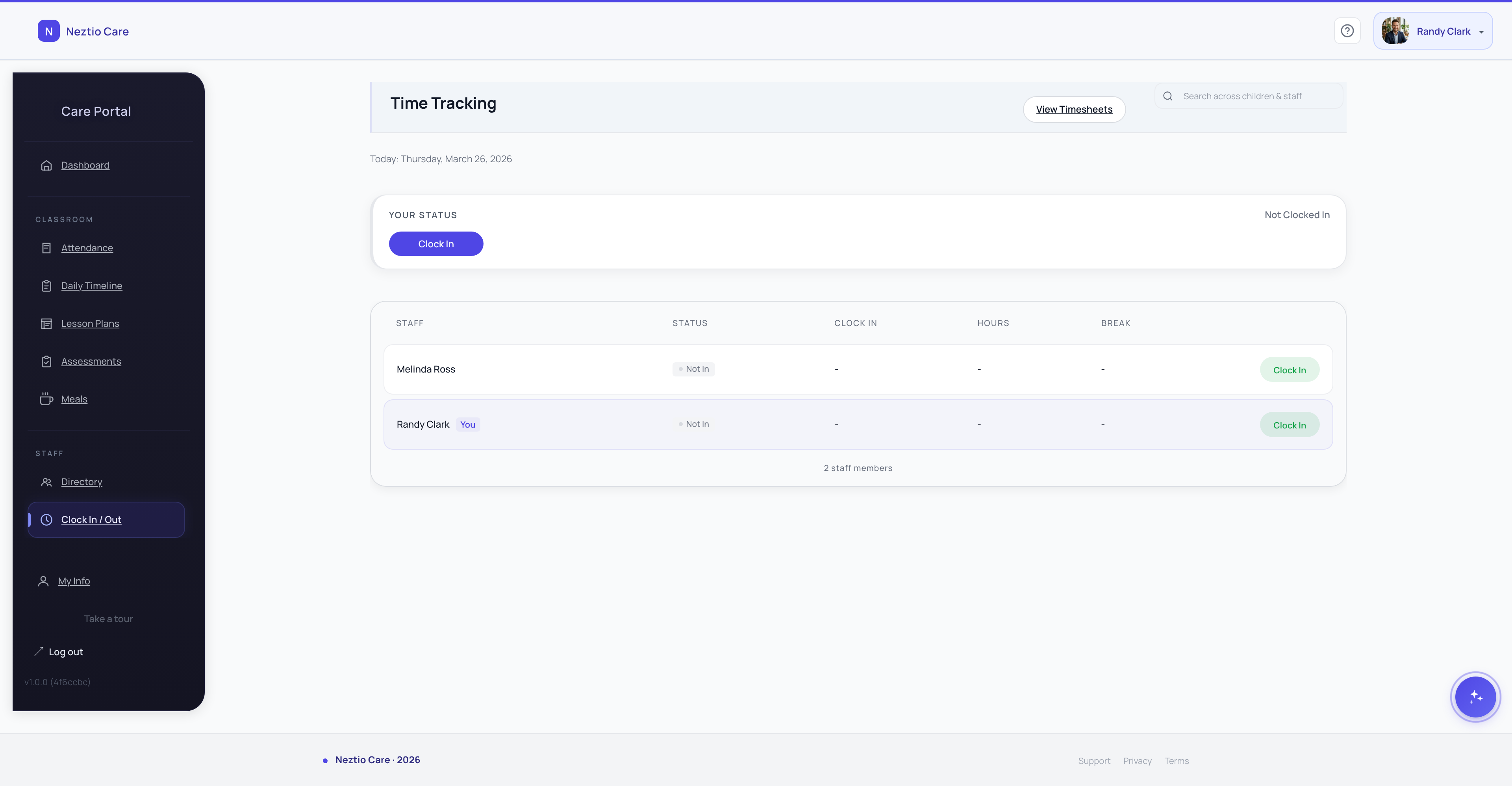
Accurate payroll starts with accurate time records. If you are paying an employee hourly (which is common for daycare assistants), you need reliable clock-in and clock-out data for every shift. Paper timesheets are error-prone and easy to lose. A digital time tracking system ensures that hours are recorded accurately and can be exported directly to your payroll service.
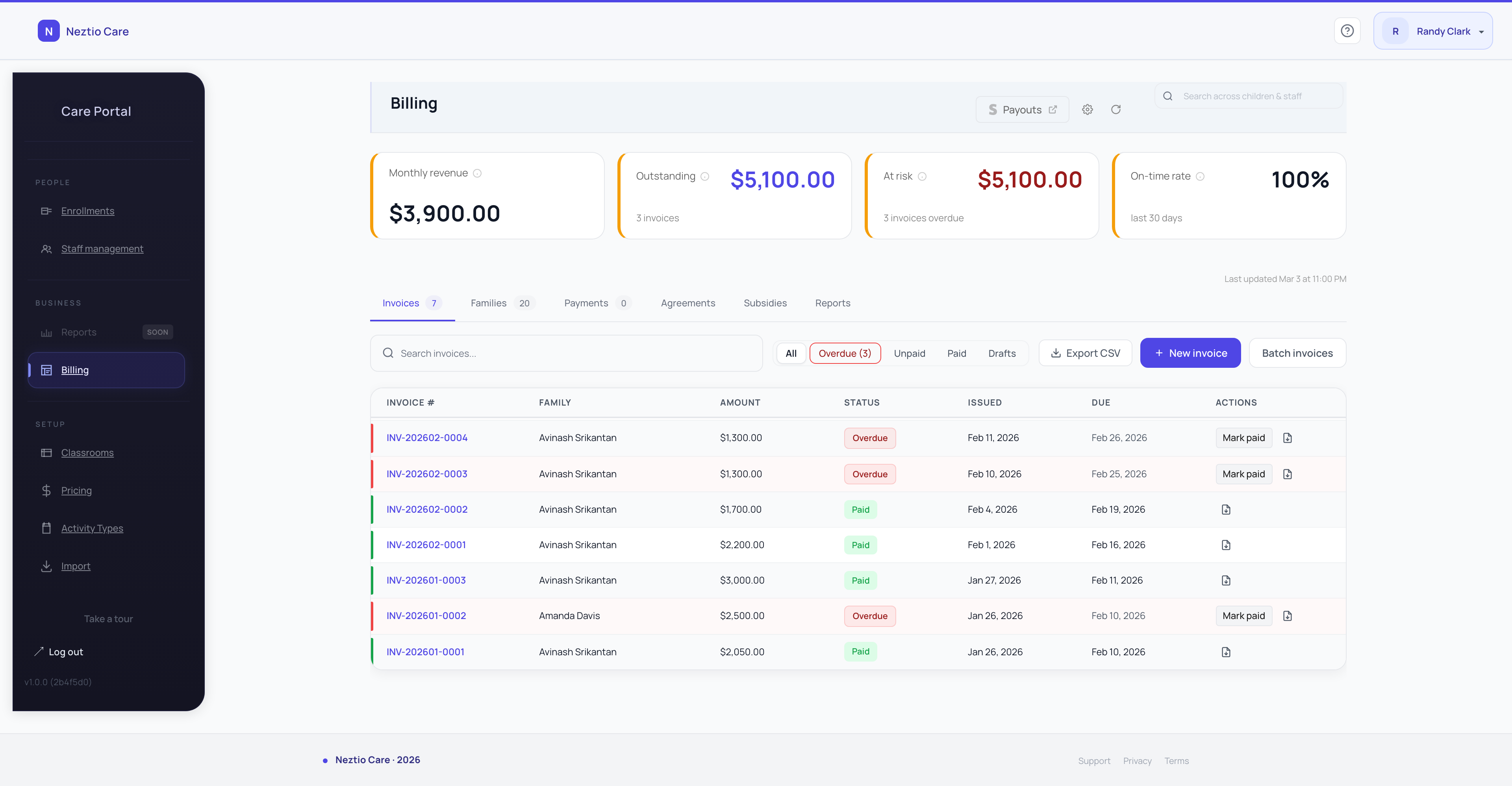
Neztio's time tracking feature lets staff clock in and clock out digitally, with records stored automatically. You can review hours for any pay period and export the data as a CSV file to import into your payroll service. This eliminates the back-and-forth of manually calculating hours from paper logs and reduces the chance of payroll errors.
For a deeper look at tracking staff hours in childcare settings, see our childcare time tracking guide.
Common Payroll Mistakes to Avoid
Home daycare owners, especially those new to having employees, frequently make these mistakes:
Paying "under the table"
It might seem simpler to pay cash with no paperwork, but it is illegal. You and your worker both face penalties, and you lose the ability to deduct those wages as a business expense.
Misclassifying employees as contractors
As discussed above, most daycare helpers are employees. Misclassification can lead to back taxes, penalties, and interest going back multiple years.
Missing quarterly estimated tax payments
If you are a sole proprietor, you need to pay estimated taxes four times a year, not just at tax time. The IRS charges underpayment penalties if you owe more than $1,000 when you file your return.
Forgetting state requirements
Each state has its own payroll tax requirements, including state income tax withholding, state unemployment insurance, and sometimes additional taxes (like disability insurance in some states). Register with your state tax agency as soon as you hire.
Not keeping records
Keep payroll records for at least four years. This includes timesheets, pay stubs, tax filings, W-4s, and I-9 forms. If the IRS or your state audits you, you need these documents.
The Bottom Line
Payroll for a home daycare is not as daunting as it seems once you understand the basics: classify your workers correctly, withhold and deposit taxes on time, file the required forms, and use a payroll service to handle the calculations. The investment in doing payroll right protects your business, your employees, and your peace of mind.
Need help tracking staff hours and streamlining your childcare operations? See how Neztio helps childcare providers manage time tracking, billing, and more so you can spend less time on paperwork and more time with the children.
Related
Childcare Payroll Processing: A Complete Guide
Related
Childcare Business Taxes: What Providers Need to Know
Glossary terms in this article
Payroll
The process of calculating and distributing wages, withholding taxes, and filing employment tax returns for staff.
Time Tracking
Recording employee clock-in and clock-out times to calculate hours worked for payroll and compliance.
W-2
An IRS form employers issue annually to report each employee's wages and tax withholding.
Independent Contractor
A self-employed worker who provides services under their own terms, paid via 1099 rather than W-2.