Nevada Childcare Licensing Requirements: A Complete Guide
Whether you are opening a childcare center in Las Vegas, Reno, or anywhere in the Silver State, Nevada has specific licensing requirements you must meet before caring for children. This guide covers the regulatory framework, application process, staff-to-child ratios, background checks, facility standards, and the state's quality rating system.
Note: Licensing requirements change frequently. This guide reflects regulations as of early 2026. Always verify current requirements directly with your state licensing agency before making compliance decisions.
Overview: who regulates childcare in Nevada?
In Nevada, childcare licensing falls under the Department of Health and Human Services (DHHS). The Child Care Licensing (CCL) program is responsible for setting minimum standards, processing applications, conducting inspections, and enforcing compliance for all regulated childcare operations in the state. The governing statutes and regulations are found in Nevada Revised Statutes (NRS) Chapter 432A and Nevada Administrative Code (NAC) Chapter 432A.
Nevada requires a license for any person or entity that provides care for more than four children who are not related to the caregiver and/or for whom the caregiver receives payment. The type of license you need depends on the size and setting of your operation:
Child Care Center: A facility that regularly provides day or night care for more than 12 children. This is the most common license type for commercial childcare businesses in Nevada.
Group Care Home: A home-based operation that provides regular care for 7 to 12 children. Group care homes must meet specific requirements that bridge home-based and center-based standards.
Family Care Home: A home-based operation that provides regular care for 5 to 6 children (not including the caregiver's own children). Family care homes have less extensive requirements than group homes or centers, but still require licensing, background checks, and compliance with health and safety standards.
Important
Licensing requirements and fees can change. Always verify current requirements directly with the Nevada DHHS Child Care Licensing program or visit their official website for the most up-to-date information.
How to apply for a Nevada childcare license
The Nevada childcare licensing application process involves several steps. Plan for the process to take several weeks to several months, depending on how quickly you can meet all requirements. Nevada childcare licenses must be renewed every two years.
- 1
Obtain and complete the application packet
Contact the Child Care Licensing program to obtain the application packet, which includes the application form, a personal statement, and a criminal history questionnaire. Review the packet carefully to understand all the documentation you will need to provide.
- 2
Submit your application and pay licensing fees
Submit the completed application packet to the Nevada DHHS. A licensing fee is required; the amount varies depending on the type of childcare operation and its capacity. Check the DHHS website for current fee schedules.
- 3
Complete background checks for all staff
All owners, directors, caregivers, and anyone who will have contact with children must complete fingerprint-based background checks. This includes FBI and state criminal history checks, as well as child abuse and neglect registry checks. Fingerprinting must be completed and submitted within 24 hours of the date of hire.
- 4
Pass required inspections
Your facility must pass a health inspection conducted by the local Health Authority and a fire safety inspection conducted by the State Fire Marshal's Office. Both inspections must be completed before your license can be issued.
- 5
Receive your license
Once you have met all requirements and passed your inspections, DHHS will issue your childcare license. The license must be posted in a location visible to parents at your facility. Remember that your license is valid for two years and must be renewed before it expires.
Nevada staff-to-child ratio requirements
Nevada sets specific staff-to-child ratios and maximum group sizes based on the ages of children in care. These ratios are defined in NAC 432A.5205 and apply to child care centers, nurseries, and group care facilities during standard operating hours (6:30 a.m. to 9:00 p.m.). If a facility cares for children of different age groups in the same classroom, the ratio and group size must be based on the age of the youngest child in the group.
| Age Group | Ratio | Max Group Size |
|---|---|---|
| Birth to 9 months | 1:4 | 8 |
| 9-23 months | 1:6 | 12 |
| 2 years | 1:9 | 18 |
| 3 years | 1:12 | 24 |
| 4 years | 1:13 | 26 |
| 5 years and older | 1:18 | 36 |
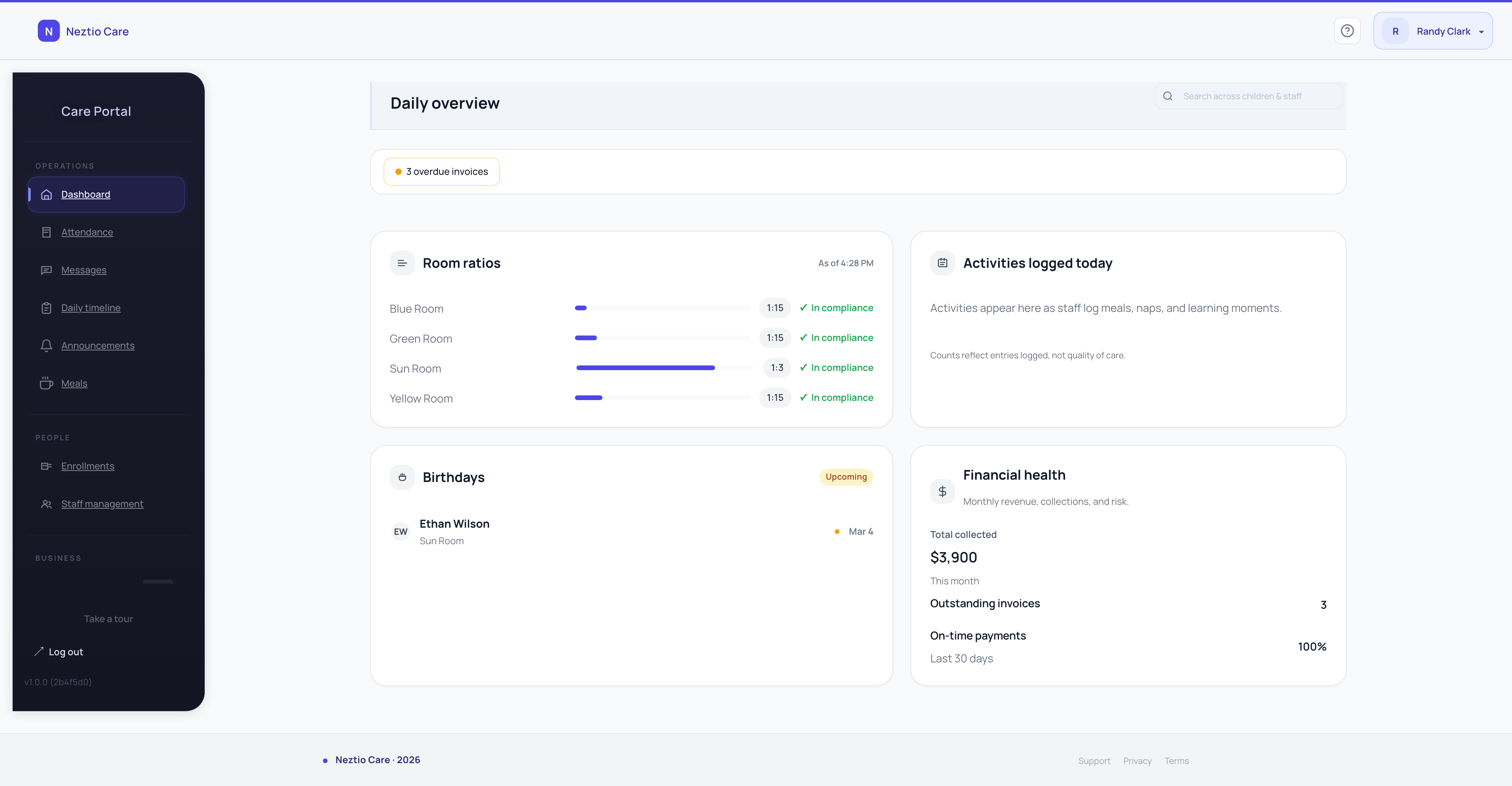
These ratios are from NAC 432A.5205. Verify current ratios with Nevada DHHS, as they may be updated periodically. For help planning your classroom staffing, try our ratio calculator.
Staff qualification and training requirements
Nevada has specific requirements for directors and caregivers working in licensed childcare facilities. Training requirements are tracked through The Nevada Registry, a statewide workforce registry for early childhood professionals.
Director qualifications: Directors of licensed child care facilities must complete initial training that includes at least three hours in child development and three hours in child care operations. Directors are responsible for screening, scheduling, and supervising all staff at the facility.
Nevada Registry membership: All caregivers must apply with The Nevada Registry within 90 days of starting employment at a licensed childcare facility and must renew their registration annually before the expiration date.
CPR and First Aid (within 90 days): All new employees must complete in-person CPR and First Aid training that addresses the ages of all children in the facility within the first 90 days of employment. This training must be Nevada Registry approved.
Signs of Illness and Bloodborne Pathogens: Within the first 90 days, new hires must also complete in-person training on recognizing signs of illness and bloodborne pathogens protocols.
Annual training hours: All facility employees are required to complete 24 hours of training annually, aligned with the facility's license expiration cycle. At least 2 of those hours must cover health, obesity, and/or wellness topics. All training must be approved through The Nevada Registry.
TB clearance: Every staff member, including volunteers and residents of home-based facilities, must provide written evidence that they are free from communicable tuberculosis.
Background check requirements
Nevada requires comprehensive background checks for all individuals who will have contact with children in a licensed childcare facility. The background check process is handled through the Nevada Automated Background System (NABS).
Who must be checked: All directors, caregivers, substitutes, volunteers, and any person regularly present at the facility during operating hours. Nevada also requires fingerprinting for employees who are minors (under 18). For home-based operations, all household members must be checked.
Fingerprinting timeline: Fingerprinting must be completed and submitted within 24 hours of the date of hire. This is one of the strictest timelines in the country, so it is important to have the process ready to go before a new employee's first day.
What is checked: Fingerprints are used to check the FBI criminal history database, the Nevada Criminal History Repository, and the Child Abuse and Neglect System (CANS).
Renewal: Background checks must be renewed every five years for all staff members.
Out-of-state residents: If an employee has not resided in Nevada for the past five years, they must complete an Out of State Verification Form within 90 days of hire.
Facility requirements
Your physical space must meet Nevada's minimum standards under NAC Chapter 432A before a license can be issued. Key requirements include:
Indoor space: A minimum of 35 square feet of indoor space per child. This measurement excludes bathrooms, hallways, kitchens, stairs, storage spaces, and multipurpose rooms or gymnasiums that are not regularly used for childcare activities.
Outdoor space: A minimum of 37.5 square feet of outdoor play space per child, based on the maximum number of children stated on the facility's license. Outdoor areas must be fenced, free of hazards, and equipped with age-appropriate play equipment.
Age-appropriate equipment: All furniture, cribs, and play equipment must be safe, in good repair, and appropriate for the ages of children enrolled. Cribs must meet current CPSC standards.
Fire safety inspection: Your facility must pass an inspection conducted by the State Fire Marshal's Office. Working smoke detectors and fire extinguishers must be installed and maintained, and fire drills must be conducted and documented regularly.
Health inspection: A health inspection by the local Health Authority is required before licensing. This covers sanitation, food preparation areas, diaper changing stations, handwashing facilities, and general cleanliness of the facility.
Health and safety requirements
Nevada's licensing standards include detailed health and safety requirements that licensed operations must follow every day.
Immunization records: Up-to-date immunization records are required for all enrolled children. Records must be on file and available for inspection at all times.
Medication administration: Medications may only be administered with written parent authorization. All medication administration must be documented, including the medication name, dosage, time given, and the staff member who administered it.
Illness exclusion: Operations must have a written illness exclusion policy. Staff trained in recognizing signs of illness must monitor children daily, and parents must be notified when their child becomes ill during the day.
Safe sleep practices: For infants, Nevada requires adherence to safe sleep guidelines. Infants must be placed on their backs to sleep in approved cribs, with no soft bedding, pillows, bumper pads, or toys in the crib.
Emergency procedures: Written emergency procedures must be posted and practiced regularly. Staff must know procedures for fire, severe weather, medical emergencies, lockdown situations, and other crises.
Handwashing: Proper handwashing procedures must be followed by both staff and children, including before and after meals, after diaper changes, after using the restroom, and after outdoor play.
Record-keeping requirements
Nevada licensing requires childcare operations to maintain detailed records that are available for review during inspections. Keeping these records organized and current is essential for staying in compliance.
Attendance records: Daily sign-in and sign-out records for every child, with the time recorded for each entry. These records must be retained for the period specified by DHHS.
Child enrollment records: Complete enrollment information for each child, including emergency contacts, authorized pickup persons, medical information, allergies, and immunization records.
Staff records: Personnel files for every employee, including background check results, training documentation, Nevada Registry membership status, certifications, TB clearance, and employment history.
Incident reports: Written documentation of any injuries, accidents, or unusual incidents that occur at the facility, including details of what happened and what actions were taken.
Fire drill logs: Documentation of every fire drill conducted, including the date, time, number of children and staff present, and evacuation time.
Medication administration logs: Records of all medications administered to children, including parent authorization forms.
Tip: Childcare management software like Neztio can help you maintain digital records for attendance, enrollment, staff documentation, and billing, making it much easier to stay organized and inspection-ready at all times.
Inspections and compliance
Once licensed, your operation will be subject to ongoing monitoring by the Nevada Child Care Licensing program.
Unannounced inspections: Child Care Licensing conducts unannounced inspections of licensed childcare operations during normal operating hours. These inspections can happen at any time and may cover any aspect of your operation.
License renewal inspections: A comprehensive inspection is conducted as part of the two-year license renewal process. All aspects of the operation are reviewed during renewal.
Corrective action: If deficiencies are found during an inspection, the operation is given a specified timeframe to correct the issues. The timeframe depends on the severity of the deficiency.
Adverse actions: Repeated or serious violations can result in adverse actions, including probation, license suspension, license revocation, or monetary penalties. The most serious violations can result in emergency suspension or closure.
Night-time staffing: For facilities operating overnight, NAC 432A.5205 requires that every member of staff on duty at night must remain awake during their duty hours.
Silver State Stars: Nevada's Quality Rating and Improvement System
Silver State Stars is Nevada's voluntary Quality Rating and Improvement System (QRIS). It is a 5-star system open to center-based childcare, school-based pre-K programs, and family childcare programs. The program is designed to help providers improve their quality of care beyond minimum licensing standards.
How it works: Participating childcare programs receive up to 18 months of free coaching support before being assessed for their star rating. Each star rating is valid for two years.
Quality standards: The QRIS evaluates programs across several areas, including program policies and procedures, administration and staff development, health and safety, learning environments, family and community partnerships, and positive child interactions.
No cost to participate: There is no cost to participate in Silver State Stars. All associated activities and resources, including initial training, ongoing training, and technical assistance, are provided free of charge to licensed programs.
Benefits for providers: Achieving a higher star rating can help your program stand out to families, demonstrate quality to parents, and potentially increase subsidy reimbursement rates.
Resources
Here are key resources for Nevada childcare providers:
Nevada DHHS Child Care Licensing: The official state agency website for childcare licensing, including application forms, regulations, and contact information for licensing staff.
The Nevada Registry: The statewide workforce registry for early childhood professionals. All childcare employees must register, and the Registry tracks training hours and professional development.
Silver State Stars QRIS: Nevada's voluntary quality rating program. Participating programs receive free coaching, training, and technical assistance to improve their quality of care.
Nevada Child Care Resource & Referral: A network that provides training, technical assistance, and support to childcare providers across the state. They can help with licensing questions and professional development.
Stay compliant with the right tools
Meeting Nevada licensing requirements is just the beginning. Staying in compliance day after day requires organized records, consistent documentation, and clear communication with families and staff. The best way to prepare for an unannounced inspection is to operate every day as if one could happen.
See how Neztio helps Nevada childcare centers manage attendance, billing, staff management, and parent communication so you are always inspection-ready.
Related
Childcare Licensing Checklist: What Every New Center Needs
Related
Starting a Daycare: A Step-by-Step Guide
Glossary terms in this article
Licensing
State-issued permission to operate a childcare facility, requiring compliance with health, safety, and staffing standards.
Staff-to-Child Ratio
The required number of qualified staff per group of children, set by state licensing regulations based on age.
Background Check
Criminal history and registry screenings required for all childcare workers under the CCDBG Act of 2014.
Group Size
The maximum number of children allowed in a single classroom or care group, determined by state licensing rules.
Accreditation
Voluntary quality certification from organizations like NAEYC or NAC that recognizes programs exceeding minimum licensing standards.