Tennessee Childcare Licensing Requirements: A Complete Guide
Tennessee licenses thousands of childcare providers through its Department of Human Services. Whether you are opening a new child care center, starting a home-based program, or preparing for your annual evaluation, this guide covers the key requirements you need to understand to get and keep your Tennessee childcare license.
Note: Licensing requirements change frequently. This guide reflects regulations as of early 2026 based on Tennessee DHS rules (Chapter 1240-04-01). Always verify current requirements directly with the Tennessee Department of Human Services before making compliance decisions.
Overview: who regulates childcare in Tennessee?
In Tennessee, childcare licensing is administered by the Tennessee Department of Human Services (DHS). DHS is responsible for setting licensing standards, processing applications, conducting evaluations, and enforcing compliance for all regulated childcare operations in the state. The licensing rules are codified in Chapter 1240-04-01 of the Tennessee Administrative Code.
Tennessee requires licensing for any child care agency that provides care for five or more unrelated children for three or more hours per day. DHS recognizes four main categories of licensed childcare:
Family Child Care Home: A home-based operation that provides care for at least 5 but no more than 7 children under 17 years of age who are not related to the operator. This is the smallest regulated category.
Group Child Care Home: A home-based operation that provides care for at least 8 but no more than 12 children. Up to 3 additional school-age children may receive care before and after school, on school holidays, snow days, and during summer vacation.
Child Care Center: A facility that provides care for 13 or more children. Every child care center must have an on-site director. This is the most common license type for commercial childcare operations.
Drop-In Child Care Center: A facility providing care for 15 or more unrelated children at the same time for short periods, not to exceed 14 hours per week per child. These have their own set of specific requirements.
Important
Enrollment of children under six (6) weeks of age is prohibited in all licensed Tennessee child care agencies. For questions about licensing, you can contact the Tennessee Child Care Complaint Hotline at 1-800-462-8261.
How to apply for a Tennessee childcare license
The Tennessee childcare licensing application process involves several steps. Plan for the process to take several weeks to several months, depending on how quickly you can meet all requirements.
- 1
Contact your local DHS licensing office
Start by contacting the Tennessee Department of Human Services regional office in your area. A licensing consultant will guide you through the requirements specific to the type of child care agency you plan to operate.
- 2
Complete the DHS-sponsored orientation
Tennessee requires applicants to attend a DHS-sponsored child care informational intake meeting and orientation session before a license can be issued. This ensures you understand the licensing standards and the responsibilities of operating a child care agency.
- 3
Submit your application and required documentation
Submit a completed application along with required documentation, which includes your staffing plan, floor plan, proof of liability insurance, and organizational details. You will also need to provide documentation of the facility meeting fire, safety, and health codes.
- 4
Complete background checks for all staff
All owners, directors, caregivers, and anyone with access to children must complete fingerprint-based TBI and FBI criminal background checks before the license can be issued. See the background check section below for full details.
- 5
Pass the initial licensing evaluation
A DHS licensing consultant will conduct an on-site evaluation of your facility to verify it meets all licensing standards for space, safety, equipment, staffing, and documentation. Any deficiencies must be corrected before your license is granted.
- 6
Receive your license and Report Card
Once you have met all requirements and passed your evaluation, DHS will issue your childcare license along with a Report Card rating. Both must be posted in a location visible to parents at your facility.
Tennessee staff-to-child ratio requirements
Tennessee sets specific staff-to-child ratios and maximum group sizes based on the ages of children in care. These ratios are defined in Chapter 1240-04-01-.22 of the Tennessee Administrative Code and must be maintained at all times, including during meals, naps, outdoor play, and transitions.
| Age Group | Ratio | Max Group Size |
|---|---|---|
| Infants (6 wks - 15 mos) | 1:4 | 8 |
| Infants/Toddlers (6 wks - 30 mos) | 1:5 | 10 |
| Toddlers (12 - 30 mos) | 1:6 | 12 |
| 2 years (24 - 35 mos) | 1:7 | 14 |
| 2-4 years (mixed age) | 1:8 | 16 |
| 3 years | 1:9 | 18 |
| 4 years | 1:13 | 20 |
| 5 years | 1:16 | 20 |
| School-age (K and above) | 1:20 | No max |
Infants must have a separate space and may never be grouped with children older than 30 months of age. Ratios may be relaxed during naptime, but at least one adult must remain awake and supervising in each nap or sleeping area. Infant and toddler ratios must still be maintained during nap periods.
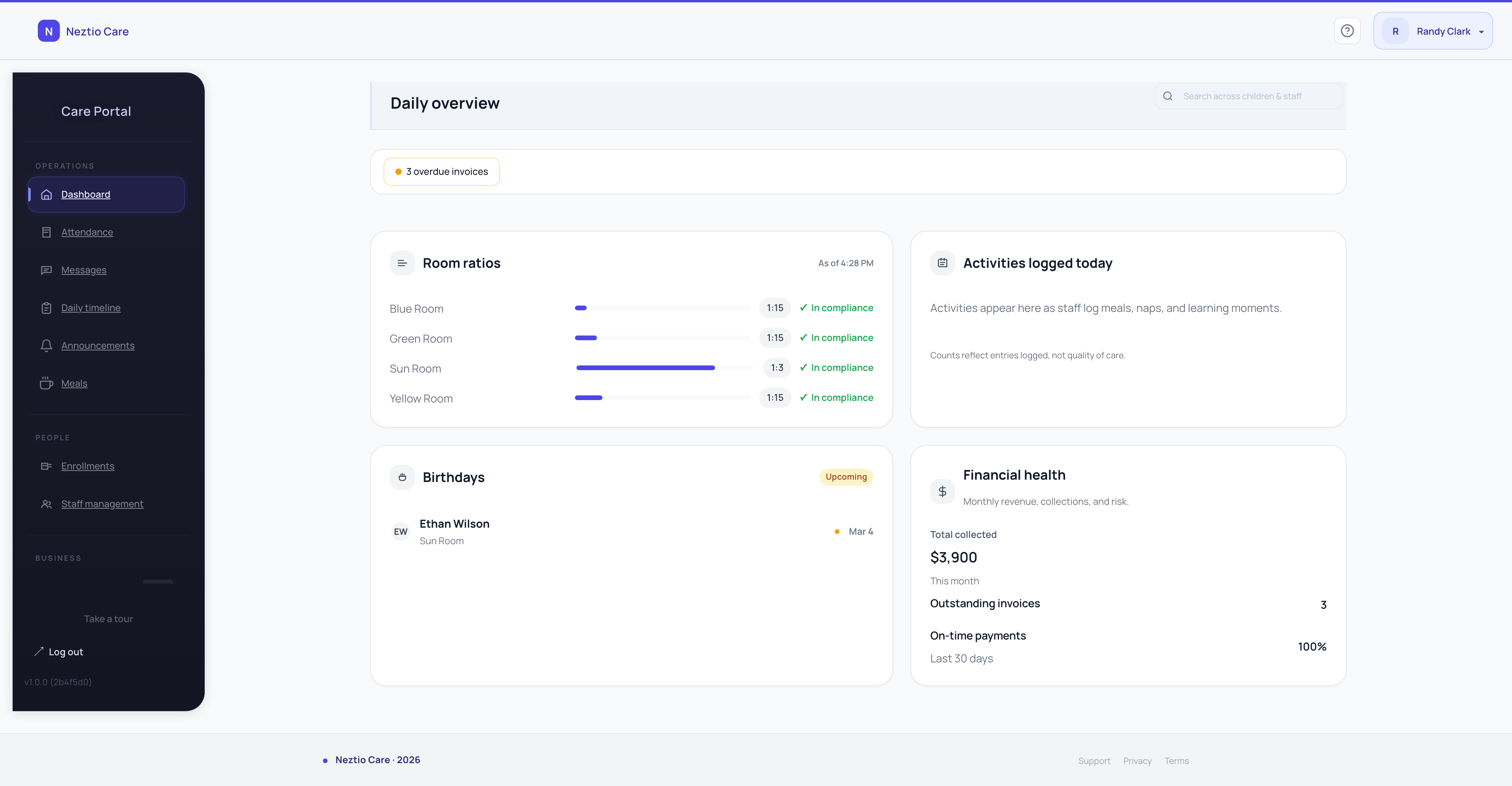
These ratios are from the Tennessee DHS licensing rules. Always verify current ratios with DHS, as they may be updated. For help planning your classroom staffing, try our ratio calculator.
Staff qualification and training requirements
Tennessee has specific requirements for directors and caregivers working in licensed childcare facilities.
Director qualifications: Directors of licensed child care centers must have a high school diploma (or DHS-recognized equivalent), a Tennessee Early Childhood Training Alliance (TECTA) certificate for completing 30 clock hours of orientation training (or the equivalent as recognized by DHS), and at least 4 years of experience working with children.
Caregiver minimum age: All caregivers in a licensed child care agency must be at least 18 years of age.
Orientation training: All new employees must complete orientation and child abuse prevention training before working directly with children. Primary caregivers must also complete a DHS-sponsored child care orientation class within three months of employment.
CPR and First Aid: All staff on duty must obtain first aid training and CPR certification (applicable to the ages of children present) within 90 days of employment. Training must be from a DHS-recognized provider.
Annual training hours (directors): Directors of single-site child care centers must complete a minimum of 24 clock hours of in-service training each year (assistant directors must complete at least 18 hours). Training must cover topics relevant to child development, health and safety, and program administration.
Annual training hours (caregivers): Caregivers are required to complete a minimum of 12 clock hours of in-service training each year. Training must cover topics specified by DHS, including child development, guidance and discipline, and health and safety.
Character and fitness: All staff must have knowledge of child behavior and development, and must be physically, mentally, and emotionally suited to care for children.
Background check requirements
Tennessee requires comprehensive background checks for anyone who will have access to children in a licensed childcare operation.
Who must be checked: All directors, caregivers, substitutes, volunteers with access to children, and any person regularly present at the facility during operating hours. For home-based operations, all household members must be checked.
TBI and FBI fingerprint checks: Individuals must supply their fingerprints and submit to both Tennessee Bureau of Investigation (TBI) and Federal Bureau of Investigation (FBI) criminal record checks prior to employment.
Registry checks: The background screening includes the sex offender registry and the Tennessee child abuse and neglect registry.
Renewal requirement: Background checks must be renewed at least every five (5) years for all staff.
Transferability: A background check may be transferred if the employee was fingerprinted within the last five years and has worked for a Tennessee licensed child care agency without a break in employment of more than 180 days.
Facility and space requirements
Your physical space must meet Tennessee DHS licensing standards before a license can be issued. Key requirements include:
Indoor space: A minimum of 30 square feet of usable indoor play space per child in each classroom. Nap rooms must also contain at least 30 square feet of floor space per child. This measurement excludes kitchens, bathrooms, hallways, staff-only areas, and storage.
Outdoor space: A minimum of 50 square feet of usable outdoor play space per child using the area at any one time. Outdoor areas must be fenced, free of hazards, and equipped with age-appropriate play equipment.
Age-appropriate equipment: All furniture, cribs, and play equipment must be safe, in good repair, and appropriate for the ages of children enrolled. Cribs must meet current CPSC standards.
Fire safety: Working smoke detectors and fire extinguishers must be installed and maintained. Regular fire drills are required and must be documented. Your facility must meet local fire codes and have a posted evacuation plan.
Liability insurance: All licensed child care agencies in Tennessee must maintain liability and medical payment insurance coverage as specified in the licensing rules.
Health and sanitation: Your facility must pass a health and safety inspection covering sanitation, food preparation areas, diaper changing stations, handwashing facilities, and general cleanliness.
Health and safety requirements
Tennessee licensing rules include detailed health and safety requirements that licensed operations must follow every day.
Immunization records: Up-to-date immunization records are required for all enrolled children. Records must be on file and available for inspection at all times.
Medication administration: Medications may only be administered with written parent authorization. All medication administration must be documented, including the medication name, dosage, time, and the staff member who administered it.
Safe sleep practices: For infants, Tennessee requires adherence to safe sleep guidelines. Infants must be placed on their backs to sleep in approved cribs, with no soft bedding, pillows, bumper pads, or toys in the crib.
Handwashing: Proper handwashing procedures must be followed by both staff and children, including before and after meals, after diaper changes, after using the restroom, and after outdoor play.
Drug testing policy: Tennessee requires licensed child care agencies to maintain a drug testing policy for staff as part of their licensing compliance.
Emergency procedures: Written emergency procedures must be posted and practiced regularly. Staff must know what to do in the event of a fire, severe weather, medical emergency, or other crisis.
Tennessee Report Card and Star-Quality program
Tennessee operates a two-tier quality system for licensed childcare agencies: the mandatory Report Card and Rated License System, and the voluntary Star-Quality Child Care Program.
Report Card and Rated License (mandatory)
Every licensed child care provider must receive an annual evaluation as part of its licensing process. The evaluation scores two main components: Health and Safety, and Teacher-Child Interactions. Child care centers are evaluated on 8 areas, while family and group homes are evaluated on 6 areas. After the evaluation, providers receive a Report Card with their rating, which must be posted alongside their license where parents can easily see it.
Star-Quality Child Care Program (voluntary)
The Star-Quality program is Tennessee's Quality Rating and Improvement System (QRIS). It recognizes child care agencies that meet standards above the minimum licensing requirements. Agencies can earn one, two, or three stars, with each star level representing increasingly higher quality standards.
How it works: The QRIS evaluates two areas of quality on a quarterly basis over four visits. Each visit is scored out of 100 points, and the four scores are averaged to determine the agency's overall quality rating.
Eligibility: To participate, a child care agency must have received at least a score of 1 in Program Assessment and an overall rating of at least 1 on their Report Card.
Financial benefit: Earning stars raises the reimbursement rate for children served through the TDHS Child Care Certificate program. Even one star raises the reimbursement rate to 5% above the base rate, with higher stars providing greater increases.
Support available: TDHS offers technical assistance and training to help agencies that want to improve their quality and earn more stars.
Record-keeping requirements
Tennessee licensing requires childcare operations to maintain detailed records that are available for review during evaluations and inspections.
Attendance records: Daily sign-in and sign-out records for every child, with the time recorded for each entry. These records must be retained for the period specified by DHS.
Child enrollment records: Complete enrollment information for each child, including emergency contacts, authorized pickup persons, medical information, allergies, and immunization records.
Staff records: Personnel files for every employee, including background check results, training documentation, certifications, and employment history.
Incident reports: Written documentation of any injuries, accidents, or unusual incidents that occur at the facility, including details of what happened and what actions were taken.
Fire drill logs: Documentation of every fire drill conducted, including the date, time, number of children and staff present, and evacuation time.
Medication administration logs: Records of all medications administered to children, including parent authorization forms.
Tip: Childcare management software like Neztio can help you maintain digital records for attendance, staff documentation, billing, and parent communication, making it much easier to stay organized and evaluation-ready at all times.
Resources
Here are key resources for Tennessee childcare providers:
Tennessee DHS Child Care Services: The official state agency website for childcare licensing, including licensing rules, application information, and provider resources at tn.gov/humanservices.
Star-Quality Child Care Program: Tennessee's voluntary QRIS program that recognizes providers who exceed minimum licensing standards. Earning stars can increase your subsidy reimbursement rates.
Tennessee Early Childhood Training Alliance (TECTA): Provides orientation training, professional development, and certification for childcare professionals across Tennessee.
Tennessee Child Care Resource and Referral Network (TNCCRR): Offers quality improvement resources, training, and technical assistance to childcare providers throughout the state.
KidCentralTN: A state-supported resource for families and providers with information about child care star ratings, provider search, and support services.
Stay compliant with the right tools
Meeting Tennessee licensing requirements is just the beginning. Staying in compliance day after day requires organized records, consistent documentation, and clear communication with families and staff. The best way to prepare for your annual evaluation, or an unannounced visit, is to operate every day as if one could happen.
See how Neztio helps Tennessee childcare centers manage attendance, billing, staff management, and parent communication so you are always evaluation-ready.
Related
Childcare Licensing Checklist: What Every New Center Needs
Related
Starting a Daycare: A Step-by-Step Guide
Glossary terms in this article
Licensing
State-issued permission to operate a childcare facility, requiring compliance with health, safety, and staffing standards.
Staff-to-Child Ratio
The required number of qualified staff per group of children, set by state licensing regulations based on age.
Background Check
Criminal history and registry screenings required for all childcare workers under the CCDBG Act of 2014.
Group Size
The maximum number of children allowed in a single classroom or care group, determined by state licensing rules.
Accreditation
Voluntary quality certification from organizations like NAEYC or NAC that recognizes programs exceeding minimum licensing standards.