Washington State Childcare Licensing Requirements: A Complete Guide
Washington state has a well-structured childcare licensing system governed by detailed administrative codes. Whether you are opening a new center, launching a family home program, or expanding an existing operation, this guide covers what you need to know about getting and maintaining a Washington childcare license.
Note: Licensing requirements change frequently. This guide reflects regulations as of early 2026. Always verify current requirements directly with your state licensing agency before making compliance decisions.
Overview: who regulates childcare in Washington?
In Washington, childcare licensing is administered by the Department of Children, Youth, and Families (DCYF). DCYF oversees all licensed early learning programs in the state, setting standards through the Washington Administrative Code (WAC), specifically Chapter 110-300, known as the Foundational Quality Standards for Early Learning Programs.
Washington requires licensing for childcare operations based on the type and size of the program. The main license types include:
Child Care Center: A facility that is not the provider's home and cares for children in a group setting. Centers must meet the full requirements of WAC 110-300 including staffing, space, and program standards.
Family Home Child Care: A home-based program where care is provided in the licensee's own residence. Family home providers can care for up to 12 children depending on age composition and staffing. These programs must also meet WAC 110-300 standards adapted for home settings.
School-Age Program: A program specifically serving children enrolled in kindergarten or above, governed by WAC 110-301 with its own set of ratio and operational requirements.
Important
Washington does not charge fees to obtain a childcare license. DCYF provides free pre-licensing orientation and support to help prospective providers through the process.
How to apply for a Washington childcare license
DCYF has a structured licensing process that begins with orientation and ends with an on-site inspection. Plan for the process to take several weeks to several months. DCYF's Pre-Licensing Support team offers personalized guidance through group sessions and one-on-one meetings to help you through each step.
- 1
Complete the online orientation
DCYF requires all prospective providers to complete an online orientation program before applying. The orientation is available for both family home and childcare center applicants. It covers licensing standards, provider responsibilities, and what to expect during the process. Orientations are available in English, Spanish, and Somali. Upon completion, you receive an orientation certificate that you must email to DCYF to access the provider portal.
- 2
Submit your application through the DCYF provider portal
After completing the orientation, you can access the online application through the DCYF provider portal. You will provide information about your facility, program plan, and staffing. DCYF will process your application within three months of submission.
- 3
Register in MERIT and complete background checks
All staff, household members (for home-based care), and regular volunteers must register in the Managed Education and Registry Information Tool (MERIT) and complete portable background checks, including fingerprinting through IdentoGO. Background checks must be completed before working with children.
- 4
Complete preservice training requirements
Staff must complete federally required health and safety trainings within 90 days of hire or before caring for children unsupervised. Preservice topics include safe sleep practices, medication administration, emergency preparedness, and child abuse prevention, among others as specified in WAC 110-300-0105.
- 5
Pass the initial on-site inspection
A DCYF licensing representative will conduct an on-site inspection to verify your facility meets all standards for space, safety, equipment, and documentation. Any deficiencies must be corrected before your license is issued.
- 6
Receive your license
Once all requirements are met and your inspection is passed, DCYF issues your childcare license. The license must be posted in a location visible to families at your facility.
Washington staff-to-child ratio requirements
Washington sets specific staff-to-child ratios and maximum group sizes for child care centers under WAC 110-300-0356. These ratios must be maintained at all times during operating hours, including during off-site activities and transportation. Washington offers some flexibility by providing two ratio options for infant and toddler age groups.
| Age Group | Ratio | Max Group Size |
|---|---|---|
| Infants (birth - 11 months) | 1:4 | 8 |
| Infants (birth - 11 months, alt.) | 1:3 | 9 |
| Toddlers (12 - 29 months) | 1:7 | 14 |
| Toddlers (12 - 29 months, alt.) | 1:5 | 15 |
| Preschool (30 months - 6 years) | 1:10 | 20 |
| School-age (5+ years) | 1:15 | 30 |
A child with special needs who requires individualized supervision does not count toward the staff-to-child ratio. Centers may combine children of different age groups for up to two hours at the start or end of the day, provided they maintain the ratio and group size designated for the youngest child in the mixed group.
These ratios are from WAC 110-300-0356. Verify current ratios with DCYF, as they may be updated periodically. For help planning your classroom staffing, try our ratio calculator.
Staff qualification and training requirements
Washington has specific qualification requirements for directors, lead teachers, assistants, and aides under WAC 110-300. All staff must register in the MERIT system and maintain their professional development records there.
Director qualifications: Center directors must have an ECE state certificate or equivalent within five years of hire, at least two years of experience as a teacher of children in any age group, and at least six months of administration or management experience (or a DCYF-approved plan). Directors must be on site at least 50% of operating hours, up to 40 hours per week.
Preservice training: All staff must complete federally required health and safety trainings within 90 days of hire or before caring for children unsupervised. Topics include safe sleep, preventing and controlling infectious diseases, medication administration, emergency preparedness, recognizing and reporting child abuse and neglect, and other areas specified in WAC 110-300-0105.
Annual in-service training: Every early learning provider who has worked at least 12 consecutive months must complete 10 hours of in-service training per calendar year (January through December). Up to five hours may be carried over from one year to the next. Aides working 19 or fewer hours per month are exempt from in-service requirements but must complete preservice training.
CPR and First Aid: At least one caregiver with current pediatric CPR and First Aid certification must be present at all times when children are in care.
TB testing: All staff, household members (for home-based care), and regular volunteers must pass a tuberculosis (TB) test as part of their initial qualification requirements.
Experience-based competency alternative: As of recent legislative changes, licensed providers have until at least August 1, 2028 to demonstrate experience-based competency as an alternative to an early childhood education certificate for meeting licensing rules.
Facility requirements
Your physical space must meet WAC 110-300 standards before a license can be issued. Key requirements include:
Indoor space: A minimum of 35 square feet of usable indoor space per child in attendance. Floor space under tables, desks, chairs, and equipment used for children's activities is included in the calculation. Office or kitchen space inaccessible to children is excluded. Napping areas count as program space if mats and cots are removed when not in use.
Additional infant/toddler space: Centers must provide an additional 15 square feet for each infant or toddler using a crib or playpen, if the crib or playpen is located in the sleeping or play area.
Outdoor space: A minimum of 75 square feet of licensed usable outdoor play space per child accessing the area at any given time. Outdoor areas must be fenced or enclosed with a barrier that prevents children from exiting and discourages climbing. Shaded areas must be provided by trees, buildings, or shade structures.
Alternate outdoor plans: If your program does not have enough outdoor space for all enrolled children at once, you may develop an alternate plan (such as rotating groups) subject to DCYF approval. Off-site play areas may also be used with department approval.
Fire safety: Working smoke detectors and fire extinguishers must be installed and maintained. Fire drills must be conducted and documented regularly. Your facility must have a posted evacuation plan.
Health and safety inspection: Your facility must pass a health and safety inspection covering sanitation, food preparation areas, diaper changing stations, handwashing facilities, and general cleanliness.
Background check requirements
Washington uses a centralized background check system managed through DCYF. All background checks are submitted through the MERIT system and are portable, meaning they follow the individual across employers within the state.
Who must be checked: All staff, household members age 16 and older (for home-based care), and regular volunteers must complete a portable background check. Every individual must register in the MERIT system and receive a STARS ID.
Fingerprint-based checks: All applicants age 16 and older must complete fingerprinting through IdentoGO by IDEMIA, DCYF's contracted fingerprint vendor. Fingerprints are required under the federal Child Care and Development Block Grant (CCDBG) Act before an individual can begin working in an early learning program.
Renewal: Background checks are valid for five years. Fingerprints must be reprinted no less than every five years as required by the CCDBG Act.
Address history: Applicants must provide addresses where they have lived for the last five consecutive years as part of the background check application.
Timing: Background checks must be completed before a person has unsupervised access to children in care. There is no grace period for this requirement.
Health and safety requirements
WAC 110-300 includes detailed health and safety requirements that licensed operations must follow at all times.
Immunization records: Up-to-date immunization records are required for all enrolled children. Records must be on file and available for inspection at all times.
Medication administration: Medications may only be administered with written parent authorization. All medication administration must be documented, including the medication name, dosage, time given, and the staff member who administered it.
Illness exclusion: Programs must have a written illness exclusion policy and procedures for notifying parents when their child becomes ill during the day.
Handwashing: Proper handwashing procedures must be followed by both staff and children, including before and after meals, after diaper changes, after using the restroom, and after outdoor play.
Safe sleep practices: For infants, Washington requires adherence to safe sleep guidelines. Infants must be placed on their backs to sleep in approved cribs, with no soft bedding, pillows, bumper pads, or toys in the crib.
Emergency procedures: Written emergency procedures must be posted and practiced regularly. Staff must know what to do in the event of a fire, earthquake, severe weather, medical emergency, or other crisis.
Record-keeping requirements
Washington licensing requires childcare programs to maintain detailed records that are available for review during inspections. Keeping these records organized and current is essential for staying in compliance.
Attendance records: Daily sign-in and sign-out records for every child, with the time recorded for each entry. These records must be retained as required by DCYF.
Child enrollment records: Complete enrollment information for each child, including emergency contacts, authorized pickup persons, medical information, allergies, and immunization records.
Staff records and MERIT profiles: Personnel files for every employee, including background check results, training documentation, certifications, and MERIT registration. Professional development progress must be documented annually.
Incident reports: Written documentation of any injuries, accidents, or unusual incidents, including details of what happened and what actions were taken.
Fire drill and emergency drill logs: Documentation of every drill conducted, including the date, time, number of children and staff present, and evacuation time.
Medication administration logs: Records of all medications administered to children, including parent authorization forms.
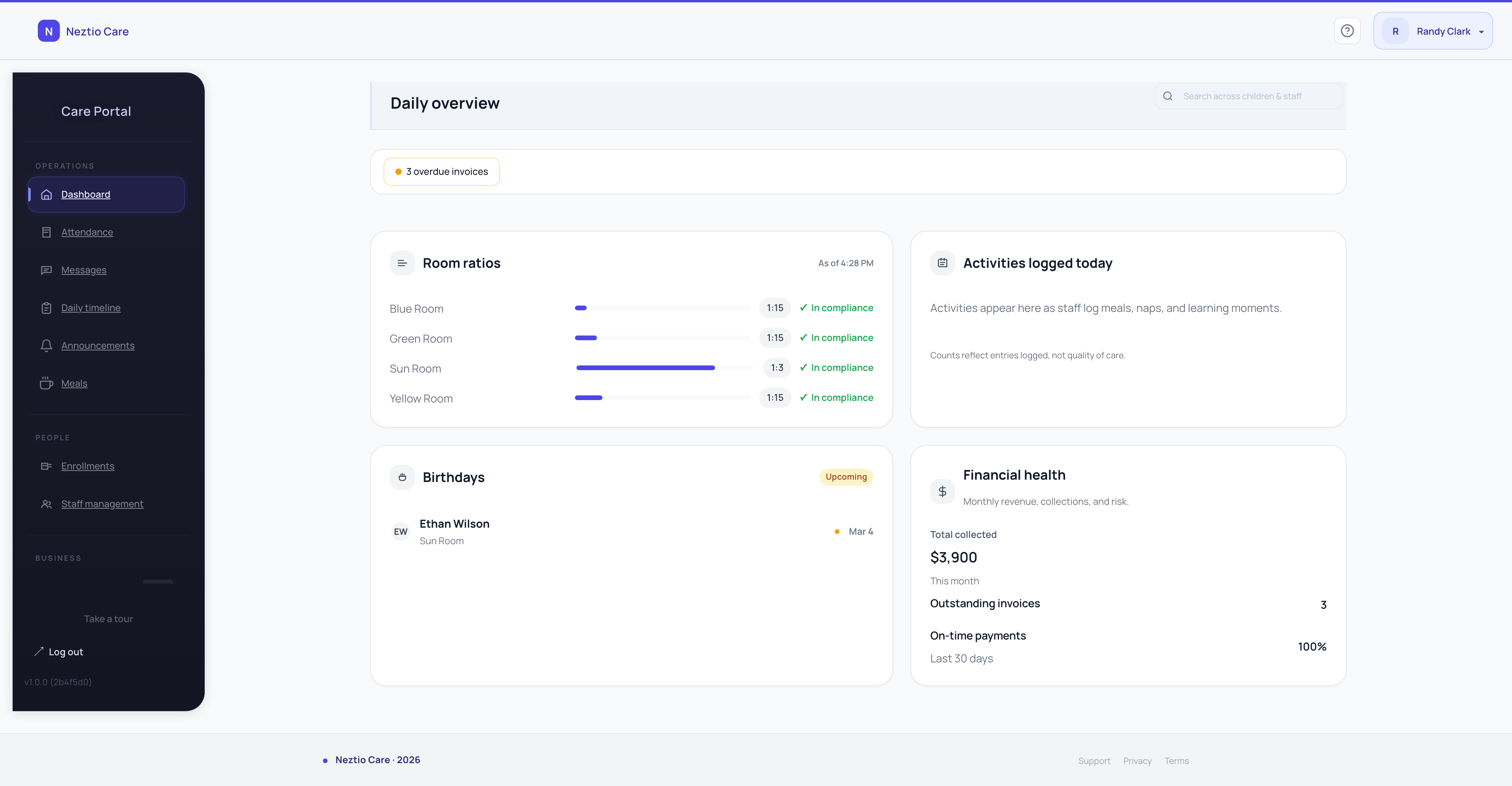
Tip: Childcare management software like Neztio can help you maintain digital records for attendance, enrollment, staff documentation, daily reports, and billing, making it much easier to stay organized and inspection-ready at all times.
Inspections and compliance
Once licensed, your program will be subject to ongoing monitoring by DCYF.
Unannounced inspections: DCYF conducts unannounced inspections of licensed childcare programs during normal operating hours. Inspections can cover any aspect of your operation, from ratios and safety to record-keeping and program quality.
Corrective action: If deficiencies are found, you will be given a specified timeframe to correct them. The timeframe depends on the severity of the issue.
Adverse actions: Repeated or serious violations can result in adverse actions, including probation, license suspension, license revocation, or fines. The most serious violations, those posing an immediate threat to children, can result in emergency suspension.
Public records: Licensing and inspection information for childcare programs is available to the public through DCYF, allowing families to review a program's compliance history.
Early Achievers: Washington's quality rating system
Early Achievers is Washington's Quality Rating and Improvement System (QRIS). It is a voluntary program that helps early learning programs improve quality and provides families with information about program quality through a rating system.
Rating levels: Early Achievers uses a quality rating scale from Level 1 to Level 5. Subsidy providers are considered "At Quality" at Level 3 or higher. ECEAP providers must reach Level 4 or higher.
Subsidy requirement: The Washington State Legislature requires childcare providers who serve non-school-age children and receive state subsidies to participate in Early Achievers.
Support and resources: Early Achievers offers training, coaching, mental health support, and financial assistance to help providers improve their quality ratings. Participants include licensed family child care homes, licensed child care centers, Head Start, ECEAP, and certified tribal or military facilities.
Benefits: Achieving higher quality ratings through Early Achievers can increase your subsidy reimbursement rates and demonstrate to families that your program exceeds minimum licensing standards.
Resources
Here are key resources for Washington childcare providers:
DCYF Early Learning: The official DCYF website for childcare licensing, including licensing applications, forms, and FAQs about WAC 110-300 requirements.
MERIT system: Washington's Managed Education and Registry Information Tool for background checks, training records, and professional development tracking for all early learning staff.
Early Achievers: Washington's QRIS program offering quality ratings, coaching, training, and financial support for participating early learning programs.
Child Care Aware of Washington: A statewide resource and referral network that provides training, technical assistance, and support to childcare providers across the state.
Stay compliant with the right tools
Meeting Washington licensing requirements is just the beginning. Staying in compliance day after day requires organized records, consistent documentation, and clear communication with families and staff. The best way to prepare for an unannounced DCYF inspection is to operate every day as if one could happen.
See how Neztio helps Washington childcare centers manage attendance tracking, billing, staff management, and parent communication so you are always inspection-ready.
Related
Childcare Licensing Checklist: What Every New Center Needs
Related
Starting a Daycare: A Step-by-Step Guide
Glossary terms in this article
Licensing
State-issued permission to operate a childcare facility, requiring compliance with health, safety, and staffing standards.
Staff-to-Child Ratio
The required number of qualified staff per group of children, set by state licensing regulations based on age.
Background Check
Criminal history and registry screenings required for all childcare workers under the CCDBG Act of 2014.
Group Size
The maximum number of children allowed in a single classroom or care group, determined by state licensing rules.
Accreditation
Voluntary quality certification from organizations like NAEYC or NAC that recognizes programs exceeding minimum licensing standards.