Staff-to-Child Ratios: What Every Childcare Director Needs to Know
Ratio compliance is the most important safety requirement in childcare. It is also one of the hardest to maintain throughout a full day. This guide covers how ratios work, where centers get into trouble, and how real-time tracking eliminates the guesswork.
1. What are staff-to-child ratios?
Staff-to-child ratios define the maximum number of children one caregiver can supervise. Every state sets its own requirements, and they vary by age group. Younger children require more adults per child because they need more hands-on care.
| Age Group | Typical Ratio | What This Means |
|---|---|---|
| Infants (0-12 months) | 1:3 to 1:4 | One adult for every 3-4 infants |
| Toddlers (12-24 months) | 1:4 to 1:6 | One adult for every 4-6 toddlers |
| Two-year-olds | 1:6 to 1:8 | One adult for every 6-8 two-year-olds |
| Preschool (3-5 years) | 1:8 to 1:12 | One adult for every 8-12 preschoolers |
| School-age (5+ years) | 1:12 to 1:15 | One adult for every 12-15 school-age children |
Important
These are typical ranges. Your state's specific requirements may differ. Always check your state's licensing regulations for exact ratios. Some states also set maximum group sizes in addition to ratios.
Use our ratio calculator to quickly determine how many staff you need for your enrollment, or browse our state licensing guides for the exact ratio requirements in your state.
2. When ratio violations actually happen
Most ratio violations are not malicious. They happen during the normal chaos of a busy childcare day. Understanding the common scenarios helps you prevent them.
Staff breaks and lunch
When a teacher leaves the room for a break, the ratio changes. If no one covers the room, you are out of compliance for the duration of that break. This is the single most common source of violations.
Early arrivals and late pickups
Your morning and afternoon staffing may be lighter than midday. When children arrive earlier than expected or parents pick up late, the reduced staff count creates ratio pressure.
Room transitions
Moving children between classrooms for activities, outdoor play, or nap time creates temporary ratio imbalances. Six children move to the gym, but only one teacher goes with them.
Staff absences
When a teacher calls in sick and no substitute is available, the remaining staff must cover. This frequently pushes classrooms over their ratio limits.
Mixed-age groups
When children of different ages share a room (common at opening and closing time), the stricter ratio applies. Three infants and eight preschoolers in the same room means you need infant ratios for the whole group.
3. The consequences of non-compliance
Ratio violations are taken seriously by licensing agencies. Consequences escalate with severity and frequency:
Written citation on your licensing record (visible to parents in many states)
Mandatory corrective action plan with follow-up inspection
Fines ranging from $50 to $500 per violation per day
Probationary status that limits your ability to enroll new children
In severe or repeated cases, suspension or revocation of your license
Beyond regulatory consequences, ratio violations are a safety issue. The ratios exist because research shows that children receive inadequate supervision beyond certain thresholds. A licensing citation is a signal that children may not have been safe.
4. Why manual tracking fails
Most centers track ratios informally: the director walks through classrooms, counts heads, and makes mental adjustments. This approach has fundamental problems.
You can only be in one room at a time. While you are counting heads in the toddler room, a child arrives in the infant room.
Counts are only accurate at the moment you take them. Five minutes later, a parent picked up and a teacher went on break.
You have no record of historical compliance. When a licensing inspector asks about last Tuesday at 2 PM, you are guessing.
Staff breaks, transitions, and schedule changes are not reflected in any central view.
The core problem
Manual ratio tracking gives you a snapshot. Compliance requires continuous monitoring. You need a system that knows the current state of every room at all times.
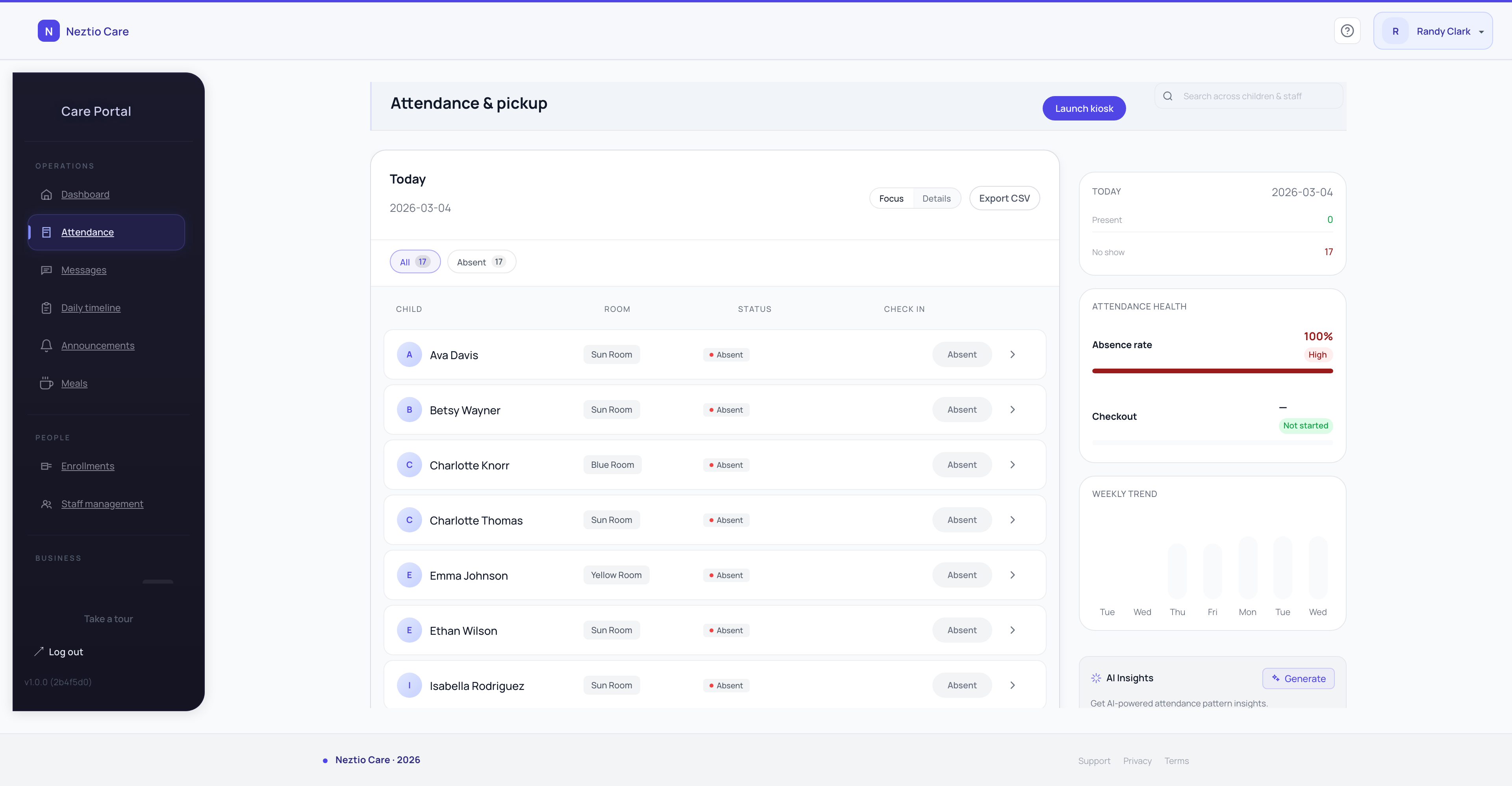
Digital attendance tracking eliminates many of these manual errors by automatically updating headcounts as children check in and out throughout the day. Learn more in our glossary entry on staff-to-child ratios.
5. How real-time ratio monitoring works
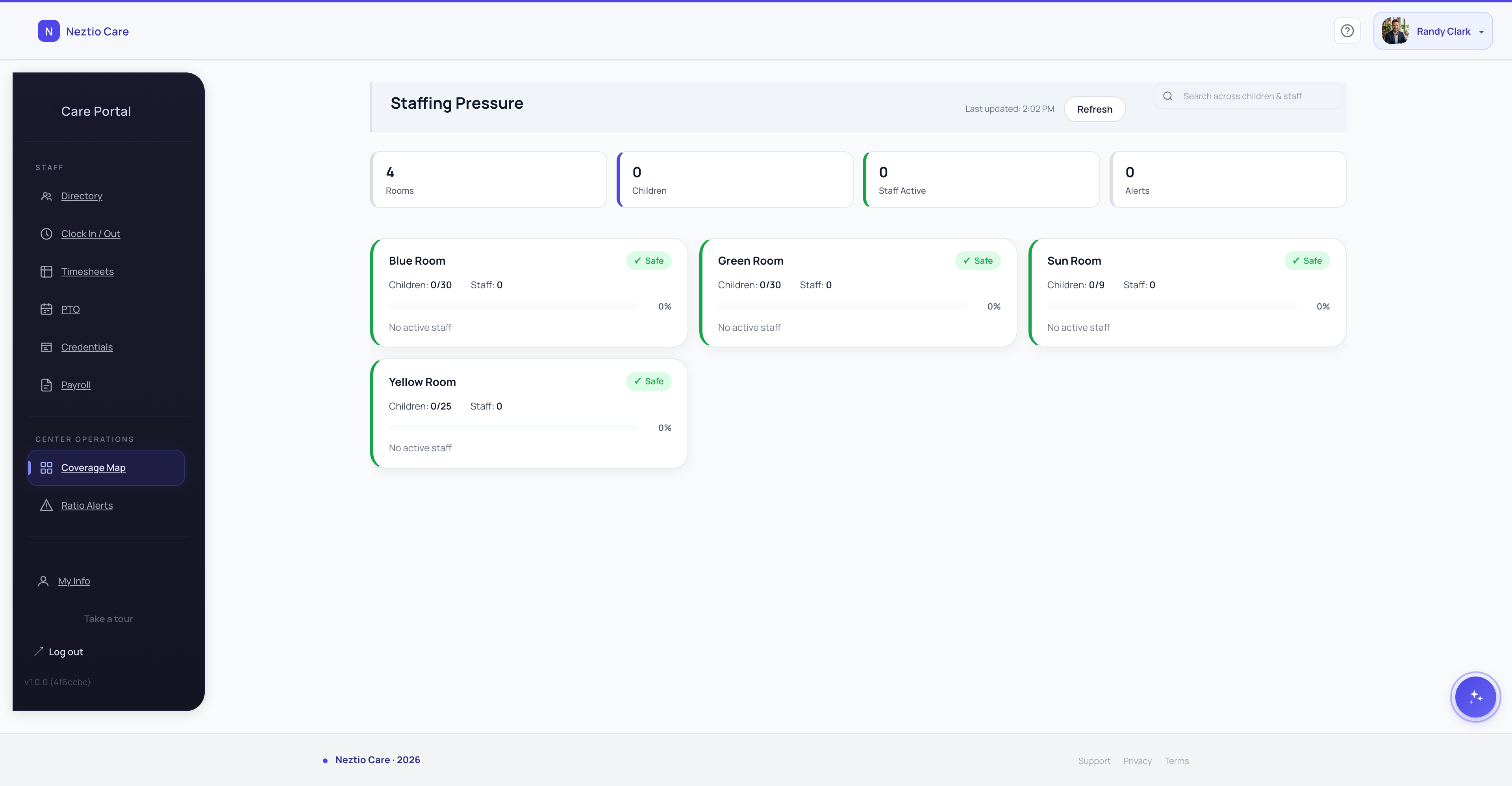
When attendance and staff assignments are tracked digitally, ratio calculations happen automatically. The system always knows how many children are in each room and how many staff are assigned.
Live dashboard
See every classroom, the number of children present, staff assigned, and the current ratio on one screen. Green means compliant. Yellow means approaching the limit. Red means action needed.
Automatic updates
When a child checks in, the count updates instantly. When a teacher logs a break, the staff count adjusts. No manual recounting needed.
Proactive alerts
The system can notify you when a room is one child away from its ratio limit, giving you time to reassign staff before a violation occurs.
Historical records
Every ratio calculation is logged with a timestamp. When a licensing inspector asks about compliance on a specific date, you pull up the data in seconds.
Break coverage planning
Before approving a staff break, check the dashboard to ensure the room will remain compliant. No more guessing.
6. Practical strategies for staying compliant
Technology helps, but good operational practices are just as important. These strategies work regardless of what software you use:
- 1
Staff at least one person above minimum ratio
If your infant room allows 1:4 and you have 8 infants, schedule 3 teachers, not 2. The third person covers breaks, handles emergencies, and prevents ratio violations during transitions.
- 2
Stagger staff breaks
Never have two teachers from the same room on break simultaneously. Create a break schedule that ensures coverage at all times.
- 3
Plan transitions carefully
Before moving a group of children to another area, verify that both the origin and destination rooms will remain in ratio. A 30-second check prevents a violation.
- 4
Cross-train staff across age groups
When a teacher calls in sick, you need someone who can step into that room immediately. Staff who are comfortable in multiple age groups give you flexibility.
- 5
Communicate with parents about pickup times
Late pickups are a predictable ratio risk. Set clear expectations and enforce your late pickup policy consistently.
7. What to look for in ratio tracking software
Not every childcare platform includes meaningful ratio tracking. Some show attendance counts but leave the ratio math to you. Others calculate ratios but only update when you manually refresh. Here is what to look for:
Real-time updates - ratios should recalculate within seconds of a check-in, check-out, or staff change
All-classrooms view - you need to see every room on one screen, not click into each room individually
Configurable ratio limits - the system should let you set your state's specific requirements per age group
Audit trail - historical ratio data should be accessible for licensing inspections
Avoid - systems that only show attendance without calculating ratios, or that require manual room assignments to get accurate counts
The bottom line
Staff-to-child ratios are not just a regulatory checkbox. They are the foundation of child safety in your center. Manual tracking - walking room to room, counting heads, hoping nothing changed while your back was turned - is not a reliable compliance strategy.
Neztio calculates ratios in real time across every classroom, using live attendance data and staff assignments. Start a free 30-day trial and see your ratios on a live dashboard from day one.
Glossary terms in this article
Staff-to-Child Ratio
The number of caregivers required per group of children, set by state licensing regulations based on age.
Group Size
The maximum number of children allowed in a single classroom or care group, regulated by state licensing.
Licensing
State-issued permission to operate a childcare facility, requiring compliance with health, safety, and staffing standards.
QRIS
Quality Rating and Improvement System, a state framework that assesses and communicates the quality of childcare programs.